
Testimony by Joshua Drumming, Staff Attorney
April 30, 2026
The Washington Legal Clinic for the Homeless envisions a District of Columbia where housing is a human right, racial justice is a reality, and all people have true and meaningful access to the resources needed to thrive.
Recently, making ends meet has become more difficult for low-income D.C. residents. Housing has become more expensive, cost of living continues to increase, and the social safety net is steadily unravelling. While the precariousness of the situation is known, the mayor’s proposed budget fails to reflect the need. Low-income and primarily Black residents are the most impacted by critical program and funding cuts in D.C.’s FY27 local budget. D.C. Council needs to invest in permanent housing resources, legislate so that DHS improves its provision of services, expand access to rental assistance, suspend all full encampment evictions, and improve the shelter system.
- End Homelessness: Housing Vouchers
One of the most effective ways to end D.C.’s homelessness and affordability crisis is to use and appropriately fund all of the different types of vouchers available. Homelessness has risen 4.4% since 2025. However, Mayor Bowser’s proposed budget includes zero new vouchers to end homelessness in FY27. Residents need access to a variety of voucher types to meet their housing needs. PSH vouchers are appropriate for some, but LRSP vouchers are also necessary, less costly, and more accessible to a larger number of D.C. residents in need of stable housing.
This will inevitably lead to increased homelessness. D.C. has an unemployment rate 155% of the national average (6.7% versus 4.3%), an Emergency Rental Assistance Program with a higher-barrier eligibility threshold and only $7 Million FY27 budget, a Rapid Re-Housing program that has been largely dismantled and with paused entries, voucher programs with paused matching despite D.C. Council allocating those funds last budget season, and zero new vouchers for individuals or families. Circumstances are dire for those who rely on D.C.’s human services sector.
D.C. Council must adequately fund vouchers for individuals and families. This is necessary to protect encampment residents from future targeting and prevent prolonged homelessness amongst families in shelter and temporary housing programs. D.C. Council must also ensure that DHS and DCHA have the requisite staffing and coordination for participants to be quickly identified and approved for permanent housing resources and to swiftly lease up. Agency bureaucracy prolongs homelessness.
We, along with our coalition partners, request the FY27 budget meet the full housing needs of D.C. residents by funding enough vouchers to permanently house approximately 6,000 households. Specifically, we are asking for the following:
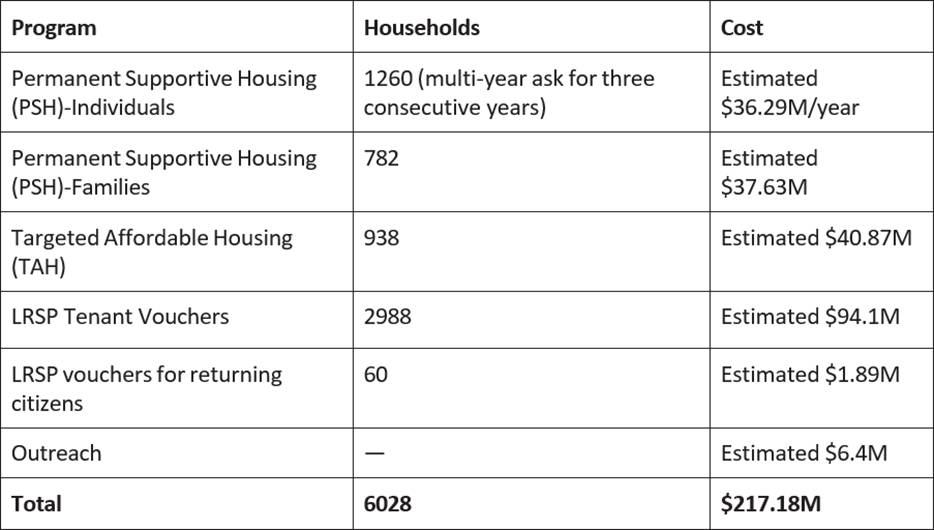
Once vouchers are funded, this committee and D.C. Council at large must ensure that DHS is appropriately budgeting in order to properly administer funds allocated by D.C. Council. After being appropriated, DHS funds are often reprogrammed and shifted away from the programs and services that D.C. Council intended. Many of these changes are masked by opaque agency budgets and inaccurate accountings of programmatic costs.
D.C. Council must increase oversight of DHS and DCHA to promote more efficient voucher administration, utilization, and staffing, and to reduce bureaucracy that prolongs homelessness due to delays in distributing and utilizing vouchers. D.C. Council must also increase funding for all permanent voucher programs and increase investment in homelessness outreach services.
II. Prevent Housing Instability and Repeated Homelessness for Residents with Extremely Low Incomes
Rapid Re-Housing (RRH) was created to aid low-income D.C. residents, placing them on a path to financial fortitude by subsidizing the majority of their monthly rent. Unfortunately, the program has never achieved its stated ends. Its “one-size-fits-all” model cycles the lowest-income residents in and out of homelessness, sometimes saddling them with evictions and experiencing more financial harm than before entering the program. DHS has generally focused its resources on shallow subsidies, such as DC Flex, that, even when funded, are incapable of establishing enduring housing stability for the extremely low-income residents that make up the overwhelming majority of those who need housing assistance. However, in the proposed FY27 budget, Mayor Bowser even abandoned those meager shallow subsidies.
The decision not to fund permanent housing vouchers or shallow subsidies reflects a troubling policy seemingly indicating that D.C. residents who cannot afford to live in D.C. without government assistance/support should not be in D.C. Unfortunately, this stance is further supported when DHS utilizes its programs and funding to pay D.C. residents to leave D.C.
D.C. must meaningfully consider the housing needs of residents that cannot afford D.C. rents and make substantial investments in housing and supplemental resources that keep people permanently housed. We urge D.C. Council to require accurate and transparent program data and costs from DHS in all of its time-limited and shallow housing subsidy programs, including data on the long-term housing stability of participants after the assistance has ended, evaluate current DHS program outcomes and barriers to more appropriately invest in permanent housing stability, and fund permanent housing subsidies.
III. Expand Access to Emergency Rental Assistance
The Emergency Rental Assistance Program (ERAP) allows D.C. residents to avoid eviction and stay in their homes when they face emergencies that hamper their ability to afford rent. This budget year marks the second year ERAP has been cut, having lost nearly forty-five (45%) percent of its funding since Fiscal Year 2025. Due to last year’s legislative alterations that drastically restrict eligibility, ERAP is now inaccessible to many D.C. residents that need it. These were not data-driven changes. Changes were largely based upon unsubstantiated allegations of fraud, racist tropes, and classist myths about low-income, Black people. D.C. Council should amend the program yet again to expand access and prioritize tenant interests.
We ask that D.C. Council revise and pass updated ERAP legislation that reverses the harm of the current legislation, expands access, and requires landlord accountability and cooperation with the ERAP application process. Further, we ask that the ERAP application process be improved to ensure it is fully accessible, low-barrier, and legally compliant. Lastly, we ask that Council increase its oversight of DHS to require consistency in ERAP administration and distribution and regular agency reporting, including timelines, staffing, delays of administering organizations, and demographics of approved residents, ensuring residents can access sufficient funds to prevent massive displacement/eviction, trauma, and homelessness.
IV. Reform and Expand Access to Family Shelter System
D.C.’s housing landscape and social safety nets have been greatly diminished. This will naturally increase the number of D.C. residents that require and seek emergency and family shelter. D.C. Council must make these sites safe and accessible. Unfortunately, accessibility has seemingly decreased since the Virginia William Family Resource Center’s (VWFRC) move to 64 New York Avenue. While DHS assured D.C. Council that their services would remain just as accessible as they were in their Rhode Island location, our office’s shelter access case numbers indicate that this is not the case. Council must ensure that any eligible D.C. resident is able to access shelter. Once in shelter, residents should be treated with dignity, not subjected to unsanitary conditions, and not be forced to choose between access to safe shelter or keeping their belongings/remaining within their chosen family.
We urge this Committee to amend the Homeless Services Reform Act (HSRA) to require low barrier family shelter, implement consistent and standardized staff training so that families are not routinely, arbitrarily, and unlawfully denied shelter placements, and increase reporting and data on access, eligibility, and denials to D.C. shelter services.
Additionally, D.C. Council should enact legislative policies to ensure that all shelters, including current and future non-congregate shelter sites, operate at intended maximum capacity, with legal protections pursuant to the Homeless Services Reform Act (HSRA).
D.C. Council should fully fund and implement the Pets in Housing Amendment Act of 2024 and dedicate $1.5 Million towards secure storage options to safeguard the belongings of those experiencing homelessness. D.C. council should also reintroduce, pass, and fund the Housing is Maternal Health Amendment Act, and require DHS to permit legal services outreach at Virginia Williams Family Resource Center.
Conclusion
This is the most harmful proposed local budget for low-income residents in recent years. Many D.C. residents have made the difficult decision to leave the city or had the decision made for them after multiple D.C. budgets that have restricted access to crucial supports, refused to tax wealth, and funded affluent comfort over low-income survival.
D.C. Council must make a different decision for FY27or risk continuing this cycle of harm and displacement.