By Amber W. Harding, Executive Director of Washington Legal Clinic for the Homeless
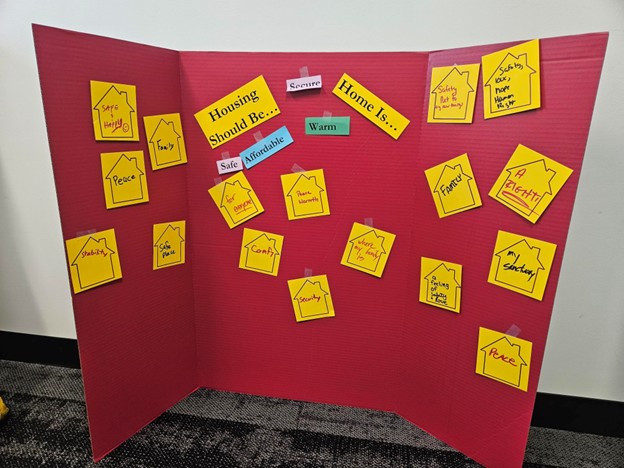
This holiday season, I want to talk a little about what having a home means. In my view, home is not quite the same as housing—it is more. You can have housing without having a home, but you cannot have a home without housing. Recently, the Legal Clinic was invited to a community event hosted by Spur Local where we asked participants to share their thoughts on our poster about what home means to them. Here are some of their answers:
Home is…
- peace, warmth
- a safe place, sanctuary
- safe and happy
- comfy
- a safety net to try new things
- where my family is
- security
- stability
- safety, love, hope
- a human right for everyone
This question, this feeling, of what home is, is something that comes up at the Legal Clinic frequently. (The cover image on our website is actually rocks formed into the words “home is…”). Many of us believe that having a home is so inextricably linked with our humanity that there is no excuse for failing to ensure that everyone in our community has a home.
“Many of us believe that having a home is so inextricably linked with our humanity that there is no excuse for failing to ensure that everyone in our community has a home.”
While being without a home can be dehumanizing, being with a home can be life-altering, sometimes in quiet, subtle ways. When people ask me what stories stay with me after twenty-some years working with people experiencing homelessness, I always say it is the moments my clients have found their homes.
Having a home after being homeless is a real and tangible shift. It is a roof over your head, protection from the cold, heat, rain, or snow. It is protection from assault. It is the ability to sleep through the night. But it is also all the intangibles: the feelings, the senses, the dreams. Having a home is feeling like yourself again, feeling some power or control over your life. It is a place to love, to rest, to hope, and to plan for a better future.
When people who have slept on the street or in shelter for a long time find a home, they often describe how the little differences feel like big shifts. They talk about being able to lock a door for the first time, not because of anyone in particular they want to keep out, but because of the feeling they get when they can lock their door. They talk about cooking in a kitchen, putting food they want to eat in their cupboards, not so much because they were hungry before, but because of what cooking means to them, of what they experience when cooking and eating their own food. Parents talk about their kids having friends over for the first time, not because they necessarily want other kids to come over, but because of how normal their kids get to feel. They talk about being able to celebrate holidays and traditions that are unique to their family or culture, to choose their own meal, their own gifts, even to light a candle, both because they miss those traditions and also because of what practicing their faith and traditions in their home means to them.
During the holidays, there is often increased attention given to the importance of a home, as well as the importance of helping people in the community who need support. I welcome this increased attention and support, yet challenge all of us to envision a world where people don’t have to crowdsource to meet basic needs, or where they don’t have to line up for hours in hopes of getting a free turkey, a toy for their kid, or a chance to apply for help paying their rent. What if we could create a community where we recognized the importance of having a home year-round and we did everything we could to make that a reality for all? That would be a gift beyond measure.
As we wrap up this year and begin to make our resolutions for the next, we hope you will join us in our efforts to fight for homes, and long-term housing stability, for everyone in D.C., whether by raising your voice, volunteering to be a legal monitor or to represent a client, or supporting our work financially.