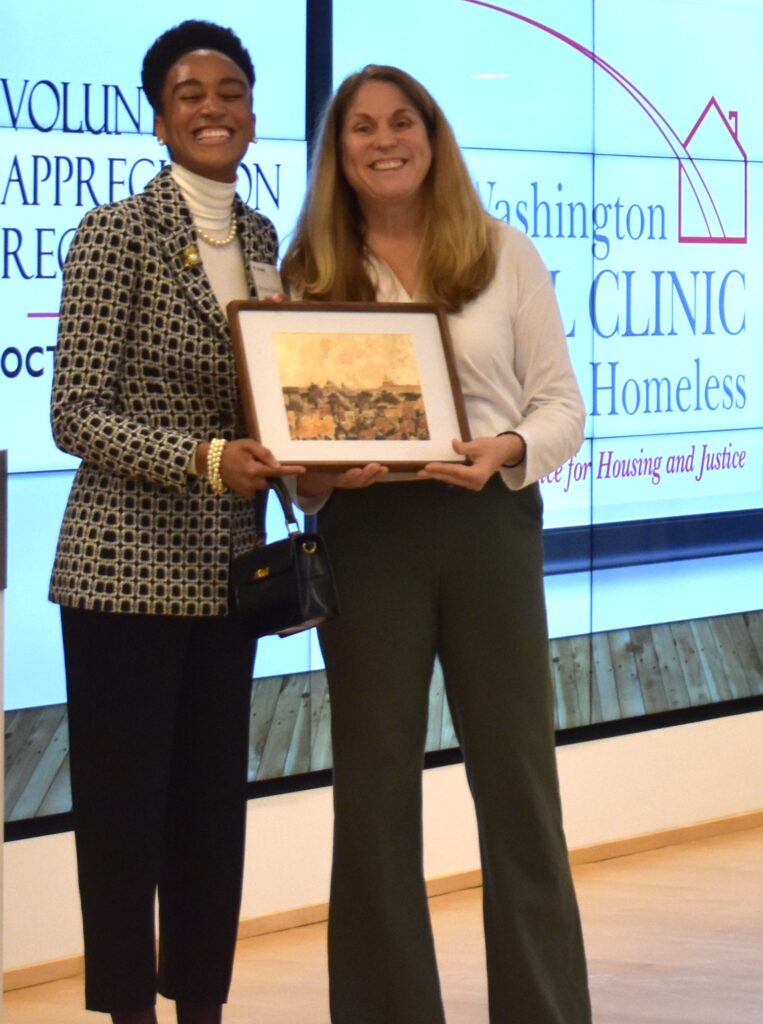
• On Tuesday, October 21, the Legal Clinic held its annual Volunteer Reception to thank all of its volunteers and honor some of its most exceptional volunteers and law firms. We are grateful to Crowell & Moring for hosting, and to all of our volunteers, staff and board members, friends and family who came to celebrate our wonderful community.

    As Executive Director, Amber Harding, said in her opening remarks:

    Many of our clients face long odds in their fight for justice. We believe that they shouldn’t have to fight alone, and that our efforts can shift those odds in their favor. Our clients have fewer legal protections and less political power than they deserve—so at the very least they should be able to access the best legal representation available. You will hear stories tonight of zealous representation that led to great outcomes for our clients—but not every one of those stories involves winning a court case or overturning a harmful decision. Tonight, we want to recognize the importance of being in the fight, the importance of being in solidarity with our clients as they fight injustice, and the importance of pulling out all the stops to fight for change. Every single one of you is an integral part of that work—and I want to take a moment to thank all of you for everything you are doing to fight for housing justice in D.C.

    The Legal Clinic presented the following awards:

    2025 Outstanding Pro Bono Service Award:

    The group of attorneys and legal support staff that, along with Children’s Law Center and Legal Clinic attorneys, brought two class actions on behalf of D.C. families in the rapid re-housing program, including: Jim Rocap, Gabe Scavone, Kylie Clouse, and Laura Niday from Steptoe; Michelle Coleman, George Ruttinger, Edward (“Ted”) North, Tim Laderach, Eric Herendeen, John Nakoneczny, Sangeeta Joshi, Deborah Neufville, and Victoria Vakhrusheva from Crowell & Moring; and Kristen Reilly from Combs & Taylor.

    2025 Outstanding Firm Pro Bono Service Award: Winston & Strawn

    2025 Exceptional Volunteers: John Babcock and Laura Driscoll, Akin

    2025 Exceptional Volunteer: Matthew Lunder, DOJ

    2025 Exceptional Volunteer: Krysten Thomas, Sheppard Mullin

    Becky O’Brien, Legal Director, Legal Assistance Program, closed out the evening with a story, and a reimagined ending:

    A child is standing on a beach where a storm has washed up thousands of starfish. The child is picking up the starfish one by one and tossing them back into the sea. An adult sees what this child is doing and approaches. The adult points out the futility of this task since there are countless starfish and you cannot help them all. The child without stopping continues to throw one more starfish into the ocean and turns to the adult saying “it made a difference to that one.”

    I have always liked that story like that story because, to me, to shows that we can each add value and make a difference as an individual. And that speaks to the idea that is the basis of the Legal Assistance Program—that volunteer attorneys join this work, share their skills and impact outcomes of individual cases. But I would like to offer a better ending to this story—the adult watches this child continue and then joins. They call to their friends and others all along the beach to join as well. When they look behind them, they see more and more people showing up to join in.  

    We are grateful to every one of our volunteers for the work they do for and with our clients. If you are interested in joining them, in joining the crowd on the beach so to speak, you can learn more about volunteer opportunities here.

  • By Brittany K. Ruffin, Legal Director, Systemic Advocacy and Litigation; Joshua Drumming, Staff Attorney; and Charisse Lue, Staff Attorney

    On July 28, D.C.’s FY 2026 budget process concluded. From the start, the budget season was riddled with delays and extensions caused by a series of local and congressional budget actions. Unfortunately, the mayor’s proposed budget left much to be desired. Once again, it underfunded or failed to fund critical housing resources and programs within the Department of Human Services (DHS), setting up another fiscal year in which D.C.’s lowest-income residents have to split inequitable investments. Like last year, those who need the most support in the budget had to do the most advocacy to have their needs represented in D.C. Council’s final budget. While several months of advocacy resulted in a less harmful budget than originally intended by the mayor and some important investments, the final FY26 Budget was an extremely disappointing budget for housing resources. D.C. government and its residents will certainly feel the impact of the overall disinvestment in the year to come.

    Over the last couple of years, despite increasing homelessness, the mayor funded no new housing vouchers in her proposed budgets. All vouchers that ended up in the budget were solely D.C. Council investments. This year, we were pleased to see an initial voucher investment by the mayor to fund 156 Permanent Supportive Housing (PSH)-Family vouchers (for families being terminated by the mayor’s administration from the Family Re-Housing Stabilization Program (FRSP)). However, the mayor included zero housing vouchers for homeless individuals. Of course, the best way to end homelessness in D.C. is by adequately funding vouchers of all types (PSH, TAH, and LRSP) for individuals and families. Fortunately, D.C. Council funded an additional 160 Targeted Affordable Housing (TAH) vouchers and twenty (20) PSH-Family vouchers in the final budget. Those vouchers will end homelessness for hundreds of households with minor children; however, a total of 336 housing vouchers is still less than nine percent (9%) of the family voucher need. Unfortunately, individuals experiencing homelessness were fully neglected in the final FY26 budget, receiving no funding at all for safe, permanent housing, for the first time in over a decade. This lack of investment in housing resources for individuals is particularly shameful and devastating as unsheltered residents are targeted by the local and federal government for simply existing in public spaces.

    The dismantling of the Emergency Rental Assistance Program (ERAP) continued in this budget, and the mayor funded even less for the Emergency Rental Assistance Program (ERAP) than last year. Even with an additional D.C. Council investment, the final FY26 amount ($8.6 million) is approximately sixty-eight percent (68%) less than in FY25 (FY26 investment will increase to $11.6M if there is later revenue growth). The total FY26 investment to fund repairs and rehabilitation of DCHA’s aged and dilapidated public housing stock was also less than in previous years. While the mayor made a FY26 and FY27 investment, the FY26 final amount ($26.2 million) was significantly less than previous years and approximately forty-four percent (44%) of the annual recommendation. We were pleased to see the mayor return to fully funding the Housing Production Trust Fund (HPTF) at $100 million, the recommended investment. In the final FY26 budget, D.C. Council increased the funding to $110 million, provided there is later revenue growth.

    Two of the most notable housing advocacy “wins” in the FY26 budget were the removal of unexpected policies proposed by the mayor in the Budget Support Act (BSA). In one subtitle, the mayor attempted to quietly change the definition and eligibility for project-based LRSP, raising the limit from 0-30% AMI to 0-50% AMI and creating an incentive for further neglect of deeply affordable housing creation by developers. This change would have had a critical impact on D.C.’s affordable housing creation infrastructure, reversing the recent D.C. progress in HPTF funding of 0-30% AMI housing development. Fortunately, D.C. Council advocacy prevailed, and the proposed change was removed from the BSA. In another subtitle, the mayor attempted to reverse established law that requires D.C. to provide non-congregate (private) shelter to families experiencing homelessness. Hundreds of advocates and community members joined together to successfully convince D.C. Council to stop the mayor’s covert attempt to change long-standing D.C. policy and increase harm to families with minor children seeking emergency shelter. These policy proposals were removed from the FY26 BSA and are evidence that hard-fought advocacy works; however, they were advocacy “fights” that never should have had to happen.

    Unfortunately, in the same BSA subtitle where the mayor attempted to roll back family shelter protections, she, for a consecutive year, successfully proposed legislation to further harm Rapid Re-Housing Program families and individuals by removing program protections so that participants could be terminated more quickly. In particular, participants will no longer have the right to stay in the program while they appeal an exit, meaning hundreds of households will face eviction for unpaid rent before they ever have a hearing on whether the exit was lawful.

    D.C. is too well-resourced to continue the pattern of de-prioritizing the human service needs of its residents. Between the additional cuts to ERAP, D.C. Council limiting eligibility for emergency rental assistance (ERAP), underinvestment in housing vouchers, the termination of families and individuals from the Rapid Re-Housing Program, and further FY26 cuts to ERAP funding, homelessness and housing insecurity will undoubtedly increase. The yearly decision to prioritize slashing the funds and programming for critical human services and needs has real and debilitating consequences for D.C. residents and the homeless services system. The unfortunate reality is that D.C. government will have to pay for its disinvestment, one way or another. Insufficient investment in permanent affordable housing and eviction prevention now will result in more harm and increased need later. We must continue to urge D.C. government to prioritize the basic needs of its residents, elevate the resources and investments that keep people safely and permanently housed, and disrupt the pattern of disinvestment towards marginalized communities that has become all too familiar.

    ** Check out all of Legal Clinic’s 2025 funding and reform recommendations here.  

    ProgramRecommendationOutcomePercentage
    TAH3058 vouchers160 vouchers5%
    PSH-Families764 vouchers176 vouchers23%
    PSH-Individuals1200 vouchers (multi-year ask)0 vouchers0%
    LRSP tenant vouchers800 vouchers0 vouchers0%
    LRSP vouchers for returning citizens60 vouchers0 vouchers0%
    Public Housing Repairs$60M$26.2M43.6%
    HPTF$100M$100M ($110M, if later revenue increase)100% (potentially 110%)
    ERAP$100M$8.6M ($11.6M, if later revenue increase)8.6% (potentially 11.6%)
    Storage funding for unhoused individuals$1.5M$00%
  • D.C. Stands Strong Against Trump Administration’s Escalated Attacks Against Unhoused D.C. Residents 

    By Amber W. Harding, Executive Director of the Washington Legal Clinic for the Homeless

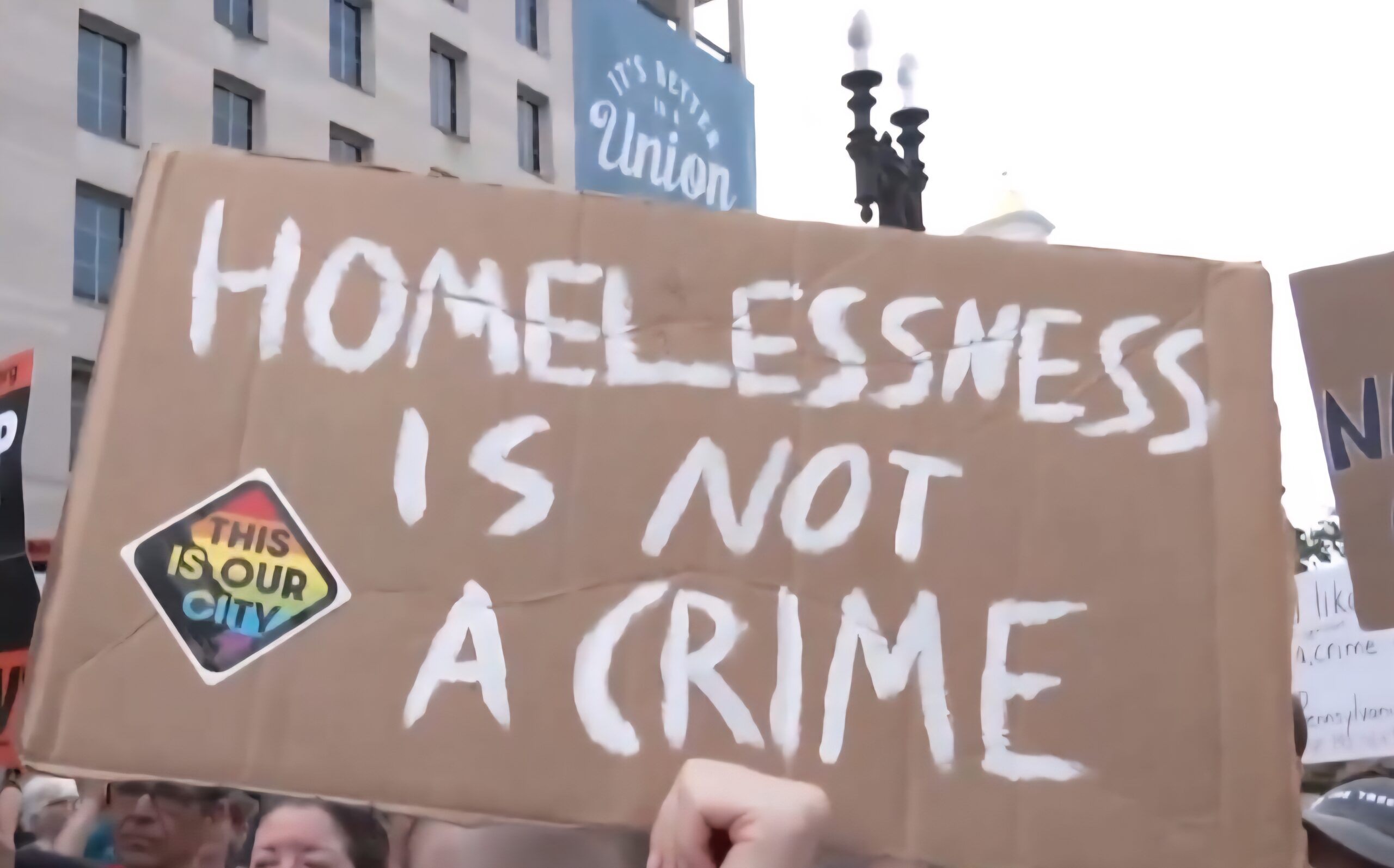
    On August 14, 2025, D.C. showed up in full force to protect the rights and dignity of D.C. residents who sleep on the street. The Legal Clinic had 5 teams of legal observers and outreach staff. I saw activists, lawyers, faith leaders, outreach workers, media, D.C. government workers, and other D.C. residents come together to witness, to record, and to protect people on the street from government abuse of power. I saw the culmination of a week of collaborative effort to get people inside, out of harm’s way, and to overcome real barriers to emergency shelter that exist- all in a state of panic and with no new resources. (It is important to note that precisely zero resources—no money, no vacant federal buildings, no housing—have come from the federal government to support moving people inside.) 

    Among people on the street, I saw confusion, fear, and distrust. One elderly man told us he would just walk all night, because he didn’t want to risk sitting or lying down. For some, it solidified their belief that the federal government is targeting them. Others couldn’t understand why they would ever be targeted since they weren’t hurting anyone and were just trying to survive.  

    Last night, a group of federal law enforcement officers tried to forcibly evict and destroy the belongings of a small group of people in Washington Circle. A resident of one of the tents and our legal observers showed the officers the notice from the D.C. government that instructed people to leave by Monday, August 18. They convinced the federal officers not to move forward with the destruction.  

    This afternoon, without notice to outreach workers, D.C. human service agencies, or anyone impacted, federal and local police officers moved through D.C. destroying property in parks, on sidewalks, and outside of programs that serve unhoused residents—including the tents at Washington Circle with the signs permitting residents to stay until Monday.  

    We do not yet know the full scope of harm being wrought on people throughout the streets of D.C., and the situation is constantly evolving. However, last night, I saw a community of people who love their city and understand that we are all less safe and free when our government uses its power to harm its own people. That community stands ready to do what is necessary to protect our neighbors. 

  • On Monday, July 14, the D.C. Council will take its first vote on our local budget and many legal changes that will impact the lives of D.C. residents. As we discussed here, the mayor’s budget proposal was regressive and harmful, hardly befitting a city where the vast majority of residents support progressive and humane economic and social policies. The Council has already reversed some of these harmful proposals, but when it comes to responding to the ever-growing gap between household income and the cost of rent, both branches of government are failing D.C. residents, particularly those who are homeless or at imminent risk of homelessness.

    For individuals experiencing homelessness, there is not one dime in this budget to end homelessness. Not one permanent supportive housing voucher, proven time and time again to be the most effective intervention to permanently end one’s chronic homelessness. Not one local housing voucher for the thousands who have been waiting on the housing waitlist for decades. To compound the harm, despite there being very few shelter spaces available and no housing funded, the mayor is devoting $900,000 to fund encampment evictions.

    For families experiencing homelessness, while there are some housing vouchers in the current version of the budget, the budget proposes terminating more families from housing than it does supporting them with housing—resulting in a deliberate, government-caused net increase in family homelessness. Here is a loose timeline leading up to today of the failures of the mayor and the Council in the past few years to solve family homelessness in a humane, nontraumatic way:

    • Mayor Bowser announced, post public health emergency, that too many families were in rapid re-housing. She proposed solving this problem by terminating thousands of families from their housing.
    • The Council agreed with families and advocates that that is not the right approach. Chairman Mendelson proposed fixing the program via the Rapid Re-housing Reform Amendment Act. (Some more information here, and yes, we were wrong to be so optimistic about the chance for reform.)
    • The Council never moved the bill forward, despite near-unanimous support at the public hearing.
    • The Council did, unanimously and repeatedly, pass emergency and temporary legislation ensuring that families be offered an opportunity for extensions in the program.
    • The mayor claimed there are still too many families in the program. She proposed legislation to “fix” that problem—not by helping people secure more stable long-term housing, or by helping people increase their income so they can afford rent. Instead, the mayor proposed terminating even more families, but faster, by no longer providing extensions and by taking away most of the legal rights people have in the program, including fair hearings.
    • The vast majority of the Council strongly opposed this legislation. The agency claimed there were tremendous cost savings to be had when gutting the legal rights of the people it serves. The legislation passed when the Council failed, despite their stated opposition, to secure enough money to pay for the removal from the Budget Support Act. More info here.
    • Over three thousand families received termination notices over the next year. Only about half were able to transition into a permanent housing program. The rest will lose or have already lost all of their housing support and face rising rental debt and eviction.
    • The Council passed legislation that makes families in rapid re-housing ineligible for emergency rental assistance when they lose their rental support, removing the very last safety net for avoiding eviction.

    That brings us to present time. The mayor has decided that the Department of Human Services should be able to terminate people in rapid re-housing even more quickly, and that participants still have too many rights. She proposed yet another Budget Support Act subtitle eliminating more rights, making the program even more draconian. (Note: proposing such changes in the Budget Support Act ensures there will be no public hearing and that there will be no Racial Equity Impact Statement performed by the Council.) This time she proposed stopping the rent payments before someone even has their appeal heard. She stripped away the right to an extension, giving the agency director “sole and absolute discretion” on extensions.

    Most likely recognizing that the impact of these mass housing terminations will surely soon be felt in increased family homelessness, the mayor chose once again not to solve that problem in a humane or even logical way–by keeping families housed. No, her solution is to remove health and safety protections in the law for family shelter—so she can place families with minor children in the same sleeping quarters as strangers.

    As a reminder, Mayor Bowser ran on a platform of not placing families in congregate settings, stating that: “I will not treat our homeless families like emergency flood victims, housing them in city recreation centers.” The Council, including then Councilmember Bowser, has twice—in 2010 and 2014—unanimously rejected proposals to force families to share sleeping quarters.  When families filed a class action in 2014 after Mayor Gray placed homeless families in recreation centers, a judge concluded that: “As to those named Plaintiffs who have not been placed in apartments or private rooms the court finds that they, particularly the children, incur increased risk of communicable disease, are denied adequate privacy and physical security, are likely to experience emotional trauma and stress, hence are likely to suffer irreparable harm in the absence of a restraining order.”

    In other words, so far, the mayor has proposed “solving” housing unaffordability for individuals by failing to fund any housing that would end their homelessness and instead increasing encampment evictions. For families, her solution is kicking families out of housing, eviscerating their legal rights, and then forcing children to sleep next to strangers. The Council so far, while sometimes opposing this approach in their words, has failed to effectively put a stop to this pervasive harm against unhoused D.C. residents. The Council must reject any language that puts children at risk in shelter and either fix rapid re-housing or fund enough housing vouchers so that families can exit the program without cycling back into homelessness.

    Raise your voice. Tell the mayor and the Council that they must stop failing unhoused D.C. residents. Ask them to remove harmful Budget Support Act language (“Subtitle K”) that will increase rapid re-housing terminations and force families into shared sleeping quarters with strangers. Tell them to fund housing vouchers to end homelessness permanently.

    Take action here!

    Update: from our friends at Fair Budget Coalition, please come to the Wilson building (1350 Pennsylvania Ave NW) on Monday, July 14 at 9AM for a rally and at 11AM to pack the vote. RSVP here.

  • By Amber W. Harding, Executive Director, and Brittany K. Ruffin, Legal Director, Systemic Advocacy and Litigation

    In Washington D.C., the lack of statehood has become increasingly urgent and impactful. In a jurisdiction where 92% of voters are registered as Democrats, but where it is uniquely subject to the whims and consolidated power of President Trump and Congressional Republicans, D.C.’s elected leaders may feel stuck “between a rock and a hard place.” They must withstand a steady stream of misinformation, inflammatory statements, and pressure from Congress while feeling compelled to bite their tongues in fear of retaliation or the repeal of Home Rule, i.e., the ability to govern ourselves. Nevertheless, Mayor Bowser’s recent proposal for policy and spending priorities represents a far more regressive approach than can be explained by a reasonable fear of losing autonomy.

    D.C. is, of course, a city with its own stated values and priorities. Our local human rights law is easily one of the most inclusive and expansive in the country. D.C. has declared itself a human rights city. Despite the economic displacement of Black and brown residents over the past few decades, D.C. remains a diverse and majority-minority jurisdiction. We are not a city without its struggles, but we have made progress over the years in embracing change, understanding and responding to systemic oppression in a humane way, rejecting myths and stereotypes, and supporting data-based solutions when crafting legislation and policy.

    Now, because of the actions of the president and Congress, many more people in our community are suffering. Many have lost their jobs or are about to—so many that D.C. is on the brink of a recession. Many who were already searching for work find the job market flooded with people with decades of government experience. Immigrants, documented or not, are scared—they are seeing ICE show up masked and in plain clothes at their children’s schools and at their workplaces. People who are transgender are worried about losing their jobs, their healthcare, and more. People staying on the street are worried about being forced to move, losing all of their belongings, or being arrested for sleeping outside. Women are worried about losing reproductive and economic freedoms. Black and brown residents are worried about the increasingly overt racism and the loss of their civil rights.

    When people are experiencing harm at the hands of the federal government, it is even more critical that they can trust their local government to stand up for their rights and to insulate them from further harm.  Mayor’s Bowser proposal, however, not only fails to insulate D.C. residents from the harmful federal actions, but it actually furthers the harm to those communities. For example, the proposal repeals sanctuary city protections, defunds the Office of Migrant Services, abolishes the D.C. Healthcare Alliance (the locally funded healthcare program that serves many immigrants who cannot qualify for Medicaid), and effectively excludes immigrant families seeking asylum from lifesaving emergency shelter and housing programs. Mayor Bowser’s proposal does not just capitulate to threats of losing federal funding; instead, it goes much further than even the most cautious and fearful political leader might suggest.

    Beyond anything arguably responsive to federal pressures, the mayor’s budget proposal reverses decades of progress and reflects a very regressive view of D.C. and its residents. On the brink of a recession, when the job market is more competitive than ever and housing unaffordability is at its height, there are increased sanctions on families receiving Temporary Assistance for Needy Families (TANF), cuts to the Emergency Rental Assistance Program, and a stricter arbitrary time limit for participants in the Rapid Re-Housing Program. At a time when, both, the federal government and the local government are aggressively evicting people from encampments, there are no housing vouchers funded to move those unhoused individuals into housing. While there are funds proposed for D.C.’s public housing repairs and some voucher resources for families being terminated from the failing Rapid Re-Housing Program, the amounts are nowhere near the need. While money is allocated to the Housing Production Trust Fund for affordable housing creation, proposed policy changes threaten the future of housing production for residents at the lowest-income levels. Despite a news cycle that constantly reminds us of the harm that unchecked executive power can have and of the importance of due process, the mayor’s proposal gives unchecked discretion to herself in multiple areas, including “sole and absolute” discretion to refuse housing subsidy extensions, cut people off of housing benefits prior to any opportunity for review of the decision, and send unhoused D.C. families with children to crowded, congregate shelters.

    What is to be gained by Home Rule if our local laws and lawmakers refuse to reflect our local values? D.C. residents deserve better than the mayor’s proposed budget. They expect elected officials to stand up for them through an unwavering commitment to asserted D.C. values. There is still time for D.C. Council to mitigate the harm of the mayor’s budget and ensure that the final budget “looks like” D.C. We must continue to urge D.C. government to prioritize the basic needs of its residents and elevate the policies, resources, and investments that keep people safe and protected in all aspects of their life.

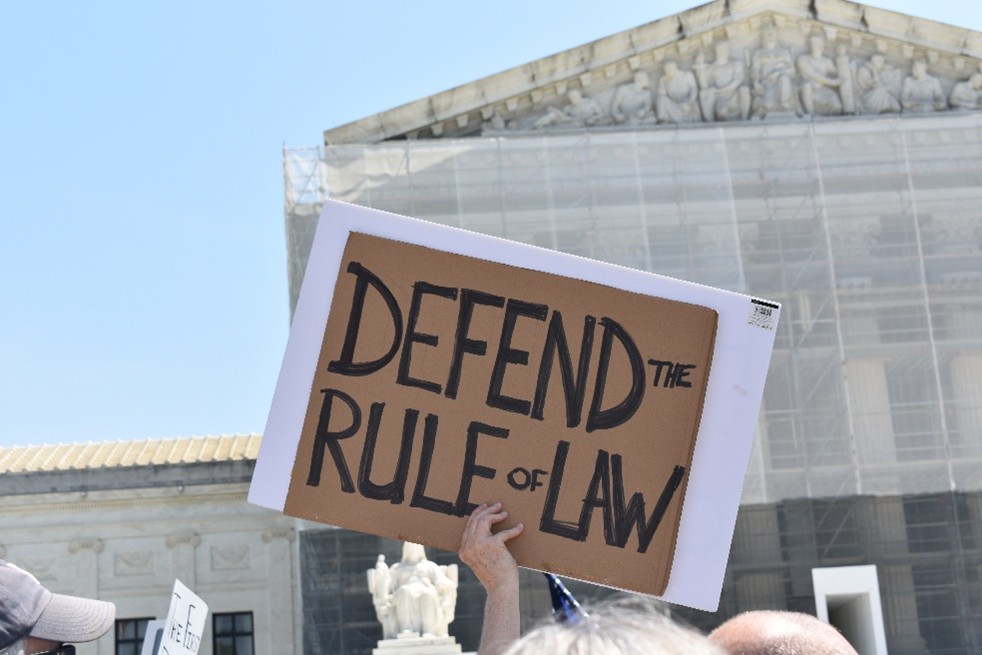
  • Lately, the “rule of law” has been in the news, prompting many of us to think more critically about the law’s role in our democracy, as well as a lawyer’s role in preserving the rule of law. On May 1, many of us at the Legal Clinic attended the DC Law Day rally at the Supreme Court organized by Lawyers for Good Government. It was a great rally, with inspirational speakers, creative signs, and hundreds of lawyers reciting their oath of office.

    It is a strange time to be a lawyer (or perhaps it is just a strange time to be, unrelated to anyone’s profession). The legal profession is rarely of one mind on any topic, of course, but belief in the rule of law—meaning belief that no one is above the law, that our Constitution is the supreme law of the land, and that we must aspire to create equal and fair systems of justice for everyone—may be the closest we come to unanimity. What we will each do to live up to or fight for those beliefs remains to be seen.

    Like many, my path to the law was not particularly linear. I had no interest in becoming a lawyer as a child. If you had asked me if I wanted to become an activist or advocate, then yes, but I had no exposure to lawyers as agents of social change. What drew me to the practice of law was an experience I had working with homeless youth in Arizona who were banned by businesses, assaulted by police, and dehumanized by passersby. The homeless youth needed new laws to protect them from harm and lawyers—free lawyers—to enforce those laws.

    At rallies, people often chant “when we fight, we win.” But when you fight for justice, you don’t always win. Our justice system is made up of humans who can make mistakes or who carry the same biases that we are often fighting against when we fight for justice. Sometimes there is no equal justice under law. Sometimes courts decide that people who are homeless or living in poverty aren’t entitled to due process, as they did in our federal rapid re-housing class action. Sometimes our highest court decides that people on the street aren’t entitled to the same protection from cruel and unusual punishment as others, as they did in Grants Pass.

    What I do know to be true, is that you cannot win if you do not fight. One thing I love about the Legal Clinic is that we are always willing to stand up for what is right and to be in the fight with our clients. We work with clients who have fewer legal protections than they should and less political power than they deserve. We try to address those injustices by supporting them with some of the best staff and volunteer lawyers in the city—lawyers who are willing to fight hard to ensure the client has a safe place to go. At the same time, our policy and advocacy team lends their expertise and fire to fight for a budget and legal framework that moves the city closer to our vision for housing justice.

    As lawyers, we know that the law can be an effective tool for justice and can increase government transparency and accountability, but only if the law creates explicit protections and has strong enforcement clauses. Lawyers interested in furthering the principles of fairness and justice must advocate for laws that protect the public in the worst-case scenario. We do not take elected leaders or agency heads at their word that they will do something different than what the law says, we insist that laws must be written to protect us from the worst intentions and actions of those with power. We are a “hope for the best, prepare for the worst” profession. We are in a moment in time where we will find out how well prepared our laws and institutions are.

    I strongly believe that laws can serve to equalize and can be used to demand respect for one’s basic human rights. When laws are written to protect the most vulnerable, with protection against the actions of the most powerful, they serve to protect all of us from tyranny and tyrants. Most importantly, when “power tends to corrupt, and absolute power corrupts absolutely,” the rule of law and its enforcers play a critical role in checking and rebalancing power.

    Amber W. Harding, Executive Director

  • Statement on D.C. Encampments:  Destroying Communities Will Not Make D.C. Great

    On February 10, the Washington Post reported that: “President Donald Trump is expected to issue an executive order that would seek to ratchet up penalties and enforcement of violent and petty crimes, clear homeless camps, and clean graffiti in the District of Columbia.” Then, on February 20, the Post reported that President Trump had spoken again about homelessness in D.C., indicating that there was too much visible homelessness in D.C.

    It is no secret that we at the Legal Clinic believe that housing is both the solution to homelessness and the only humane way to “clear homeless camps.” Unfortunately, we have seen no indication that the current administration is intending to dedicate resources to affordable housing to reduce the number of people living outside.

    The implication of President Trump’s statements is that forcibly displacing unhoused people is required to clean up D.C. People are not trash to be swept away. People are not criminals, by virtue of their unhoused status. People are struggling to afford rent and food in an expensive city (and nation). We agree that we should not have homelessness in our nation’s capital. But the path to ending homelessness is housing, not displacement.

    In December, Mayor Bowser said: “President Trump and I both want Washington, D.C., to be the best, most beautiful city in the world and we want the capital city to reflect the strength of our nation.” D.C. is a beautiful city, one that should be a beautiful state. It is beautiful not because it is pristine or without its challenges.  D.C. is beautiful because it is real. It is a real, dynamic community made up of people of all races, ethnicities, genders, and income brackets. D.C. is a community with its own music, food, and customs.

    Hurting unhoused people with encampment clearings hurts our entire community and does nothing to end homelessness. Harming people without homes because one can, because one does not think they (or D.C. residents or D.C. elected officials) will fight back, is quintessential bullying. Using punitive measures to remove people from the streets, to hide problems rather than solve them, indicates a lack of understanding or interest in root causes homelessness—and a lack of competence in solving complicated problems in this city and this nation.

    D.C. is not a colony. The President and the National Park Service are still subject to federal laws and the U.S. Constitution. D.C. has its own government and a mayor and legislators that were chosen by D.C. residents to represent the best interests of all of its residents.

    While we are talking about D.C.’s own elected officials, we would be remiss not to note that Mayor Muriel Bowser has been regularly, aggressively, and harmfully clearing encampments for her entire time as mayor. She is easily the most hostile mayor to her constituents who sleep outside of any in our recollection. She does not need Trump’s encouragement to forcibly expel residents from tents. She doubled down on encampment evictions after a front loader picked up a man in a tent, and then cleared an encampment at a recreation center in order to hold a press conference on affordable housing. Mayor Bowser holds no moral high ground on encampment evictions.

    Perhaps the President’s incendiary statements about D.C. and his dehumanizing language implying that people without homes mar D.C.’s beautiful lawns will be the wake-up call our local elected leaders need to realize that forcibly displacing unhoused persons does not reflect D.C. values, and that the only humane path out of street (and all) homelessness is the funding and provision of deeply affordable housing.


    Additional resources:

    1. Statement from our colleagues at the National Homelessness Law Center
    2. Campaign to protect D.C. Home Rule and autonomy, Free DC
    3. Infographic on non-harmful solutions to encampments

    Update: On March 28, President Trump issued an executive order, titled “Making the District of Columbia Safe and Beautiful.” On April 23, a group of advocacy organizations sent this letter to Mayor Bowser, urging her to resist any federal attempts to deprive D.C. residents of basic rights, including resisting the criminalization of homelessness and poverty.

  • We Give Thanks for Legal Clinic Volunteers

    It is a week of reflection and gratitude and, here at the Legal Clinic, our cup is overflowing.  We are so thankful for our amazing staff and board, our clients, and all of our supporters and allies. We want to take a moment to extend particular gratitude to the lawyers, paralegals, and legal assistants who donate their time to support our fight for housing justice on behalf of D.C. residents.

    Volunteerism is baked into our foundation. In 1986, as homelessness emerged as a major social issue in D.C., local attorneys explored how to use their legal toolbox to assist D.C. residents experiencing homelessness and severe housing instability, and crafted a pilot program to break down barriers, by sending lawyers out of their offices and into the shelters, dining programs and day centers where potential clients were accessing other services, and where, most importantly, those clients felt comfortable. The pilot was incorporated as the Washington Legal Clinic for the Homeless in 1987.

    The last two years have brought increasing strains on those experiencing homelessness and housing insecurity. As pandemic-era relief programs ended, legal protections such as the eviction moratorium were lifted; the number of D.C. residents experiencing homelessness increased, and the Legal Clinic has seen an increase in the need for our services. When we called upon the D.C. legal community and its strong culture of pro bono, many firms and agencies welcomed our staff to hold trainings and information sessions. We are thankful to stand with these dedicated attorneys and staff to help meet the legal needs of our clients.

    During D.C.’s 2024 Pro Bono Week in October, we gathered to appreciate our legal volunteers for the truly outstanding work they have done for our clients. The same day of our Volunteer Reception, hosted by Crowell & Moring, we filed a class action on behalf of over 800 families in the rapid re-housing program facing loss of their housing. Our expert legal team includes attorneys from Crowell & Moring, Steptoe & Johnson, Combs & Taylor, and our fellow non-profit partner, Children’s Law Center.  Without that pro bono team, we would not have been able to fight for the housing stability of hundreds of families at risk of becoming homeless again. In addition to the high impact class action work that our volunteers make possible, our office is representing dozens of families in the individual cases—work that is only possible because of the volunteer lawyers who take those cases with our training and support.

    The Washington Legal Clinic for the Homeless staff is grateful to each and every volunteer, all of whom enable the Legal Clinic to serve as many people as possible. This October, we recognized the particularly notable efforts of a few volunteers. We had the honor of presenting 2024 exceptional volunteer awards to Marissa Ditkowsky, Tommy Rucker, and Cara Wulf, and a 2024 Outstanding Pro Bono Award to Sheppard Mullin for their enthusiastic commitment to our work this year.

    2024 Exceptional Volunteers

    Marissa Ditkowsky “went above and beyond for her very first client at the Legal Clinic…” says Ann Marie Staudenmaier, Senior Counsel at the Legal Clinic. Marissa has been diligently and passionately representing her client in a case that persisted far longer than most to ensure that they are in safe and stable housing.

    Cara Wulf has shown unwavering service during her five years of volunteering at the Legal Clinic. Britney Monroe, Legal Assistance Project Coordinating Attorney, says “her consistent presence has been a source of strength for both our team and the clients we serve.” Cara has shown sensitivity and attention to her clients during her several challenging and barrier-facing cases in 2024.

    Tommy Rucker has been an active volunteer, ambassador, and advocate for the Legal Clinic for several years. He has worn many hats – from helping to recruit fellow colleagues to volunteer with us to his involvement in our fundraising campaigns. Jesse Owens, Staff Attorney, shares that he has shown “zealous and dedicated advocacy throughout 2024.”

    2024 Outstanding Pro Bono Award

    Sheppard Mullin has shown a deep interest in working with the Legal Clinic and expanding the relationship between the firm and our organization.  They learned about the need that the Legal Clinic addresses in our community and took concrete action by providing immediate coverage of legal intake and placement of cases and agreeing to cover monthly legal intakes. Becky O’ Brien, Director of Legal Services, says that “Sheppard Mullin is doing incredible work on behalf of our clients.”

    With their commitment to housing justice and the mission of our organization, each of our volunteers carries on the spirit that brought the Washington Legal Clinic for the Homeless into existence in the 1980s.

    We extend heartfelt gratitude to our volunteers for their dedication in helping to keep this important work going strong for more than three decades, and we look forward to standing strong together no matter what challenge the future brings for housing justice.

    How can you help? If you would like to volunteer, contact our Volunteer Coordinator, Kelsey Vaughan at kelsey.vaughan@legalclinic.org and complete our Volunteer Application. If you would like to support our work with a donation, please consider a Giving Tuesday contribution to the Legal Clinic this year.

  • We urge DC Council to vote no on the Emergency Rental Assistance Reform Emergency Act of 2024 to be voted on Tuesday, October 1. The bill is bad for tenants and landlords. If passed, it will increase evictions and housing insecurity and make it harder for tenants to pay, and landlords to collect, rent.

    The Emergency Rental Assistance Reform Emergency Act of 2024 does not:

    1. Help tenants pay rent.

    2. Help landlords pay their mortgages or operating costs.

    3. Remedy, or even acknowledge, the rising cost of living in D.C.—most critically that rents have increased 10.7% since 2019. (Not to mention that the global pandemic that occurred in 2020 made it harder for many middle- and low-income tenants to pay rising housing costs.)

    4. Fix the delays in rental assistance payments caused by the Department of Human Services. DHS is taking months to issue checks after tenants are found eligible for assistance.

    The Emergency Rental Assistance Reform Emergency Act of 2024 does:

    1. Reduce the number of households who qualify for ERAP by narrowing the definition of “emergency,” making it harder for struggling households to avoid eviction and stay in their homes. In fact, this change alone could remove the last safety net available to #KeepFamiliesHoused in rapid re-housing.

    2. Delay ERAP payments  by increasing the documentation requirements for applicants.

    3. Memorialize unproven myths and stereotypes about poor, primarily Black people who apply for government programs into official government policy. Despite no evidence of fraud, the bill removes the ability of tenants to self-certify eligibility. (As a reminder, unlike the federal counterpart during the pandemic, ERAP payments do not go to tenants—they go to landlords to pay back rent.) It undoes long-fought-for reform to this program without any evidence of fraud or abuse.

    4. Increase the speed and number of evictions in D.C. regardless of whose fault any delay in processing ERAP is.

    5. Run the risk of increasing housing insecurity and homelessness, on top of already rising numbers and fewer resources to serve those in need.

    We urge members of the D.C. Council to vote against this emergency bill and convene a working group to come up with real solutions. (Some ideas here.)

    We urge you to contact your Councilmember to express your opposition. (Jews United for Justice has a call script here.)

    To make matters worse, the Department of Human Services announced on September 26 that the agency is choosing to delay the opening of the rental assistance portal that was slated to open on October 1, further delaying the application process and payments to the landlords for hundreds of D.C. residents who currently face eviction. This action has serious consequences for our community. You can reach the Director of the agency, Laura Zeilinger, at laura.zeilinger@dc.gov and Mayor Bowser at mayor@dc.gov.

  • Chairman Mendelson circulated an emergency bill, to be voted on on Tuesday, October 1, that will do nothing to address the affordability crisis that both landlords and tenants are asking for assistance with. Instead, the bill will narrow eligibility for emergency rental assistance (ERAP), lengthen the amount of time it takes to process ERAP applications, and allow evictions to happen even when the landlord or the government agency is at fault for delays in ERAP payments. This bill will harm both landlords and tenants and increase evictions. Passing this bill on an emergency basis, with no hearing and no real assessment of the cause of rental arrears or whether this is a solution, much less the right one, is irresponsible policymaking that risks mass eviction and displacement.

    We urge members of the D.C. Council to vote against this emergency bill and convene a working group to come up with real solutions. We urge you to contact your Councilmember to express your opposition. (Jews United for Justice has a call script here.) 

    Below is a letter sent today from Legal Aid DC, Legal Counsel for the Elderly, the D.C. Pro Bono Center, Bread for the City, and the Washington Legal Clinic for the Homeless opposing the bill and suggesting better solutions to this crisis.

    Re: Emergency Rental Assistance Reform Amendment Act of 2024

    Dear Members of the Council of the District of Columbia,

    We, the undersigned organizations, are a coalition of legal services organizations that represent tenants facing eviction and applicants for rental assistance. We are writing to express our opposition to the Emergency Rental Assistance Reform Amendment Act of 2024 and share suggestions to improve the legislation that will reduce inefficiencies in Emergency Rental Assistance Program (ERAP) processing and ensure that eligible tenants are able to receive assistance in a timely manner. As drafted, the bill does little to address the problems the Council has identified regarding delays in eviction cases and rental assistance processing. Indeed, the bill may well exacerbate delays by creating burdensome administrative requirements and novel legal proceedings, all while displacing tenants who have a pathway to pay the rent they owe. The Council should reject this approach and reorient the bill toward improving the administration of ERAP — a goal all stakeholders should agree on.

    Any reforms to the ERAP program must fundamentally recognize that the vast majority of tenants are applying for ERAP in good faith, and the delays in court proceedings and ERAP processing are largely outside their control.

    Tenants and Landlords are Impacted by Significant Delays in ERAP Processing

    There have been significant delays in DHS’ processing of applications and distribution of ERAP funds. In many instances, tenants who have already been found to be eligible for ERAP wait months, and in some egregious cases over a year, for distribution of ERAP funds. Our understanding is that a new system of payment orders was implemented in FY2024 that led to a slow roll out of the funds. During a difficult period this summer, one ERAP processor informed us that they had $8 million in applications that they were ready to approve but could not move forward because they were waiting on funds from DHS. This situation went on for many weeks and was extremely frustrating to both landlords and tenants as cases needed to be delayed while they waited for the money to arrive.

    These delays were evident for one tenant who applied for ERAP in January 2024. The application was accepted, processed, and ready for approval in mid-March. But due to the slow issuance of funds from DHS to the processor, her application was not approved until April and the payment did not appear on her ledger until June. The eviction matter was not resolved until mid-July because of lack of response from the landlord about funds in the registry and dismissal of the case. The slow distribution of funds and the failure of this landlord to respond caused this case to drag on for an additional four months — both matters outside of the tenant’s control.

    This tenant’s story is one of many that underscore the need for the Council to require faster processing of ERAP applications and payments to reduce court delays. We would recommend, for example, that this legislation require that all applications should be claimed by an ERAP processing agency within 45 days of submission, all applications should be processed within 45 days of being claimed, and all payments should be issued to the housing provider within 14 days of approval.  

    As drafted, the bill will only exacerbate processing delays by requiring additional documentation from tenants and eliminating self-certification. Eliminating a tenant’s ability to self-certify by imposing a documentation requirement will create further delays in processing timelines. Moreover, requiring an applicant to prove that an emergency led to the need for assistance will unnecessarily limit who is eligible without giving ineligible applicants any new pathways to assistance. If the goal is to eliminate delays and increase rent payments to landlords, requiring more paperwork and limiting eligibility will be counterproductive.

    ERAP Stays Are Necessary to Protect Tenants in Eviction Proceedings

    The proposal to eliminate automatic ERAP stays will add to court delays. As drafted, the proposed bill adds new administrative hurdles to the process. This change will require additional court proceedings — for example, by creating a new type of evidentiary hearing regarding a tenant’s ERAP eligibility and the amount that might be paid — which will only further delay cases.

    We agree with limiting the number of stays as a matter of right to one per case. Subsequent stays should be presumptively granted. If the landlord challenges the request for an additional stay, they must prove (1) that the ERAP application was filed in bad faith and (2) that the housing provider has been reasonably diligent in the ERAP application process. At a minimum, the bill should include automatic stay of final judgment and eviction, which would allow parties to proceed on underlying issues that can be addressed through the normal court process, while still protecting tenants from eviction in cases where ERAP will help the tenant stay in their home.

    In our experience, many of the delays in court proceedings and ERAP processing are caused by some housing providers failing to respond to requests for basic documentation like ledgers and leases, which are necessary to determine ERAP eligibility and to ultimately resolve the case. This can result in the denial of meritorious ERAP applications and delay to a court case. By refusing to engage with the ERAP process, housing providers are undermining a fundamental protection under DC’s eviction law that a tenant cannot be evicted if they pay all the money that is owed.  We have found that some housing providers’ repeated failures to engage in good faith negotiations further delay resolutions of their cases. Housing providers and tenants’ counsel can often resolve rental arrearages — even arrearages that exceed the ERAP limit — through a combination of an ERAP payment and a payment plan. Unfortunately, it often takes months longer than it should to reach these settlements because some housing providers’ counsel do not respond to repeated phone calls and emails.

    One example of these issues is a tenant who applied for ERAP in July and had their application accepted by a processor within the month. Through counsel, the tenant has raised numerous eviction defenses including serious housing code violations. The tenant has been paying a substantial portion of their rent into the court registry as the eviction case proceeds. After the landlord initially moved toward settling the case with the payment of ERAP assistance, they then reversed course and refused to cooperate with the processor to issue the ERAP funds or provide documents. The tenant’s application was denied at the end of July because of the landlord’s lack of responsiveness. This eviction matter is still not resolved. The landlord has now reversed their position again, and the tenant intends to apply for ERAP again in October.

    To meaningfully address these types of delays, any reform effort should incentivize housing providers to engage with the ERAP and court processes, by, for example, deeming rent waived if a tenant can show a landlord’s repeated failure to comply with ERAP requirements.

    Reforms to ERAP will not address the root cause of the District’s housing crisis. We urge the Council to focus on addressing the fundamental issue that rents are outpacing income for too many District residents, by, for example, leveraging the Housing Production Trust Fund, funding more permanent vouchers, inclusionary zoning for new housing developments at 30% AMI, and funding the First Right to Purchase Program (FRPP) so tenant TOPA purchasers can keep their buildings affordable. But in the immediate term, we look forward to working with the Council to address the issues with this bill and the ERAP program.

    Sincerely,

    Legal Aid DC

    Bread for the City

    Washington Legal Clinic for the Homeless

    D.C. Bar Pro Bono Center

    Legal Counsel for the Elderly

I am a Search Dialog!