• How well were you served in 2020? Here’s how to let DC Council know!

    The time is upon us. DC Council will begin holding oversight hearings this month on the performance of DC government agencies in 2020. We don’t have to tell you that 2020 was a doozy of a year. Government agencies were forced to rethink their service delivery models when the pandemic hit, while simultaneously facing growing human needs. Some rose to the occasion while others faltered. Yet no assessment of their performance can be done by the DC Council without hearing from DC residents who rely on government agencies.

    What does it mean to testify before DC Council?

    Testifying is a way to share stories with DC Councilmembers and staff about the ways in which DC programs have affected your life. This is an opportunity for families and individuals who’ve dealt with DC government agencies to share their experiences with shelters, hotels, housing programs, and other government services.

    Things to keep in mind

    • These are public events. All DC Council hearings and roundtables are recorded and shown on public access television. The public can watch hearings live, as well as view the recordings afterward on the DC Council website.
    • Testimony can be verbal and written. Written testimonies are added to the public record.
    • During the COVID-19 public health emergency, Council hearings are happening virtually. “Live” testimony means participating in the hearing online, “voicemail” testimony means leaving a voicemail with your thoughts.
    • Generally, people who testify are referred to as witnesses, and individuals are usually given three minutes to speak (although there is some variation among committees).
    • If you or someone you are helping needs language interpretation or reasonable accommodations for live testimony, let the Council committee know when you sign up.
    • A full list of oversight hearings and instructions can be found here.

    Here are some tips on testifying from Legal Clinic Grassroots Advocacy Coordinator, Kristi Matthews:

    • Identify who you are (name, why you are testifying, and program you are testifying about)
    • Tell your story (pick an event or issue that you have worked directly on or been affected directly by that you are comfortable sharing with the public)
    • Explain why you felt the need to testify (how you have been impacted by this program)
    • Describe solutions (how can they improve the program if needed)

    Please feel free to contact us with questions or to request help preparing your testimony: (202) 328-5500.


    Some Key Agency Performance Oversight Hearings

    Department of Behavioral Health

    Under the oversight of the Committee on Health (Committee Chairperson: Ward 7 Councilmember Vincent Gray)
    Programs covered: mental health services, housing programs for people with mental illness

    Live testimony

    • Date: February 12, 2021, 9AM-6PM
    • How to sign up: email mcameron@dccouncil.us or call 202-341-4425
    • Deadline to sign up: 5PM on February 11, 2021

    Voicemail testimony: 202-350-1828

    Written testimony:

    Office on Returning Citizens Affairs, Commission on Reentry and Returning Citizen Affairs

    Under the oversight of the Committee on Government Operations and Facilities (Committee Chairperson: At-Large Councilmember Robert White)
    Programs covered: services and housing for returning citizens

    Live testimony:

    • Date: February 19, 2021, 12PM-6PM
    • How to sign up: email facilities@dccouncil.us or call (202) 741-8593
    • Deadline to sign up: COB February 17, 2021

    Voicemail testimony: none

    Written testimony:

    Department of Human Services and Interagency Council on Homelessness

    Under the oversight of the Committee on Human Services (Committee Chairperson: Ward 1 Councilmember Brianne Nadeau)
    Programs covered: homeless services, emergency shelters, Permanent Supportive Housing, Targeted Affordable Housing, Rapid Re-housing, TANF, EBT (food stamps), IDA, ERAP, child care, Homeward DC’s plan to end homelessness

    Live testimony:

    Voicemail testimony: 202-741-2111

    Written testimony:

    Department of Employment Services

    Under the oversight of the Committee on Labor and Workforce Development (Committee Chairperson: At-Large Councilmember Elissa Silverman)
    Programs covered: job programs, unemployment, paid family leave

    Live testimony:

    Voicemail testimony: 202-455-0153

    Written testimony:

    Deputy Mayor for Health and Human Services

    Under the oversight of the Committee on Health (Committee Chairperson: Ward 7 Councilmember Vincent Gray)
    Programs covered: encampments, including trash removal and clearings/displacement

    Live testimony:

    • Date: March 4, 2021, 9AM-6PM
    • How to sign up: email mcameron@dccouncil.us or call 202-341-4425
    • Deadline to sign up: COB March 3, 2021

    Voicemail testimony: 202-350-1828

    Written testimony:

    Metropolitan Police Department

    Under the oversight of the Committee on the Judiciary and Public Safety (Committee Chairperson Ward 6 Councilmember Charles Allen)
    Programs covered: policing, violence prevention, diversion of funding to community needs

    Live testimony:

    Voicemail testimony: none

    Written testimony:

    Office of Human Rights

    Under the oversight of the Committee on Government Operations and Facilities (Committee Chairperson At-Large Councilmember Robert White)
    Programs covered: enforcement of the DC Human Rights Act, Fair Criminal Records Screening for Housing Act, proposed new protections including Fair Tenant Screening Act, Michael A. Stoops Anti-Discrimination Act and Eviction Records Sealing Authority Act

    Live testimony:

    • Date: March 5, 2021, 12PM-6PM
    • How to sign up: email facilities@dccouncil.us or call (202) 741-8593
    • Deadline to sign up: COB March 3, 2021

    Voicemail testimony: none

    Written testimony:

    DC Housing Authority

    Under the oversight of the Committee on Housing and Executive Administration (Committee Chairperson: At-Large Councilmember Anita Bonds)
    Programs covered: public housing, vouchers, Local Rent Supplement Program

    Live testimony:

    • Date: March 5, 2021, 9AM-12PM
    • How to sign up: call 202-724-8198 or email housing@dccouncil.us
    • Deadline to sign up: March 1, 2021

    Voicemail testimony: 202-350-0894

    Written testimony:

    Department of Housing and Community Development

    Under the oversight of the Committee on Housing and Executive Administration (Committee Chairperson: At-Large Councilmember Anita Bonds)
    Programs covered: Housing Production Trust Fund, use of federal funds for rent relief

    Live testimony:

    • Date: March 9, 2021, 9AM-3PM
    • How to sign up: call 202-724-8198 or email housing@dccouncil.us
    • Deadline to sign up: March 5, 2021

    Voicemail testimony: 202-350-0894

    Written testimony:

    Office of Planning

    Under the oversight of the Committee of the Whole (Committee Chairperson: Chairman Phil Mendelson)
    Programs covered: Comprehensive Plan

    Live testimony:

    Voicemail testimony: 202-430-6948

    Written testimony:

    Department of Health

    Under the oversight of the Committee on Health (Committee Chairperson: Ward 7 Councilmember Vincent Gray)
    Programs covered: DC Healthcare Alliance, vaccine distribution, pandemic testing and response, housing programs for people with HIV/AIDS

    Live testimony:

    • Date: March 19, 2021, 9AM-6PM
    • How to sign up: email mcameron@dccouncil.us or call 202-341-4425
    • Deadline to sign up: COB March 18, 2021

    Voicemail testimony: 202-350-1828

    Written testimony:

  • DC Planning Practices Must Reflect Housing Justice

    The work of the Legal Clinic began in the 1980s, as many in the United States took increasing notice of homelessness. At that time, a group of lawyers in DC were spurred to form a model for providing direct, no-barrier legal services to unhoused residents – thus laying the foundation for the Washington Legal Clinic for the Homeless. We carry on that work today in a DC where not only has homelessness not been solved, but it has been fueled by a severe loss of affordable housing. Our housing justice work has expanded and today takes place in the context of a District of Columbia that became one of the epicenters of gentrification in the United States, where residents face crisis levels of housing unaffordability and displacement – with at least 20,000 Black DC residents being displaced between 2000 and 2013.

    At the Legal Clinic we strive to ground our advocacy in lessons learned through direct representation and organizing efforts with community members impacted by housing and economic insecurity. This has led us to deepen our work around the issue of how land use impacts housing instability and homelessness. Since May 2017, we have been actively involved in the current amendment cycle for Washington, DC’s Comprehensive Plan, work that has largely taken place through the DC Grassroots Planning Coalition, in which Legal Clinic attorney Caitlin Cocilova serves as a Steering Committee member. DC’s Comprehensive Plan is a 1500+ page document that anticipates and guides future development decisions over a 20-year period. The Comp Plan includes “Citywide Elements” that cover the entirety of DC (i.e., housing, economic development, transportation), “Area Elements” that are specific to smaller geographic areas within the District, and maps that dictate what could be built or created on a particular plot of land.

    The Mayor of Washington, DC (our local executive branch) is legally mandated to oversee planning processes in the District and must amend, or update, the 20-year plan every four years before a complete rewriting of the document. DC’s Office of Planning generally handles this process. DC Council (our local legislative branch) can then approve or alter whatever the Mayor’s Office of Planning proposes in terms of changes to the Comp Plan. This process must include opportunities for public input.

    As the guide for planning and development in DC, the Comprehensive Plan impacts all DC residents. When a developer proposes to build something different than what is automatically allowed by the zoning designations on a particular parcel of land, the proposed project still must legally “not be inconsistent with the Comprehensive Plan.” The Zoning Commission must review the Comp Plan provisions and make sure that any proposed project is in line with the planning document. This means that the language and maps in the Comp Plan – much of which has been molded over many years by affected and engaged residents – serve as a check on new projects that could otherwise cause harm to their communities in the way of, for example, environmental impacts or displacement.

    The Legal Clinic, as a part of the DC Grassroots Planning Coalition, has continued to analyze the document’s ability to provide equity in practice, not just in rhetoric, and to prevent displacement. We have testified at DC Council hearings on the Mayor’s proposed changes to the Plan and helped plan and conduct monthly presentations alongside other Coalition members and groups to foster dialogue and a better understanding of this huge document.

    We are concerned that the proposed amendments to the Comprehensive Plan, released by the Office of Planning in April of 2020, do not adequately address DC’s ongoing housing crisis and the continued displacement of low-income Black and brown residents. We thus support the Housing Justice Priorities put forth by the DC Grassroots Planning Coalition as a productive start to better planning practices in DC.

    The impacts of development and planning practices on DC residents who are unhoused or housing insecure require immediate and strong policy responses. As Caitlin stated in her December 2020 testimony submitted to the DC Council on the Comprehensive Plan:

    The way we have seen the growth of DC most intimately impact our clients has been by increased, sometimes permanent, encampment sweeps in gentrifying neighborhoods due to complaints on neighborhood listservs (ex. NoMa) and cases of clients discriminated against when attempting to access Class A apartments using vouchers. We have few cases of clients with vouchers, including rapid rehousing, who have been able to access any of the many new builds. Even if Council believes in supply and demand theory – the idea that building more housing to meet a growing demand will reduce housing costs and allow for people with lower incomes to access the housing market presumably without a voucher – how long do we wait for the tipping point to occur that causes housing costs to decline?

    The results we see today, of people in high numbers doubled up, in shelters, on the street, and in temporary housing programs, are the consequences of planning that has failed to include their needs. Public planning and policy that has allowed for such injustice must be corrected. We echo the call in the DC Grassroots Planning Coalition’s Housing Justice Priorities: DC’s Comprehensive Plan would be strengthened by adding policies and actions that fortify existing affordable housing programs and require community-led equitable development strategies that further racial equity.

  • On Thursday, July 23, the DC Council took its final vote on the Fiscal Year 2021 budgetchoosing to cut health and human services during a global pandemic because the majority of councilmembers decided that undoing an advertising tax was more important. Only Councilmembers Brianne Nadeau (Ward 1) and David Grosso (At-Large) voted against this amendment. 

    A little background and context are in order. We have been updating you on investments in housing at each step. On Tuesday, when the second vote was supposed to happen, we had been hoping to see some increases in funding to affordable housing programssome recognition and response to the humanitarian crisis developing with regard to COVID-19 cases among people who are homeless, or maybe some more funds for public housing repairs. 

    Instead, on Tuesday, debate over an amendment that would have cut library funding to curtail part of the advertising tax somehow devolved into Chairman Mendelson proposing a recess to come up with $18 million in cuts to completely repeal the advertising tax. He suggested starting with Council “enhancements” to libraries, eviction prevention, and excluded workers unemployment. No one knew how these decisions would be made—when asked by a councilmember what the process would look like, Chairman Mendelson responded that the process was “as clear as milk.” 

    Many DC residents reacted strongly and swiftly to this threat to safety net programs. Hundreds if not thousands of DC residents contacted councilmembers to oppose cuts, particularly cuts to programs that serve low-income residents. Excluded workers protested outside of Chairman Mendelson’s house on Wednesdayhis threat to cut their financial support had occurred only a few hours after he committed to protesters that he would fund the program. Social media blew up with DC residents outraged at what the Chairman was proposing. #JustRecoveryDC trended on Twitter. 

    At around 10PM on Wednesday, Chairman Mendelson circulated an amendment that proposed to eliminate the advertising tax in exchange for cuts to mental health services and the elimination of ongoing funding for eviction prevention and homeless outreach services. Introducing the amendment on Thursday, Chairman Mendelson seemed to lash out at the public, stating that the Council has not met the costly demands of the most strident groups” and “don’t preach to us about morality.”  

    But the budget is a moral document. As our colleague at Miriam’s Kitchen, Jesse Rabinowitz, stated“By finding $18 million in just two days, the Council reminds us that corporate interests are worthy of resources while people experiencing homelessness must be satisfied with crumbs. Instead of using this $18 million to fix a manufactured crisis, the Council could have used these $18 million to end chronic homelessness for more than 650 additional individuals.”  

    Councilmember Nadeau gave the most comprehensive, biting statement on the amendment and the process by which it was negotiatedNadeau explains that no one would help her find $800,000 for healthcare for undocumented residents but: when the choice was made to recess on Tuesday, the Chairman was able to craft a plan to produce $18 million in revenue in just about 24 hours, a portion of that money coming from a PAYGO Capital dollars. A pot of money he expressly and repeatedly prohibited any of the rest of us from tapping into.” She went on to lay out the impact of the cuts: “The repeal we are voting on today converts $3.5 million from ERAP and $1.8 million from Homeless Outreach to one-time dollars. That is on top of $1.32 million for shelters for transition age youth that is proposed to be converted in the ANS [Amendment in the Nature of a Substitute] he circulated on Monday. In total, these conversions constitute a reduction of $19,860,000 collectively from these three programsThat is not to mention that the proposed amendment before us now cuts $4 million from the investments made by this Council in Community Based Mental Health Services… because $2 million of this cut has a federal Medicaid match, what this cut actually means is that we have left an additional $4.7 million in federal dollars on the table 

    After making the point that any additional funds could have gone to other underfunded programs to serve the community, Nadeau indicted the process: “I want to conclude by talking about the choice to use power and influence to subvert our legislative process. This past Tuesday an unprecedented and opportunistic action was taken to recess our meeting in order to push this body into a full repeal of the ad tax. I was not invited to the 11th hour meetings held behind figurative locked doors in small enough groups to avoid open meetings requirements to make decisions about the people’s budget. I did not receive a phone call asking for my input, despite cuts being taken from homeless outreach and ERAP, programs under my purview as chair of the Committee on Human Services. And I have to say that I have never been so proud to not be invited to the popular kids table. I wear my exclusion from this opaque process as a badge of honor and just as I played no part in those negotiations, I can play no part in pushing this proposal forward. 

    Councilmember Nadeau clearly and reasonably expected to be part of a fair, transparent process. But she’s not the only one who should demand to be in the room where it happens. We all deserve to be in the room where it happens, watching and engaging in democracy, and holding our elected officials accountable when they make troubling decisions 

    No one really knows how the
    Parties get to yes
    The pieces that are sacrificed in
    Ev’ry game of chess
    We just assume that it happens
    But no one else is in
    The room where it happens 

    Hold your nose and close your eyes 

    We want our leaders to save the day 

    But we don’t get a say in what they trade away 

    We dream of a brand new start 

    But we dream in the dark for the most part 

    Dark as a tomb where it happens 

    The Room Where It Happens,” Hamilton 

  • We are happy to see that the DC Council made some new investments in affordable housing programs in the first stage of budget decisions last week. But the DC Council needs to do so much more to get us to a #JustRecoveryDC. DC had a preexisting affordable housing crisis that is about to get much worse as a result of the global pandemic and economic recession. Many experts estimate that homelessness will increase 40-45% nationwide. A lack of safe housing and shelter combined with longstanding disparities have resulted in people experiencing homelessness being most impacted by COVID-19: 315 positive cases and 20 dead in DC.

    Nearly 9/10 people experiencing homelessness in DC are Black. We urge the Council to prevent harm from occurring to Black people, not just mourn it after harm occurs. That includes preventing homelessness, ending homelessness, investing in deeply affordable permanent housing, and diverting money from programs that hurt Black DC residents. Read our statement on systemic racism and white supremacy here.

    Check out the status of the Legal Clinic’s highest priority asks for the FY 2021 budget below. (Further background on our budget asks can be found here.)

    This blog has been updated with the latest version of the budget circulated by Chairman Mendelson on July 6. And updated again after the votes on July 7– new blog coming soon with more information on the decisions made on July 7.

    Place People in Hotels, Dorms and Housing to Prevent COVID-19 Transmission

    Ask: Fully fund a requirement that DC offer each person experiencing homelessness a noncongregate placement until a vaccine is widely available or the pandemic is over #WhatHomeDC

    Status: No progress.

    7/6 Chairman Mendelson’s circulation: No progress.

    7/7 First vote: No progress.

    Eviction Prevention

    Ask: Increase the Emergency Rental Assistance Program (ERAP) by at least $12 million (M) and develop an expanded eviction prevention program (#CancelTheRent).

    Status: DC Council restored Mayor’s $1.115M cut plus added $150,000.

    Remaining need: At least $12M for ERAP.

    7/6 Chairman Mendelson’s circulation: Added $5M for ERAP, leaving $7M unfunded.

    7/7 First vote: Added $1M to ERAP from Charles Allen’s amendment to delay to corporate tax cuts (passed unanimously). $6M left unfunded.

    End Family Homelessness

    The Mayor only added 54 affordable housing slots for families in Permanent Supportive Housing (PSH). This means that only 2% of Rapid Re-housing (RRH) families would have a longterm subsidy to exit to. The rest are likely to cycle back into homelessness. The Department of Human Services (DHS) is starting up RRH time limit terminations in July.

    Ask: 1) Require a moratorium on RRH time limit terminations in FY20 and 21 to allow families to have a shot at getting employment and recovering from the public health emergency.

    2) Add $17.39M to Targeted Affordable Housing (TAH) vouchers for 712 families.

    3) Add $10.42M for 500 LRSP tenant vouchers.

    Status: No progress.

    7/6 Chairman Mendelson’s circulation: No progress.

    7/7 First vote: Added $1.5M for TAH for 60 homeless families from Brianne Nadeau’s amendment to reform the Qualified High Tech Company tax credit (voted for by Nadeau, Pinto, Cheh, Allen, Gray, Trayon White, Bonds, Silverman, Grosso and Robert White). $15.89M left unfunded. Added $1.4M for LRSP tenant vouchers for 70 families from Charles Allen’s amendment to delay to corporate tax cuts. $9.02M left unfunded.

    End Chronic Homelessness

    The Mayor only funded PSH for 96 individuals and 54 families who are chronically homeless.

    Ask: Fund PSH for 1404 individuals and 248 families.

    Status: The Council has increased PSH for 50 individuals. No progress on families.

    Remaining need: PSH for 1354 individuals, 248 families.

    7/6 Chairman Mendelson’s circulation: No progress.

    7/7 First vote: $2M for PSH for 68 individuals and $2M for PSH for 53 families from Brianne Nadeau’s amendment to reform the Qualified High Tech Company tax credit. PSH for 1286 individuals and 195 families still unfunded.

    Invest in Re-entry Housing Pilot

    Ask: $1.8M per year for a Re-entry Housing Pilot, including services, for 50 people.

    Status: $1M funded

    Remaining need: $800,000.

    7/6 Chairman Mendelson’s circulation: No progress.

    7/7 First vote: No progress.

    Build Deeply Affordable Housing

    Ask: 1) $180M in Housing Production Trust Fund (HPTF) for households making 0-30% Area Median Income (AMI).

    2) $24M in project/sponsor-based Local Rent Supplement Program (LRSP).

    3) Better target the property tax abatement to the creation of affordable housing available to people with incomes below 50% of AMI.

    Status: Mayor added $50M, Council added $4.5M for 0-30% AMI housing ($9M total). $0 for LRSP.

    Remaining need: $125.5M for HPTF, $24M for project/sponsor based LRSP.

    7/6 Chairman Mendelson’s circulation: The Chairman decreased HPTF by $3.89M (meaning $1.95M less in 0-30%AMI for a total of $52.56M in HPTF for very low income housing). He added $5M to project/sponsor based LRSP. Some local funds are being used to leverage $88M for a new affordable housing fund. We are trying to get more information on what this is. The property tax abatement appears unchanged.

    7/7 First vote: No progress.

    Repair Public Housing

    The Mayor put $25M into FY21 and $15M into FY22 for public housing repairs.

    Ask: 1) $60M/year

    2) Include protections from the Public Housing Preservation and Tenant Protection Amendment Act of 2020 in the Budget Support Act.

    Status: The Council added $376,000 to the public housing repairs fund.

    Remaining need: $34.6M in FY21, $45M in FY22, and $60M in subsequent fiscal years.

    7/6 Chairman Mendelson’s circulation: An additional $25M in FY21 for public housing repairs, bringing FY21 funds to $50M. No additional money in later years. There is a Budget Support Act subtitle. It gives the Mayor approval over their spending plans and does not increase Council oversight. It does not include the protections for tenants that are included in the Public Housing Preservation and Tenant Protection Amendment Act of 2020.

    7/7 First vote: No progress. Robert White moved an amendment to divert $35M from the streetcar to public housing repairs in FY21, which would have guaranteed two years of funding at $50M. His amendment failed 5-8 (voted for by Robert White, Trayon White, Pinto, Nadeau and Silverman). You can read the ANC7F Resolution opposing the streetcar expansion here.

    To fund these critical needs, the Legal Clinic supports:

    1. Decreasing the police budget;
    2. Diverting money from Rapid Re-housing to permanent housing for families;
    3. Diverting $127M from the Streetcar to public housing repairs;
    4. Diverting $5.4M in Streetcar PayGo funds to ERAP;
    5. Diverting future years of the K Street Transit Project to public housing repairs;
    6. Increasing taxes on the wealthy;
    7. Closing tax loopholes; and
    8. Reforming DC’s tax code to both raise revenue and further economic and racial justice. (See here for more details.)

    As the budget stands right now, it doesn’t even meet the needs for a “normal” year. However, this year certainly isn’t normal for DC residents. It’s much worse. We hope that Councilmembers follow Councilmember Kenyan McDuffie’s lead and refuse to support an unjust budget: “If, after these protests subside, we don’t see meaningful change with actual policies that go along with funding & commitments, then it’s not real justice and I won’t be prepared to support it.”

    7/7 update: The budget did not make meaningful change, and yet all Councilmembers voted for it. As for whether Councilmember McDuffie and his colleagues led with actions or just words, you can see below that only four Councilmembers consistently supported critical programs when put to a vote: Nadeau, Trayon White, Robert White and Silverman.

    What can you do?

    Before final vote: Be on the look out for next steps soon. In the meantime you can thank your elected officials whose votes resulted in more money for critical needs yesterday, and signify to the other members that you do not agree with their choices. Below is a chart of how Councilmembers voted on the budget yesterday. We were asking them to vote “yes” on each vote.


  • Love DC. Love the People.

    It’s that time of year again—time to fight for DC residents through an equitable budget.

    Despite being disappointed in Mayor Bowser’s proposed FY21 budget, we continue to expect and demand a substantial investment in the programs and agencies that improve the lives of those who are struggling the most to survive in DC.  For too long, gentrification, underinvestment, and the DC government’s focus on big development have contributed to mass displacement and trauma for DC’s Black and extremely low-income communities.  Each year, in a city rife with income and wealth disparity, the Fair Budget Coalition aims to convince the Mayor and the Council to prioritize the needs of those who are surviving with the least. Mayor Bowser’s administration has made many grand proclamations about commitments to affordable housing creation and homelessness eradication. However, DC residents deserve to see those commitments kept.  If creating deeply affordable housing, keeping residents off of the streets, and promoting racial equity are, indeed, D.C. priorities, the DC budget must reflect that.

    In the midst of COVID-19, prioritizing the needs of DC residents has become even more critical.  The Council has stepped up over the last couple of months to pass a series of emergency bills to address some immediate concerns. However, that must only be the beginning.  The public health emergency has cast a spotlight on the programs and agencies that are truly essential for residents of the District.  The Fair Budget Coalition urges the Council to craft and pass a budget that addresses the current and future reality for so many.

    Last year, the love for go-go music, a DC institution, triggered a widespread movement of support in the face of a challenge.  That love and pride for music nurtured in this city—a product of DC’s historic Black culture—were palpable.  Encouraged by residents, councilmembers and Mayor Bowser jumped to action to protect a precious piece of the city’s history. A few months ago, that prolonged support resulted in legislation that declared go-go the “official” music of the District. It was a beautiful example of what can be accomplished in this city when intention and resolution combine.  

    Fundamentally, that’s what love is—protection and intention.  It’s action.  To love DC means to protect and support the needs of all of its people. It means affirmatively preventing harm to Black communities, not just mourning harm after it occurs. It’s making sure that people have an opportunity to thrive.  We urge the Council to come together and rise to the occasion again—this time, to pass a budget focused on protecting the lives of DC residents.

    The Fair Budget Coalition continues to work to elevate the programs and legislation that would reduce harm and best contribute to a more equitable DC budget–one that shows love for DC by showing a commitment to the people of DC.  The Fair Budget Coalition’s Housing Security Group has compiled recommendations detailing the FY21 budget investments that would have the biggest impact on minimizing the barriers to housing and creating more equitable access for vulnerable DC residents.  We want DC’s FY21 Budget to make essential investments in: repairing and maintaining public housing, ending family and chronic homelessness, funding 0-30% AMI housing, passing tenants’ rights legislation, increasing ERAP funding, creating housing for returning citizens, providing private rooms to those in shelters and on streets, and expanding rent relief.

    Check out the Fair Budget Coalition FY21 Budget Platform for a detailed breakdown of the Housing Security recommendations, the mayor’s current investments, and the entire Fair Budget Coalition FY21 Budget Platform. You can also read the full testimony that we submitted to the Committee of the Whole today here.

    The only way to love DC is to love its people.

  • True justice requires a disruption and deconstruction of systemic racism.

    We, the Washington Legal Clinic for the Homeless, pause in sorrow to speak the names and mourn the loss of George Floyd, Ahmaud Arbery, Breonna Taylor, Tony McDade, D’Quan Young, Jeffery Price, Marqueese Alston, Terrence Sterling, Alonzo Smith, Ralphael Briscoe, and all those whose names we don’t know, but who have been killed by violence from racist institutions and systems.

    We pledge to honor the lives of those lost to the violence of police brutality and redouble our efforts to more deeply understand and combat the inherent racial and economic violence that has always existed within policies, practices, and institutions at the national and local levels, and work to forge a more just and inclusive DC. Redlining, environmental racism, racially restrictive covenants, and other historic housing, zoning, and labor laws are among the causes of the violence of exclusion, displacement, adverse health impacts, and over-policing of Black communities, as well as our nation’s tremendous racial wealth and income gap. We pledge to fight the racist ideologies and institutions that have caused Black residents to be disproportionately represented among DC’s homeless population and, most recently, disproportionately represented among those who have lost their lives due to COVID-19.

    The Legal Clinic stands with those throughout the country and in our community who are demanding change and striving to dismantle systems through which white supremacy runs deep – systems that have allowed white people to build up wealth and privilege while inflicting poverty, pain, and even death upon Black people in the United States and internationally. We stand with those who demand more than performative alliance and urge concrete changes that hold Mayor Bowser to her declaration that Black lives matter. DC must divest from the MPD and other institutions, programs, and agencies that perpetuate racism and continue to harm Black DC residents. We join the voices of those calling for DC to expand its concept of public safety by significantly investing in all of the critical community needs and resources that prioritize equity and provide real protection and holistic support to Black people, including safe and deeply affordable housing. Additionally, we aim to continue to listen to and amplify the voices of DC’s Black community, fully capable and rightfully intent on determining how to best protect, honor, and sustain Black lives.

    True justice requires a disruption and deconstruction of systemic racism. True peace cannot exist in the absence of justice. Until this city and country begin to acknowledge, confront, and actively dismantle the racist institutions that have so drastically impacted Black existence, justice and peace remain elusive.

    Black lives matter.

  • 4/2/20 Update: Check out our new blog and a new advocacy letter for the next round of emergency legislation.

    The undersigned organizations sent the below letter to the Mayor and DC Council Friday afternoon. The DC Council will consider emergency legislation on Tuesday, March 17, 2020 to support DC residents and businesses during the COVID-19 public health emergency. If your organization would like to sign onto this letter, please contact joanna@jufj.org. This post will be updated periodically as we receive new sign-ons.


    Friday, March 13, 2020

    Dear Mayor Bowser, Chairman Mendelson, and Members of the DC Council:

    As social and legal service providers, and organizers and advocates for socially, racially, and economically just policies in the District, we write to thank you for your leadership in the midst of the Coronavirus pandemic. We are grateful the District is taking quick and decisive action to protect public wellbeing including by declaring a State of Emergency in the District and proposing the “COVID-19 Response Emergency Amendment Act of 2020.” 

    It is unfortunately times like this that require us to confront the interconnectedness of the human condition and entwine our collective fates for the sake of the greater good. Public health crises should not be the catalyst that drives our ability to meet the needs of the District’s many vulnerable residents, yet here we are, and we are calling on you, our elected leadership, and your designees to do whatever it takes to protect all DC residents from the spread of disease, ensure economic stability, and provide for the basic needs of our most vulnerable residents grappling with large scale and rapid changes to their daily routines and income. As a financially healthy city with full reserves and additional FY 2019 surplus capital at our disposal, we are better prepared than most to do our part to serve our residents and flatten the curve. We hope this letter will further spur legislative and administrative action by the District in response to the myriad harms posed by COVID-19. 

    The “COVID-19 Response Emergency Amendment Act of 2020” is an excellent first step as the District prepares to alleviate the suffering that is already being experienced by many. We appreciate the Council’s proactive work to advance such legislation. We believe provisions of that legislation can be strengthened in the following ways:

    • Use the full flexibility granted by the US Department of Labor to protect workers by providing UI benefits in the following scenarios related to COVID-19: (1) An employer temporarily ceases operations due to COVID-19, preventing employees from coming to work; (2) An individual is quarantined with the expectation of returning to work after the quarantine is over; and (3) An individual leaves employment due to a risk of exposure or infection or to care for a family member. In addition, ensure that our UI rules follow federal law not requiring an employee to quit in order to receive benefits due to the impact of COVID-19.
    • Adopt work-sharing in the Unemployment Insurance program to provide alternatives to mass layoffs, and encourage participation among employers by providing 100 percent payment of work-sharing benefits. Under this program, instead of laying off workers, employers can reduce worker hours and employees can receive unemployment benefits proportionate to the hours they lose. For instance, an employer, such as a hotel, with 200 workers that otherwise might lay off 50, the employer could instead employ all 200 four staggered days a week; workers then would receive unemployment benefits covering the one or more days a week they were not employed (because some people’s typical job schedule is schedule days per week). The District should take additional steps to inform employers of this program. For the small business employers receiving District general operating support grants to offset reduced consumer demand, strongly encourage them to participate in workshare. 
    • Establish a special purpose fund through Unemployment Insurance that enables contractors and consultants to receive benefits to make up for lost income due to the present state of emergency. Contractors and consultants are not typically eligible for Unemployment Insurance and are therefore otherwise without recourse to replace their slowed or eliminated income stream at this time.
    • Expand DCFMLA job protections to all employees, including those working for very small businesses, who need to care  for themselves or a loved one who has tested positive for coronavirus; extend job protection to those employees unable to perform their regular work from home and who need to take self quarantine precautions because they are in a high-risk category. 
    • Require all District businesses to immediately provide at least 14 paid sick days to their employees — including for reasons of social distancing and self-quarantining — regardless of their size or an employee’s tenure; companies of all sizes who experience hardship from paying out these extra sick days should be eligible for emergency relief through the small business grant program. Further, the small business grant program referenced in Section 202 should cover all registered businesses and nonprofit entities in the District who experience significant financial harm as a result of COVID-19, not just businesses who are already registered with the District’s “Certified Business Enterprise” program.
    • Add a 14-day grace period following the end of a public health emergency for Sections 303-306 so that people have time to return to work and earn a paycheck to enable them to pay necessary bills.
    • Amend Section 306 to put in place an eviction and foreclosure moratorium on new cases filed and create stays for pending cases. Requiring people to attend court proceedings and risk exposure to the virus and then potentially be kicked out of their housing at a time when the public is being urged to stay home is fundamentally irresponsible.
    • It is further irresponsible to require most court proceedings to continue during a state of emergency. In accordance with the legislation’s recommendation to suspend District government meetings to minimize crowds, urge the Chief Judges of DC Superior Court and DC Court of Appeals to suspend all non-emergency court proceedings on a temporary basis pending a resolution of the current public health crisis.  
    • Amend section 308 to say “the Mayor shall” as opposed to “the Mayor may”.
    • Amend section 308 to include the public benefits provided pursuant to the Homeless Services Reform Act.
    • Related to Section 308 of the emergency legislation, enhancements should be made to:
      • Include a moratorium and/or stay of any public benefit terminations or adverse actions, including emergency shelter and housing assistance.
      • Temporarily suspend annual redetermination of family eligibility for childcare services, WIC, SNAP, Medicaid, and TANF to ensure that temporary changes in family workforce participation, earnings, or other factors due to COVID-19 do not impact family eligibility. 
      • Reduce tedious public benefit paperwork processes to make it easier for clients to report a reduction in income and/or to report an addition to their current family household makeup if they have a college-aged child who is home for an extended period; families in these circumstances will need to have their benefits adjusted expeditiously so they can continue to afford necessities like groceries. 
      • Ensure college students currently eligible for public benefits remain enrolled even if their schooling and/or job status change; expand eligibility for public benefit programs for college students who remain in the District during the nation-wide shuttering of higher-education campuses. 
      • Require presumptive, low barrier access to emergency family shelter via the shelter hotline so families are not required to go to Virginia Williams Family Resource Center and obtain documents to prove eligibility from schools and other entities that may not be open during the emergency. (At the conclusion of the public health emergency, the District has statutory authority to redetermine eligibility as needed.)

    We also urge you to expand the scope of the emergency legislation to ensure greater protections for overall public health and to meet the most pressing needs of some of our most high-risk individuals. Our top priorities for legislative additions include:

    • The District should cover all costs associated with virus testing so that no one is financially burdened by taking the responsible steps for public health to come forward, get tested, and inform their networks of possible exposure. To facilitate this, we should be establishing two testing sites in every Ward in compliance with CDC safety protocols to ensure minimal transportation barriers to testing services. Only by acting swiftly to quarantine possible disease vectors can we flatten the curve. Further, the District should cover all medical treatment of individuals who do not have insurance or who are underinsured. Finally, more public guidance and public outreach – through telephonic and virtual channels – is needed to inform people of where to go for testing and treatment, and how to get there safely.
    • Ensure medically vulnerable residents experiencing homelessness who live on the street or in communal settings have access to safe shelter that meets CDC COVID-19 guidelines. This will minimize their risk to virus contraction and the broader risks posed by unnecessary public outings and congregating at this time. We must prioritize safely housing all people in high risk categories: older residents, those with diabetes, those with respiratory challenges, and all those with chronic health conditions or underlying health conditions that can weaken a person’s immune system. We recommend utilizing the District’s vacant hotel rooms to house these individuals throughout March, at a minimum.
    • Biannual recertification of the DC Healthcare Alliance must cease immediately and all currently enrolled individuals should remain enrolled through the end of the public health emergency. Additionally, the DC Government should establish an online or telephonic process to facilitate the filing of new applications for Alliance coverage so that DC’s immigrant residents can access healthcare coverage without financial hardship from the safety of their homes. An uninsured population only acts to exacerbate public health crises; this gaping loophole in our local health system should have been remedied years ago.
    • The District must ensure that no family has to choose between economic security, their child’s safety, and access to learning opportunities, and that all families have access to adequate nutrition. To do so, the District must:
      1. Allow parents and primary caregivers to utilize unemployment insurance to replace lost wages due to the need to stay home to care for children in the coming weeks and months.
      2. Ensure children – and their parents – who are eligible to utilize school lunch programs as well as families who are currently enrolled in the District’s child care subsidy program will have access to meals throughout school closures; meal preparation and distribution must adhere to thorough safety precautions to minimize exposure to the virus of those preparing, serving, delivering, and consuming meals. This will likely require establishment of more meal sites and dining staggering protocols to minimize accumulations of large groups of people.
      3. Provide parents with clear guidance on how to support their child’s learning, development, and mental health throughout school and childcare closures. Appropriate plans should be implemented to  contact all parents by phone to ensure parents are prepared to have their children home full time and meet their learning continuation needs. For those for whom remote learning is desired but have technology barriers, the District should help those students by expanding the free DC Wifi network to citywide, distributing laptops or ipads, and/or ensure course materials can be safely printed at free school meal sites.
      4. Waive any policies that terminate eligibility for child care subsidies based on a specific number of absent days within their 12-month eligibility period. These are unprecedented times and with the public being encouraged to stay home, children and families must not be penalized for following the health and safety precautions being issued by the government.
      5. Waive work and education requirements associated with a parent’s eligibility for child care subsidies to reflect disruptions to our local economy including recommendations for workplaces and educational settings to enforce social distancing precautions by temporarily shuttering.
      6. Adjust child care subsidy reimbursement payment policies so they are based on enrollment of children rather than actual attendance. This will allow children and parents to stay home as necessary without disrupting revenue for providers and their educators who already experience precarious operating budgets.
    •  Create and fund sanitation protocols in accordance with CDC guidelines for key populations who live in close quarters. The DC government must immediately act to employ efforts that manage the spread of infectious disease within populations experiencing homelessness in shelters/encampments, those residents living in our larger public housing complexes, seniors in nursing homes or assisted care facilities, and those incarcerated within DC facilities. We must guarantee access to necessary personal hygiene items and follow CDC guidelines regarding necessary and regular sanitation precautions.
    • Ensure continuity of care for District residents with physical, behavioral, and mental health challenges by maintaining current services from the Departments of Health and Behavioral Health, and by relaxing healthcare provider restrictions related to virtual services so that doctors, psychologists, social workers, and others are able to more easily utilize telehealth capabilities to treat and check in on their patients. This will help minimize unnecessary outings of both doctors and patients. Special attention should be paid to the comprehensive health needs of vulnerable populations such as people with disabilities, pregnant people, people with addictions to drugs and alcohol, those with mental health challenges, low-income LGBTQ+ residents including those engaged in sex work for survival, immigrants, and others who have insecure housing.
    • Conduct a robust public education campaign on paid sick days utilizing social media, automated calls, and email outreach, as available. It does no good to tell people to “stay home” if they cannot afford to do so. Workers must know their rights that enable them to stay home when ill or caregiving without risking financial stability.
    • Establish secure hotlines and/or online systems encouraging workers to report violations of access to paid sick days and tenants to report violations of evictions or bill collection. The Department of Employment Services should operate the hotline services for workers and should act with haste to investigate the claims made and take punitive actions against employers found to be improperly denying accrued sick leave. The Office of the Tenant Advocate should operate the hotline services for tenants and act with haste to intervene with landlords, utilities, and collection agencies to halt adverse actions experienced by residents during a likely severe disruption to their income.
    • Direct District government workers to act from a place of presumptive eligibility for all people applying for government assistance of all forms at this time and throughout the coming months. Acting quickly to get people the help and support they need will better enable our city to prevent massive economic disruption and reduce disease transmission. Now is not the time to be hard hearted with our resources – we have a robust rainy day fund so let’s use it to do right by the residents, workers, and businesses of the District of Columbia.

    We recognize there is more to be done to support our neighbors throughout the COVID-19 public health emergency and we also recognize and appreciate all that is being done already to provide support and relief. We look forward to working with you further as community needs change, as assistance from the Federal Government – hopefully – becomes available, and as the global health situation evolves. We thank you for your attention to these matters in service of the residents of the District of Columbia.

    Sincerely,

    Autistic Women & Nonbinary Network (AWN) 

    Bread for the City

    Children’s Law Center

    DC Action for Children

    DC for Democracy 

    DC Environmental Network 

    DC Fiscal Policy Institute 

    DC Hunger Solutions

    DC KinCare Alliance

    DC Statehood Green Party

    DC Tenants Advocacy Coalition

    D.C. Tenants’ Rights Center 

    Fair Budget Coalition 

    Foggy Bottom Association 

    Fund for Community Reparations for Autistic People of Color’s Interdependence, Survival, and Empowerment

    GLAA 

    Good Faith Communities Coalition 

    Jews United for Justice

    Mothers Outreach Network

    ONE DC

    Pathways to Housing DC

    Positive Force DC

    Restaurant Opportunities Center – DC

    Trabajadores Unidos de Washington DC (Workers United of Washington, DC)

    Washington Council of Lawyers

    Washington Lawyers’ Committee for Civil Rights & Urban Affairs

    Washington Legal Clinic for the Homeless 

    We Are Family Senior Outreach Network


  • In the spring of 2017, the Bowser Administration introduced amendments to the Homeless Services Reform Act (HSRA) that many of us in the community strongly opposed. The amendments did virtually nothing to improve the lives of people experiencing homelessness—instead focusing on decreasing access to critical shelter and housing services. For months a strong coalition of non-profit organizations and people experiencing homelessness fought against these changes, while simultaneously fighting for changes that we thought would help people in shelter and housing programs. Some Councilmembers fought alongside our coalition, while others seemed to adopt the Administration’s narrative and reasoning—that limited resources means the District needs to make sure only people who need help are served, rejecting our cry that creating such a high barrier, punitive system would actually do the opposite. The bill, with some improvements but not many, passed in December of 2017, and took effect in February of 2018.

    On September 6, 2019, the Department of Human Services (DHS) issued regulations (proposed and emergency) interpreting the new law. These regulations are in effect now and you can read them in their entirety here. We believe that many parts of these regulations fail to comply with the letter and/or spirit of the law, as well as fail to comport with national best practices.

    The public had thirty days to comment on the proposed regulations. On Monday, October 7, we, along with Bread for the City, Children’s Law Center, DC Coalition Against Domestic Violence, Legal Aid Society of the District of Columbia, and the Washington Lawyers’ Committee for Civil Rights and Urban Affairs, submitted extensive comments on the proposed regulations. Below is an excerpt from our cover letter, which summarizes our major concerns:

    First, the DC government is required to comply with the Administrative Procedure Act (APA). Among other things, the APA requires that any policy the agency uses to implement a program follow rulemaking requirements.[1] Throughout these regulations, there are references to including critical program requirements in program rules or contracts, neither of which comply with the APA’s requirements for public promulgation of rules. These regulations are also silent on how entire programs work (such as the Homeless Prevention Program), how eligibility is determined (in any of the housing programs DHS operates, most notably Targeted Affordable Housing, which the regulations are completely silent on), and the extent and type of assistance offered to eligible applicants (such as how rent is calculated in housing programs or how long assistance lasts). While we believe these regulations facially violate the APA in these areas, it is also important to note that any decision that DHS or providers make is subject to challenge if rules have not been properly promulgated.

    We assure you that this assertion is well-grounded in both law and in policy. There is considerable supportive case law, even case law specifically holding DHS to this standard—invalidating income guidelines,[2] emergency assistance criteria,[3] and calculation of public assistance payments[4] when no or inadequate rules were promulgated. The policy undergirding the law highlights the importance of the law, namely that people deserve to know with consistency and transparency the rules that will be applied to them and those rules must be made through the proper public regulatory process. Applicants deserve to know whether they are eligible for a program or what they must show to prove eligibility prior to applying for a program. Participants deserve to know how much rent they can lawfully be asked to pay while in a program. They deserve to know whether they can count on continuing to receive help if they comply with specific requirements, or not. And they deserve to be subject to consistent, fair, nondiscriminatory, and non-arbitrary decision-making.

    Over the years, we’ve been pleased to see the District shift to a more Housing First approach to homeless services, not just in its permanent supportive housing program but across its programs. We are concerned that the regulations before us evidence a retreat from best practices and the philosophy of Housing First. We have tried to highlight some changes that would better align programs with the Housing First model. Of particular note, we do not support a mandatory services model for any housing or shelter program and were surprised to see that services are now mandatory in Rapid Re-Housing. According to the National Alliance to End Homelessness (NAEH): “A key element of rapid re-housing is the “Housing First” philosophy, which offers housing without preconditions such as employment, income, lack of a criminal background, or sobriety. If issues such as these need to be addressed, the household can address them most effectively once it is in housing… All participation in services should be voluntary and driven by the household.”[5] We’ve also noted where applicable that clients should be allowed and encouraged to “drive” their services and case management plans—too often there are references to providers developing plans without a mention of the client’s (we think primary) role.

    Speaking of Rapid Re-Housing, we continue to oppose strict time limits that create a cliff unrelated to an individual’s ability to sustain housing. We were disappointed to see that these new regulations delete the requirement that providers consider the “totality of the circumstances” before deciding whether to extend the rental subsidy–instead providers can now refuse an extension based solely on the participant’s length of time in the program. Once again we turn to NAEH, oft-cited by the District as the premiere expert on rapid re-housing, for guidance as to how “progressive engagement” should work in rapid re-housing. In its “Rapid Re-Housing Progressive Engagement Guide,” NAEH describes a process that determines extension of assistance based on housing stability and whether “the household will return to homelessness if not provided with further assistance.”[6] No time limit is mentioned. The “Stability Conversation Guide” does not even include a question about how long the participant has received assistance. In DC, a fear of scarcity of resources seems to be driving the agency’s strict time limit policy rather than best practices or data—and certainly not input or experiences of the client and advocacy community, who have collectively been raising concerns about the harm resulting from this time limit for years. (We also note that there is data that supports that a perception of economic scarcity “produce[s] racial bias in the distribution of economic resources.”[7]) Just like the agency rightly determined that strict TANF time limits hurt children and should be softened, so should the agency reconsider having a strict time limit for Rapid Re-Housing.

    Finally, we center these comments on an ideology that all of the District’s public benefits, including emergency shelter, should be low barrier. DC is not following best practices by having such a high barrier family shelter system. The U.S. Interagency Council on Homelessness recommends that jurisdictions: “adopt a Housing First approach and create low-barrier access to emergency shelter.”[8] We believe that the agency has developed a high barrier emergency shelter system both because of a perception of scarcity of resources and because of implicit or explicit bias: an unsupported belief that families are prone to lying or “gaming the system” in order to get into shelter. These regulations bake that myth into every aspect of family emergency shelter intake, most obviously in the agency’s determination that an applicant’s own statement can never be considered credible. This reading controverts the plain meaning of “credible evidence” and unequivocally contradicts the legislative intent of that section. (As discussed more fully below, Chairman Mendelson verified three times in discussion of that provision at first reading that credible evidence would include an applicant’s own statement, including oral statements: “The standard would permit an oral statement, if it’s credible than that would meet the burden;” “If your question is whether oral evidence is permitted, of course it would be;” and “If it’s credible, yes.”[9])

    Similarly, the agency’s incredibly onerous requirements for families to prove District residency evidence an agency position that families cannot be taken at their word that they live here and intend to stay here—and even if they manage to provide acceptable proof of residency, the agency could still search and find “conflicting” information to conclude that they are not DC residents. We again note that this is a stricter standard for residency than any other public benefit, and most likely for any other program in DC.[10] Meanwhile, homeless parents and children go without shelter, risking serious harm. We hope that the District will look at homeless families as consumers and trusted partners who are in some of the worst situations of their lives; therefore treated humanely, with respect, and with trust.

    ___________________________________

    We hope to sit down with DHS in the next few weeks to discuss our comments and will be following up with the Councilmembers who were most involved in proposing amendments to the HSRA, so they are fully aware of how their words are being interpreted by the agency, and how the new law is impacting people experiencing homelessness right now. We will continue to share updates and ways to get involved.

    [1] See D.C. Code §2–502(6)(A) (defining a rule as “the whole or any part of any Mayor’s or agency’s statement of general or particular applicability and future effect designed to implement, interpret, or prescribe law or policy or to describe the organization, procedure, or practice requirements of the Mayor or of any agency.”)

    [2] Webb v. DHS, 618 A.2d 147 (1992)

    [3] Rorie v. DHS, 403 A.2d 1148 (1979)

    [4] Junghans v. DHS, 289 A.2d 17 (1972)

    [5] https://endhomelessness.org/resource/rapid-re-housing-a-history-and-core-components/

    [6] https://endhomelessness.org/resource/progressive-engagement-stability-conversation-guide/

    [7] See e.g. https://www.ncbi.nlm.nih.gov/pubmed/28910122

    [8] https://www.usich.gov/resources/uploads/asset_library/emergency-shelter-key-considerations.pdf

    [9] http://dc.granicus.com/MediaPlayer.php?view_id=2&clip_id=4199 (starting at 2:14).

    [10] Just Friday, for example, the District released proposed regulations for the Department of Human Resources that defines a resident (for purposes of obtaining employment with the District government that requires or prioritizes District residents) as “an individual who primarily lives in the District of Columbia and intends the District of Columbia to be his or her home.” 6 DCMR 399.1. For verification, merely a District identification card and an indication that the applicant will pay DC taxes are required. 6 DCMR 303.3 And if that isn’t available, a variety of other types of documents are accepted, including a “sworn affidavit.” 6 DCMR 303.4(i). Available: https://www.dcregs.dc.gov/Common/NoticeDetail.aspx?NoticeId=N0086487.

  • Below is the testimony of Amber Harding before the Committee on Finance and Revenue on May 21, 2019 on the Qualified High Technology Companies  (QHTC) Tax Incentives program. For some background on the first vote to reform this program and devote the funds to programs that primarily serve low-income DC residents,as well as an update on where we are on funding for affordable housing, check out our last blog.

    Good morning Chairman Evans and Councilmembers.  My name is Amber Harding and I am an attorney at the Washington Legal Clinic for the Homeless.  The Legal Clinic envisions – and since 1987 has worked towards – a just and inclusive community for all residents of the District of Columbia, where housing is a human right and where every individual and family has equal access to the resources they need to thrive.

    I testified in favor of reforming the Qualified High Technology Companies Tax Incentives (QHTC) program at the April 26th Committee of the Whole hearing on the Budget Support Act. You have heard multiple witnesses today speak to the value and urgency of the programs being funded by tightening up this program and you’ve heard much about why the QHTC needs reform. I want to spend a little time today talking about how this money is better used to serve and support low-income residents and how differently policymakers have treated high tech companies, as compared to people experiencing homelessness.

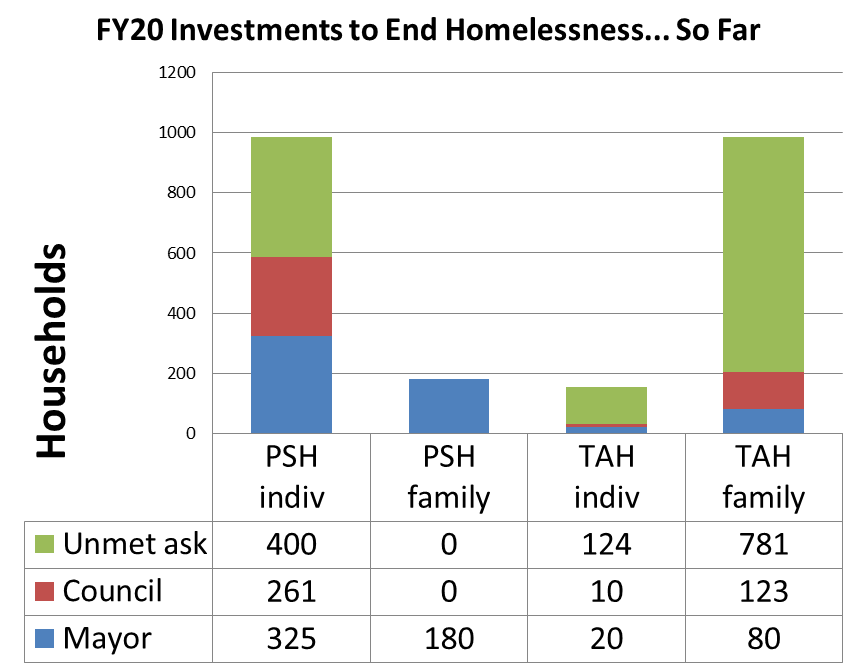
    First, we are very supportive of the programs that the amendment would fund, including $4.6 million to end the chronic homelessness of 185 individuals with Permanent Supportive Housing. However, even with this increased investment, large gaps still exist in permanent supportive housing, in Targeted Affordable Housing vouchers for families, in LRSP tenant vouchers that take families off the Housing Authority waitlist, and in eviction prevention funds. As you can see from the charts below, we are below what was funded in FY19 for homeless families, and at a historically low amount of funding for vouchers that take families from the 40,000 household waiting list. If the QHTC can be tightened even further, the money should be devoted to increasing affordable housing programs.


    Most DC residents would assume that programs that give away millions of tax dollars to corporations would be harder to get into than our family emergency shelters, but that is not the case. Where any qualified tech company is assured participation as an entitlement, the right to shelter is only guaranteed when the temperature falls below freezing. Where the QHTC program pays a “relocation tax credit” of up to $7500 for any employee who moves to the District, DC turns away families seeking emergency shelter if they cannot prove DC residency with an acceptable form of documentation. Where the QHTC program allows company to “self-certify” eligibility, the emergency shelter system requires each homeless family to provide significant documentation of eligibility. (These documents include leases from every host to prove that they are not on the lease, birth certificates, letters from friends and families, and even sometimes staff investigations of claims.) Where the QHTC program has no time limits and assistance goes on in perpetuity and regardless of need, almost all families are pressured to move into Rapid Re-Housing from shelter, where they will face a time limit on assistance irrespective of their ability to afford rent.

    What does this double standard say about DC values? It says that DC implicitly trusts the word of for-profit corporations seeking tax abatements more than it trusts the words of its own residents seeking lifesaving services. It says that fiscal responsibility is only a value when it comes to denying primarily Black and brown families shelter and housing, but not when it comes to corporate welfare. DC has continued to pay more than it needs to incentivize “economic growth,” even when data shows that it isn’t working. However, despite data that shows that families need much more help, D.C. continues to contribute far less than what it would take to adequately support DC residents in crisis. Overall, this dichotomy, if allowed to continue, makes it seem like elected officials value corporations over constituents.

    This Council must flip this script. Corporations should be able to access tax incentives only when they can prove it is absolutely necessary for them to operate in DC. At the same time, DC residents would only ever apply to emergency shelters if they had no other choice—and those residents would certainly benefit from a shelter system that was even a fraction as accessible as the one that corporations have gratuitously enjoyed for years. We ask you to support the restrictions on QHTC that Councilmember Nadeau has drafted, and that you go even further to ensure that our DC tax dollars be used responsibly and justly.

  • On May 14, the DC Council took its first vote on the Fiscal Year 2020 budget. We were pleased to see some increases in affordable housing investments, and are happy to share that the Council fully funded the public restroom bill and the homeless street outreach asks. We are particularly grateful for the substantial investments in public housing repairs and ending chronic homelessness. Unfortunately, there are still substantial gaps in funding for affordable housing, particularly for homeless families, including some historically low investments.

    Before we get into the details of what gaps remain before the final vote on May 28, we want to take a moment to talk about where some of the money came from for these investments. The Fair Budget Coalition spent a significant amount of time and effort this year exploring ways to fund our priorities that would represent more racially equitable and progressive funding. In particular, we targeted programs where there was waste or underspending as well as new initiatives that would disproportionately serve higher income DC residents. Quite a few Committees swept these programs at mark-up and diverted the funds to lower income residents or more racially equitable programming. At the Committee of the Whole, Chairman Mendelson, supported by several Council members including Charles Allen, Elissa Silverman and Robert White, took $60 million of the $206 million surplus of Events DC and devoted half of it to public housing repairs. (Now the Chief Financial Officer, who also happens to be on the board of Events DC, is saying he will not certify the budget if it pulls money out of the surplus in Events DC, but the Chairman has pledged to fight for this money.) Then, Brianne Nadeau led an effort to reform the Qualified High Technology Company incentive, which secured $1.4 million for homeless street outreach and $5.39 million for permanent supportive housing for individuals, among other important programs. The following Councilmembers joined Councilmember Nadeau on her amendment: David Grosso, Elissa Silverman, Robert White, Jack Evans, Mary Cheh, Charles Allen, Vincent Gray and Trayon White. The Councilmembers who voted no were: Chairman Mendelson, Kenyon McDuffie, Brandon Todd, and Anita Bonds.

    Repair and Preserve Public Housing

    We asked for between $10-30 million per year to do critical repairs. The Council devoted $30 million in one-time funds. This is great, but because it is one-time money, we still need a long-term plan for funding.

    End Homelessness

    The Council found enough additional housing for 271 individuals experiencing chronic homelessness and 123 homeless families. We are grateful for the additional funds but the gaps are still quite large. (For families, we are far below what DC funded in FY19.)

    End the Wait for Tenant Vouchers

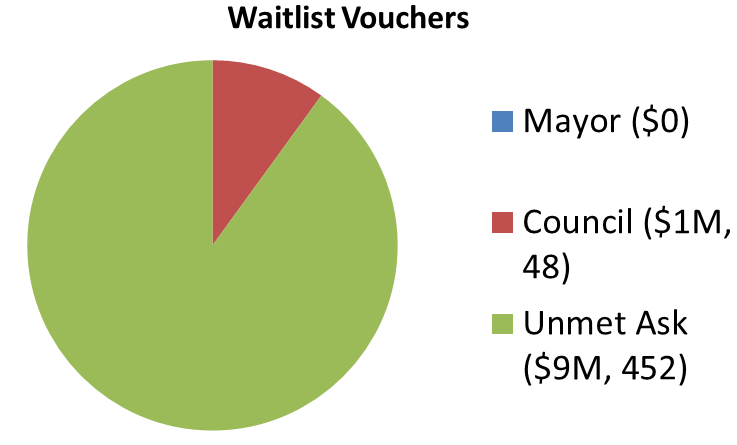
    The Council has only devoted $1 million into vouchers that pull people (primarily families) off the 40,000 household DC Housing Authority waiting list, leaving a gap of $9 million for 452 households. This is the smallest amount that has ever been added to this program, since it began in FY07.

    Prevent More Evictions

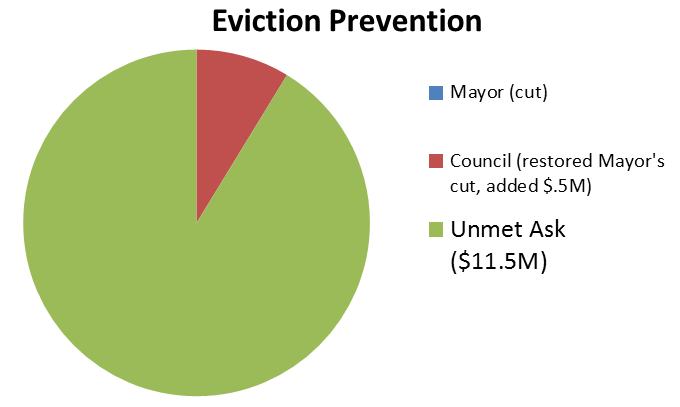
    The Council restored the money that the Mayor cut from eviction prevention funds and added an additional $491,000, but that still leaves $11.5 million unfunded.

    Build Deeply Affordable Housing

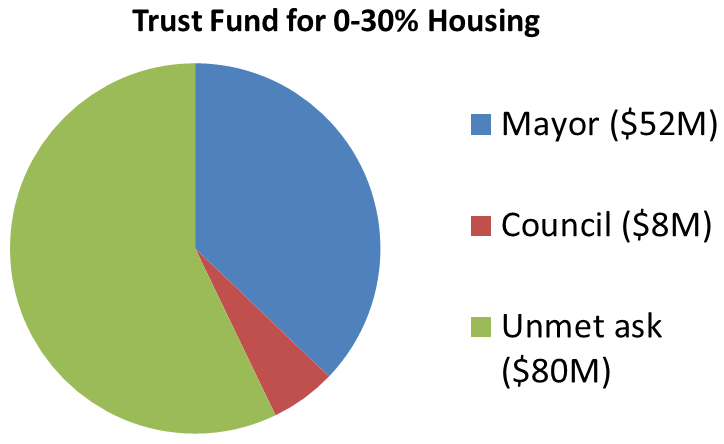
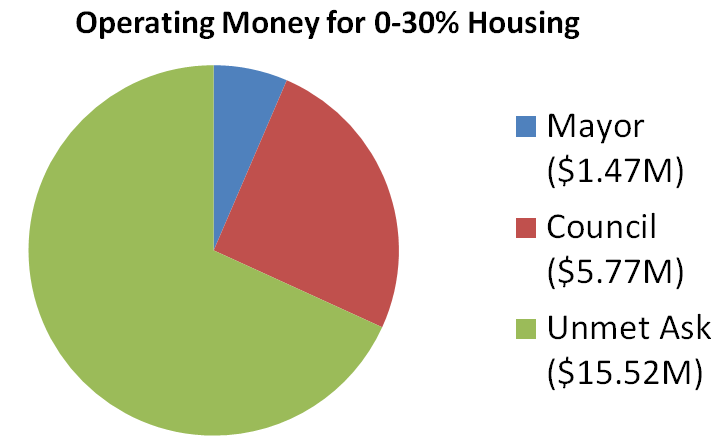
    The Mayor increased the amount of the Housing Production Trust Fund (from $100 million to $130 million). The Council then increased the portion of the funds that goes to the lowest income residents (from 40% to 50%) but reduced the amount of the Trust Fund to $120 million, leaving about $60 million in the Trust Fund devoted to the lowest income housing. $80 million of our ask is unfunded. The Council found an additional $5.77 million for an operating match, leaving $15.52 million unfunded.

    Next Steps

    Take a moment to thank your Councilmembers if they made an effort to fund affordable housing so far this budget, and ask them if they can find a way to do more to #FindTheMoney to #PutPeopleFirst before the second vote. In particular, you should thank Chairman Mendelson for the money for public housing (as well as the supporters above) and you can use this Twitter link to thank Brianne Nadeau and her colleagues for the high tech tax change amendment. (Feel free to “no thank you” those who voted against the amendment while you’re at it!)

    Stay tuned for more next steps!

I am a Search Dialog!