
• The following is cross-posted from The Fair Budget Coalition’s blog, and is written by Christine Campbell of Housing Works and the DC Community Coalition and Jen Caballero of  the Women’s Collective.

    When people living with HIV/AIDS are compelled to wait for stable, affordable housing, the impact on their health can be severe, and even fatal. At The Women’s Collective (TWC), a former client JB, a 57-year old woman living with HIV, completed an application for a housing voucher in 2007. In June of 2010, she was hospitalized for dehydration and pneumonia, and as a result was unable to pay that month’s rent. In the fall of 2010, JB was again hospitalized to remove fluid from her lungs, and by the time she was released from the hospital she had lost her home. Due to her financial struggles and unstable housing, JB was struggling with food insecurity, lack of transportation, and the progression of her HIV. After another hospitalization in October 2010, JB died on November 23, 2010. Over five years after she completed her housing voucher application, on March 1, 2012, TWC learned that JB had came to the top of waiting list for the housing voucher that she so desperately needed. Tragically for JB, this housing voucher was too late to provide what could have been a life-saving housing intervention.

    Although the Mayor’s Budget promises significant investments in affordable housing for the future, these long-term solutions do virtually nothing to address the immediate housing needs of homeless individuals, families, the elderly, and people living with HIV/AIDS. The current need for safe, decent, affordable housing in the district has reached epic proportions with over 67,000 households on the DC Housing Authority Waiting List and close to 1,000 on the HIV/AIDS Housing Waiting List. In addition, after April 12, 2013, both lists will be closed and the determination of continuing (or growing) housing needs among DC’s most vulnerable populations will be nearly impossible. The Housing First and tenant-based Local Rent Supplement rental assistance programs are key elements to addressing the urgent and immediate need for housing, and a FY 2014 budget that invested in these programs would represent a realistic approach to promoting the health and well-being of all District residents.

    DC is in the midst of a severe HIV/AIDS epidemic. Approximately 2.7% of our population is living with HIV, which exceeds UNAIDS’ definition of a “generalized” epidemic of a disease prevalence greater than 1% of the population.  As we strive to end the epidemic, we cannot ignore the critical role that stable housing plays in our efforts to prevent new infections and eradicate AIDS-related deaths. Prevention and care efforts that focus on changing individual behaviors cannot succeed if people do not have a safe and secure place to live. Housing reduces mortality rates by 80% and represents one of the strongest predictors of accessing HIV primary care, maintaining continuous care, and ultimately achieving an undetectable viral load. While many advances have been made in treating the disease and in preventing transmission, studies show that homelessness both decreases good health outcomes dramatically and increases transmission rates (due to increases in sex trade, exposure to sexual violence, and needle sharing practices).

    No DC resident with HIV/AIDS should experience homelessness. The federally funded program, Housing Opportunity for Persons with AIDS (HOPWA), was established to fill the gap between the need and the availability of generalized low income and disability based housing programs. HOPWA was never intended to be the sole source of support for homeless people living with HIV/AIDS and cannot be expected to do so in the future.   Today, people living with HIV/AIDS who are in need of permanent supportive housing are often provided the opportunity to put their names on a waitlist and nothing more. These individuals and families wait for days, months, and often years while continuing to struggle against the exacerbated health complications posed by unstable housing. As a means to correct the existing gap in housing services – and in order to do so for those who are in need today – people living with HIV/AIDS should be served by the DHS Housing First program, and a set-aside appropriation to tenant-based Local Rent Supplement Program.

    The UN Universal Declaration of Human Rights, Article 25, states: “Everyone has the right to a standard of living adequate for the health and well-being of himself and of his family, including food, clothing, housing and medical care and necessary social services, and the right to security in the event of unemployment, sickness, disability, widowhood, old age or other lack of livelihood in circumstances beyond his control.” If DC really wants to “Get to Zero”, to obtain the “AIDS Free Generation”, to really end AIDS in the District, we will dedicate the resources needed to really address the housing for this population.

    The Fair Budget Coalition is asking the DC Council to devote $1.25 million to the Housing First program and $2.5 million to tenant vouchers through the Local Rent Supplement Program. These investments will serve 250 homeless people with HIV/AIDS, and will completely end homelessness for all DC residents with HIV/AIDS.
     

  • As part of the FY 2014 Budget Support Act, DC Mayor Vincent C. Gray has proposed significant changes to the Homeless Services Reform Act (HSRA), the law governing homeless services in DC. Not only will the proposed changes do little to resolve the crisis that the Legal Clinic, the Washington Post, and other news outlets have written about in recent months, but if enacted, they may cause significant harm, particularly to families trying to access homeless services.

    We were extremely disappointed to learn that the Mayor and his Department of Human Services (DHS) have chosen to respond to the crisis of increasing family homelessness and the long list of legal violations of the right to shelter this past winter with a grab bag of punitive measures that will curtail the rights of DC residents and create more barriers for children and families trying to access life-saving shelter. None of these changes was vetted by the Interagency Council on Homelessness nor by any other community process, and the costs, both human and fiscal, of administering these changes are unacceptable.

    First, the amendments would allow the Department of Human Services (DHS) to place a family in shelter or housing “provisionally” for 14 days (or longer at DHS’ sole discretion) while the agency determines eligibility and priority, assesses the family, or identifies a referral other than shelter. Provisionally placed families would lose a host of rights that families in shelter currently have, such as the right to a 15 day notice of termination or transfer, the right to continue receiving shelter services pending an appeal of a termination, and all rights granted to residents of temporary shelters– including the right to receive case management services. Provisionally placed families could be terminated from shelter or housing, even in hypothermic conditions, with only 24 hours’ notice and without due process of law.

    Adding insult to injury, families placed “provisionally” would also be subject to new termination grounds not applicable to anyone else, including failure to “participate in” or “cooperate with” the assessment and referral process. The same intake workers at the Family Resource Center, who have been the subjects of dozens of complaints about unlawful and disrespectful treatment of families this winter, could now terminate a family based on the subjective conclusion that the family is being “uncooperative,” a term that is not defined anywhere in the HSRA.

    Second, the amendments may coerce families in shelter into accepting a short-term housing subsidy even if the program or the particular unit is not appropriate for their family. Under current law a provider can terminate a shelter resident for turning down two offers of “appropriate” housing. The proposed language would make an offer of two different units through the Rapid Rehousing program per se appropriate. In other words, a family could not turn down two units because they are unaffordable to them, they are not wheelchair accessible, they have egregious housing code violations, they are not the right size for their family, or for any other reason—without facing the possibility of being terminated from shelter as a penalty.

    The amendments also would eliminate several important rights that tenants of supportive housing programs currently enjoy. Providers could create arbitrary time limits and terminate participants once they reach these time limits, no matter what the reason.  The amended law would also permit DHS to terminate Housing First and other supportive housing tenants simply because they are hospitalized or otherwise institutionalized for 60 days or more. And, by redefining the term “provider’s premises” to include a supportive housing tenant’s private apartment (even in a scattered site program), the new law would allow DHS to terminate tenants from their housing without prior notice or the right to a hearing first when the tenant commits certain acts in his or her private apartment unit.

    Finally, the proposed amendments could revive mandatory escrow for emergency shelter residents, a program that was rejected by the workgroup that drafted the HSRA of 2005 because of its high administrative costs, negative impact on staff and resident relationships, and the inability of many shelter residents to contribute to escrow and still meet the basic needs of their children.

    We now look to the DC Council to take action to ensure that these harmful measures are not enacted into law. Stay tuned to this blog to learn more about the potential impact of each of the above amendments and the recommendations WLCH and the Fair Budget Coalition have for resolving the family homelessness crisis.

  • Last Thursday, Mayor Gray released his proposed FY14 Budget, titled “Investing for Tomorrow.” We were eager to see the details of the Mayor’s earlier commitment to invest $100 million in affordable housing and were glad to see programs like the Housing Production Trust Fund and the production side of the Local Rent Supplement Program get some much needed funding. We were also relieved that there were no major cuts in funding to already existing human services programs and happy to see investments in TANF that will help delay sanctions and replace reduced federal funding.

    While we applaud the Mayor in following through on his earlier commitment to invest $100 million in affordable housing, his proposed budget fails to “invest in today” despite the very real and very urgent housing crisis that many of our neighbors are experiencing right now. As you can imagine, building or renovating units to make affordable housing takes time. It might take two or more years before any of the housing funded by the Mayor’s proposal become available to DC residents. In the meantime, hundreds of children go without emergency shelter every year because DC shelters are full, and thousands of children are spending their formative years homeless, struggling much harder than their peers to learn and thrive merely because of an absence of affordable housing. Their parents are working as hard as they can to support them, but the cost of housing is out of reach to many parents who are employed full-time with good jobs, much less those still suffering through the job loss or reduced hours associated with the recession.

    It’s not only children who desperately need housing assistance today. Our chronically homeless neighbors with serious disabilities have no immediate housing assistance to look to, and haven’t for years; our seniors continue to live in crowded communal shelters or on the street where they’re more vulnerable to falling ill or being victimized and abused; and our homeless neighbors with HIV/AIDS face drastically lower health outcomes than those with housing. (In fact, studies show that mortality rates are reduced by 80% when homeless persons with AIDS are provided with housing.)

    The Mayor’s FY14 investments in affordable housing are a good start. But unless they are paired with investments in affordable housing programs that meet the needs of DC residents who are in extreme housing crisis today, such as the tenant vouchers through the Local Rent Supplement Program and the Department of Human Services’ Housing First program, thousands of DC residents will remain at risk while they wait for those units to be built. A more balanced approach would provide affordable housing to people today as well as tomorrow.

    In early March, the Fair Budget Coalition submitted a comprehensive and specific list of affordable housing recommendations to the Mayor. Now that the FY14 budget is in the hands of the DC Council, we hope that Councilmembers find resources to address the urgent needs of our homeless neighbors, particularly children, seniors, and those with serious health conditions. Our recommendations reflect more than an effort to put our collective finger in the dam of homelessness; instead they reflect our community’s desire to end homelessness completely for populations who are at greatest risk of harm from  having no stable place to call home.

  • The following post first appeared on The District’s Dime and is republished here with permission. It is written by M. Bruce Lustig, Senior Rabbi at the Washington Hebrew Congregation, and James E. Terrell, Pastor of the Second Baptist Church of Washington and President of the Council of Churches of Greater Washington.

    Whether it be a time of prosperity or economic crisis, the community  has a moral obligation to care for the least among us.  The obligation is always there and we must respond. As leaders of faith communities and members of Good Faith Communities Coalition we remind those throughout the city of our common responsibility to share the gifts of God with all God’s Children. The District is prospering, adding thousands of new residents each month and announcing large surpluses in revenue.  But many residents are struggling and the prosperity that has helped so many in DC has also left so many behind.

    DC lost half of its low-cost rental units over the last ten years.  With rents skyrocketing and incomes staying flat,  many families who must spend more than half of their income each month on housing are living just one step away from homelessness.  For these low-income families it means little left each month to cover basic necessities like food, clothing, transportation and savings.  It also means that they are more vulnerable to a sudden job loss or illness forcing them onto the streets.

    Mayor Gray has pledged to invest the District’s “prosperity dividend” to create and preserve 10,000 units of affordable housing by 2020.  To jumpstart this effort he has stated that he will commit $100 million from his upcoming budget to help meet the need.  We urge him to focus this current investment on those residents in greatest need—very low income individuals and families (those earning less than 30 percent of area median income, or $32,200 for a family of four) and the homeless.  We applaud this $100 million commitment, but even this substantial investment can only be a beginning.   We urge Mayor Gray to make this investment the first step in a long term commitment to address the full range of affordable housing challenges the city faces.

    For too many families homelessness is already an unfortunate reality.  With the dramatic increase DC has seen in homeless families over past several years, Mayor Gray’s budget must also include additional assistance for homeless residents.  We are deeply concerned as a community by the 600 children at the family shelter at DC General and the lack of a right to year round shelter for priority one families (families with no safe place to go), persons with disabilities and seniors.  For the most vulnerable among us, shelter must always be available, not just in hypothermia season.  And shelters must not be a permanent address, but rather a first step to affordable, sustainable housing.

    The recent report of the Comprehensive Housing Strategy Task Force, Bridges to Opportunity, set ambitious goals for DC — 8,000 units of affordable housing preserved and 10,000 net new units of affordable housing by 2020. Achieving this goal will take a long term commitment of resources and will from the District government and the community as a whole to see it through.  We must have this resolve not only in times of prosperity, but also when the economy is lean.  It is our moral obligation to respond.

  • Lost amidst the other recent stories of families struggling for lawful access to D.C.’s homeless shelters, the $417 million D.C. budget surplus, and the federal budget sequester, was the important announcement by the D.C. Housing Authority that they will be closing its Waiting List on April 12, 2013.

    Practically speaking, this announcement means that the Housing Authority will no longer be accepting new applications for people seeking Public Housing, a Housing Choice Voucher (commonly known as Section 8), or placement in the Moderate Rehab Program. Any person or family who has already applied in the past – or who applies before the April 12, 2013 deadline – will remain on the Waiting List and will be considered for placement when their application gets to the top of the list.

    Unfortunately, however, the Waiting List currently includes almost 70,000 families and individuals seeking housing assistance. A new family who joins the list in 2013 is unlikely to reach the top of the Waiting List for any of the programs for many years, as names are pulled off the list based on the initial date of application as well as particular statuses or preference categories. The Housing Authority’s Waiting List has long out-matched the available housing resources that they can provide with a mix of federal funding and some modest local funding in the form of Local Rent Supplement Vouchers.

    Regardless of whether one thinks it’s futile to sign up for a Waiting List that could take almost a decade or whether one thinks it’s valuable to at least keep the List open as an option for families and to help D.C. keep track of its unmet housing needs – this announcement is still very important for:

    • anyone who is not currently on the D.C. Housing Authority Waiting List, but who would like to be added to the list before the April 12 deadline
    • anyone who believes they are on the List, but isn’t sure if they are actually on it or if the Housing Authority has their most current contact and family information
    • anyone who believes they are on the List, but isn’t sure if they selected all of the programs they are actually interested in (aka – are you only interested in Public Housing, a Voucher, or do you want to be considered for both?) and wants to make sure their information is up-to-date
    • anyone who works with clients or families who may not have access to the internet or other major media outlets but who might be interested in applying for housing assistance from DCHA before the April 12 deadline

    Anyone can check the status of their application at www.dchousing.org or by calling the D.C. Housing Authority Call Center at 202-535-1000. You can also get additional information about the Waiting List closing here, which also includes the addresses of additional sites around town where individuals and families can go to get assistance in submitting their applications prior to the April 12, 2013 deadline.

    Please help us spread the word about this important announcement and ensure that all individuals or families who want to be on the Waiting List are able to get on it before the closure.

  • Yesterday, we shared The Fair Budget Coalition’s (FBC) recommendations for $100 million investment in affordable housing. Today, we invite you to join us and FBC in taking action to ensure that the city’s budget puts DC residents first.  Here’s why:

    The Mayor is right now finalizing his budget, and he’s said that his ears are open to suggestions for how to spend the city’s money.

    With just one click, you can let the Mayor know that the city’s budget should put people first.  The Administration needs to hear from all of us working and living in the District that we refuse to be drawn into a competition over inadequate funding. Vital services like homeless shelters, childcare subsidies, mental health services, and TANF all complement each other, weaving together the social safety net that helps move residents out of poverty. But these services, among others, have faced eviscerating cuts over the last 5 years. This year, DC Action for Children counted 1800 homeless children; the waiting list for public or subsidized housing holds over 67,000 households; the average unemployment rate in DC is 9.6% with the highest unemployment in Ward 8 with 21.6% (DOES).

    No one should have to face these issues. DC was declared a Human Rights City in 2008, and our budget must be held to these standards. Restoring funding to critical social programs restores the dignity and respect for every person.

    So please TAKE ACTION and tell the Mayor that we will not accept a budget that is balanced on the backs of our great city’s most vulnerable residents.

    To read Fair Budget’s report with this year’s budget recommendations, click hereTo volunteer for the campaign (we could use you!), please email: janelle@fairbudget.org or call 202-328-5513.

  • A Guest Blog by the Fair Budget Coalition

    This morning, Mayor Gray’s Comprehensive Housing Strategy Task Force (CHSTF) released its long-waited recommendations for addressing the District of Columbia’s affordable housing crisis. The Fair Budget Coalition (FBC) is reviewing the CHSTF report to assess how well the recommendations address the needs of the District’s lowest income residents.  In the meantime, as the Mayor closes in on decision-time for his FY 2013 Supplemental and FY 2014 Budget proposals, FBC has submitted to the Gray Administration the following specific recommendations for how Mayor Gray can best fulfill his pledge of $100 million investment in affordable housing.

    Invest $26.5 million to ensure that housing is provided right now to the most vulnerable populations, ending homelessness completely for certain particularly vulnerable populations.

    1. End homelessness for children with no safe place to sleep. With an annual investment of $5 million, Mayor Gray could end homelessness for every family in DC General and in hotels: around 300 families.

    Family homelessness increased almost 75% between 2008 and 2012, and DC  has stopped being able to serve “Priority One” families year-round in emergency shelters as a result of the high demand for services. This investment in housing would move enough additional families out of shelter over the next two years to ensure sufficient space in the shelter system to serve families with no safe place to sleep year-round, and to vastly decrease the amount of time any family has to live in DC General. (As you know, when DC invested $4 million in Local Rent Supplement Program in FY13, it drastically reduced the overcrowding in the family shelters and allowed DC to decrease dependence on costly hotel placements during the winter.) Those families who need permanent supportive housing should be served by the DHS Housing First program. The rest should be served by the Local Rent Supplement Program. 

    Program breakdown:

    Housing First: $1.5 million (60 households served with housing and supportive services)

    Tenant-based Local Rent Supplement Program: $3.5 million (240 households served with vouchers)

    2. End homelessness for all seniors. With a total annual investment of $10 million, Mayor Gray could end homelessness for every senior in DC.

    Seniors are at increased risk of becoming victims of crime on the street or in shelters and often have health conditions that worsen in these environments, unnecessarily shortening their lives. No elderly DC resident should be homeless. In 2012, 573 homeless single adults as well as adults in 3 families in shelters, were over age 62. Those who are elderly and need permanent supportive housing should be served by the DHS Housing First program. The rest should be served by a set-aside appropriation to the Local Rent Supplement Program.

    Program breakdown:

    Housing First: $5.7 million (224 households served with housing and supportive services)

    Tenant-based Local Rent Supplement Program: $4.3 million (352 households served with vouchers)

    3. End homelessness for every DC resident with HIV/AIDS. With a total annual  investment of $3.75 million, Mayor Gray could end homelessness for every person with HIV/AIDS in DC.

    DC is in the midst of a severe HIV/AIDS epidemic and housing reduces mortality rates by 80%. While many advances have been made in treating the disease and in preventing transmission, studies show that homelessness both decreases good health outcomes dramatically and increases transmission rates (due to increase in sex trade, sexual violence and needle sharing practices on the street). No DC resident with HIV/AIDS should experience homelessness. In 2012, 131 single adults and 24 adults in families were identified as homeless and living with HIV/AIDS.  (Due to under- reporting, these numbers are likely unrepresentative of the actual need.) Those who have HIV/AIDS and need permanent supportive housing should be served by the DHS Housing First program. The rest should be served by a set-aside appropriation to the Local Rent Supplement Program.

    Program breakdown:

    Housing First: $1.25 million (50 households served with housing and supportive services)

    Tenant-based Local Rent Supplement Program: $2.5 million (200 households served with vouchers)

    4. Invest $5 million in the Department of Human Services’ (DHS) Housing First Program to serve 200 additional chronically homeless individuals who are highly vulnerable but are not elderly or families and do not have HIV/AIDS.

    During Mayor Fenty’s administration, over 1000 households were served by this program, which is a national model and saves DC large amounts of money. DHS has identified 1,269 individuals and 56 families that are extremely vulnerable and in need of permanent supportive housing at this moment.

    Program breakdown:

    Housing First: $5 million (200 households served with housing and supportive services)

    5. Invest $2.75 million in Independent Living Programs for 20 additional youth who are 16–20 years and 40 youth who are 18–24 years old.

    There are over 200 youth on active waitlists, and an additional 80 youth were turned away from emergency shelters in the last month. Funds would also be used to develop a youth friendly coordinated intake system.

    Summary:

    Housing First: $13.5 million

    Tenant-based Local Rent Supplement Program: $10.3 million

    Independent Living Programs: $2.75 million

    With remainder of $100 million, nearly three-quarters of the total, we recommend supporting the production of affordable housing through the Housing Production Trust Fund and the Project/Sponsor-based Local Rent Supplement Program, such as is recommended by the Coalition for Nonprofit Economic Development (CNHED). We recommend that the majority of production support be targeted to projects that serve people at 0-30% of Area Median Income (AMI).

    For more information about Fair Budget Coalition, visit www.fairbudget.org.


  • Last Thursday evening, Councilmember Jim Graham convened a public roundtable at the DC General family shelter to hear from families about their experiences both in the shelter and in getting access to shelter. Councilmembers Anita Bonds, Kenyan McDuffie, and Tommy Wells were also in attendance.

    The number one message heard loud and clear by all in attendance was that DC needs more affordable housing. Families recounted losing their homes and being unable to find new housing they could afford. The majority of the parents who testified at the hearing were employed, but simply could not afford the rising cost of housing in the District. These parents shared harrowing stories of spending nights outside, sleeping in their cars, and spending months not knowing where they and their children would lay their heads down at night before they were placed in shelter.

    The first parent to testify was Marcaus Scales, a single father who spent months sleeping from place to place and in his car before he finally got into shelter in November. Mr. Scales described being repeatedly turned away from the central intake site for families, with workers telling him that there were no resources for his family until the weather dropped below freezing. For months, his daughter stayed at her grandmother’s while he slept on the street and struggled each day to find assistance so he would not have to spend another day separated from her. Mr. Scales asked Councilmembers to help families like his afford housing in the District and described his recent experience with the shelter system as “humbling, but also frightening because I don’t see a way out.”

    Other parents testified to similar difficulties in accessing the shelter system. Jessica Thomas and her partner spent two months sleeping in their car before they were admitted into shelter, their children sleeping inside a friend’s house nearby. Arleju Stephens testified that she and her children were living in a condemned house with a caved-in roof, and she was still denied shelter by intake workers who determined that the family had a safe place to stay despite those circumstances. She shared how her housing situation put her at risk of having her kids taken away. Her family was finally placed and has now been at DC General for 13 months because Ms. Stephens hasn’t been able to find housing that she can afford.

    Families also testified about conditions at the shelter. In addition to complaints about the heat, plumbing, pests, power outages, and poor food quality, parents decried that their kids had nowhere to do homework, to play, and to simply be kids in a shelter where family members have no privacy and rules don’t allow socializing.

    The recurring theme was that while the shelter is certainly better than being on the street, it is not an appropriate place for children to grow up. We absolutely agree.

    Now is the time to take action.  Join The Fair Budget Coalition on Tuesday, March 5th at 3:30pm in Room 412 of the Wilson Building (1350 Pennsylvania Avenue) for a press conference and forum to address “The State of the District’s Poverty: What’s the Story Behind 600 Kids at DC General?”

    This event is co-sponsored by Councilmembers Marion Barry, Anita Bonds, Jim Graham, Kenyan McDuffie, and Tommy Wells and will feature an in-depth discussion on the struggles facing thousands of DC residents living in poverty and the smart investments DC can make to end this cycle of poverty.

    Here are some other ways you can get involved. Together, we WILL end homelessness and poverty in the District.

  • In recent weeks, local media has shone a light on the significant challenges that homeless families face here in the nation’s capital. There are nearly 600 children in the DC General Family Shelter alone. While certainly far better than sleeping in cars, hospital emergency rooms or 24 hour laundromats, DC General is far from ideal. Some, but not all, local officials acknowledge the extent of the problems that the families face. We must come together as a community to work for real solutions to the crisis of homelessness. We need to speak out to let decision-makers know that we want to be part of a just and inclusive community.

    Here are four ways that you can help:

    Give of your TIME: Help us to spread the word. Host a discussion group with your
    neighbors, book club, colleagues at the office, or family and friends. We’d be happy to
    provide information or support you in whatever way we can be helpful. You can reach us
    at (202) 328-5500.

    Give of your TALENT: If you are a lawyer or legal assistant, you can volunteer with the
    Legal Clinic and help us to bring justice to our homeless neighbors. Contact Volunteer
    Coordinator Emily Uhar at emily.uhar@legalclinic.org.

    Give of your TREASURE: We rely upon the generosity of community members to allow
    us to remain present to our clients when they need us most. We take no government
    funding, which makes the support of our friends and allies all the more critical. You can
    make a donation here.

    Give of your TENACITY: Take a few moments to call, write or email our Mayor and DC
    Councilmembers to tell them that you believe in a community of justice. The District has
    had two years of significant surplus revenue and expects the same once again this year.
    Urge them to invest these dollars in affordable housing and emergency services for the
    families and individuals who need it most.

    To stay in the loop on the District’s budget and policy decisions, subscribe to this blog, friend us on Facebook, and follow us on Twitter. You will learn about opportunities to weigh in on decisions impacting shelter, affordable housing, and other crucial programs.

    Thank you for your support.

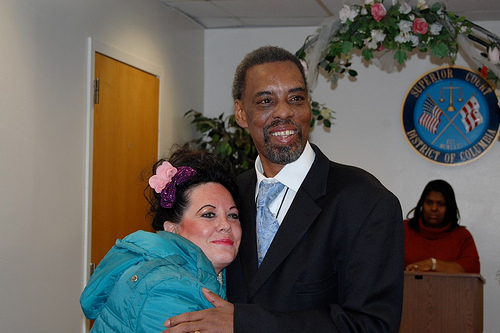
  • In January, I had the extraordinary honor of attending the wedding of former clients, Freddie Johnson and Lorraine Wollard, in the chapel at DC Superior Court. When I first met Freddie and Lorraine about five years ago they were living on 14th street… literally. They were bedding down each night in front of what’s now an upscale furniture store. The couple had their shopping cart and their blankets and were doing their very best to stay warm. Life on the street was full of perils, but it was the only way they could stay together. No DC shelters take childless couples. I bought them a “foot long” from Yums on 14th and that was the beginning of a long friendship.

    It was also the beginning of Freddie and Lorraine’s move from living outside to living inside. Former Mayor Adrian Fenty and the DC Department of Human Services had just begun a program for chronically homeless individuals called “Housing First.” This housing model, which began in New York City, recognizes that stable housing is the primary need for everyone experiencing homelessness, and that other issues that affect a household can be more successfully addressed once housing is secured. Housing First means that everyone – whether living outside or in shelter, whether clean or actively using, whether healthy or unstable – is ready for housing. This housing is then accompanied by wrap-around case management services to assist participants in overcoming their barriers to self-sufficiency.

    When I asked Freddie and Lorraine if they were interested in applying, they said yes.

    Since its inception, DC’s Housing First Program, called the “Permanent Supportive Housing Program,” has successfully ended homelessness for approximately 863 chronically homeless individuals and 250 chronically homeless families in DC and has an overall housing retention rate of 92%. Although Housing First has been nationally recognized as a model program with long-term savings, DC’s program has unfortunately shrunk in the past few years and is meeting only a fraction of the need.

    For Freddie and Lorraine, Housing First has meant stability, health, and now marriage. Living inside a stable home, they could begin to address the issues that led them to living outside. On the streets, Freddie and Lorraine struggled with severe physical and mental health challenges as well as substance abuse disorders. Freddie had a seizure disorder that was triggered by alcohol consumption and that would land him in the ER on a monthly basis. Life on the streets made it hard for Lorraine to stay on her medications and receive regular health care, and when her mental health conditions worsened she would have altercations with the police and end up in jail quite regularly.

    It’s now been 4 years since Freddie and Lorraine have been off the street, and things couldn’t look brighter. They take their medications regularly, receive regular health care, don’t abuse alcohol or drugs, and get monthly visits from a case manager. Freddie hasn’t been hospitalized for a seizure in over a year, and Lorraine likewise hasn’t had an altercation with the police in more than a year. They’ve even reconnected with long lost family members and found a religious community.

    It was this stability that led Lorraine to begin thinking about fulfilling a dream she’d had since she was a little girl — getting married. Lorraine echoed Abraham Maslow’s “Hierarchy of Needs” when she said to me back at her apartment after the wedding: “Not too long ago I was sick, living on the street, and abusing drugs. Now I’m a married woman!”

    -Written by Marta Beresin

I am a Search Dialog!