
• You may have read the Washington Post article by Petula Dvorak this past weekend, “600 homeless children in D.C., and no one seems to care.” In the article, Ms. Dvorak highlights an alarming discrepancy between the glowing financial health of the District and the fact that there are hundreds of children sleeping at the DC General Shelter. Unfortunately, these children are not alone. According to the most recent data from DC Action for Children’s Kids Count, there are actually over 1800 kids who are homeless in the District.

    The good (and hopeful) news is that the problem of child homelessness is completely solvable! As Ms. Dvorak and Mayor Gray have both pointed out recently, the District is economically stronger than ever. With a $417 million surplus for 2012 and an expected surplus of $240 million for this year, allowing children to grow up in a shelter is a decision born of priority and not of necessity.

    The solution is simple. Prioritize an investment in long-term affordable housing programs that would serve the lowest income DC residents. Programs like the Permanent Supportive Housing Program and the Local Rent Supplement Program have been proven to work but have sadly gone underfunded in the past few years. A meaningful investment in these programs will get families out of the shelters, keep children off the streets, and lead to better results in education, in health, and in job growth for all DC residents. As we’ve mentioned before on our blog, last Spring the DC Council invested a modest $4 million into the Local Rent Supplement Program to house over 250 families experiencing homelessness. That’s hundreds of children who will have a stable home in which to thrive thanks to a relatively small amount of money. Many of these families are still waiting to be housed, but for them, there is light at the end of the tunnel.

    Last week, Mayor Gray announced a commitment to invest $100 million in affordable housing, but did not give any details about how that money would be invested and if it would be used to serve homeless families and individuals in the District.  As DC residents, let’s make sure that it is.

    Here’s what you can do: Become a member of the Fair Budget Coalition (FBC), and join over 70 organizations, concerned residents, and people impacted by poverty that continue to engage in advocacy and organizing around social and economic justice in the District of Columbia. Follow both the Legal Clinic and FBC on Twitter. In the coming weeks, stay tuned to learn about ways in which you can help influence decision-makers and ensure that the message from the District is loud and clear: There are 1800 homeless children in D.C., and we care.
  • Tuesday evening, in his State of the District Address, Mayor Gray announced that he plans to invest $100 million to build and preserve 10,000 units of affordable housing!

    We were heartened to hear the Mayor recognize that housing is the key to an economically stronger and inclusive DC. An investment of $100 million could go a long way in ending homelessness for thousands of DC residents, allowing them the stability they need to regain self-sufficiency.

    We do, though, have questions about this funding. For one, the Mayor’s pledge was for one-time funding, which, as the DC Fiscal Policy Institute points out on its blog, “…would make it unlikely that this new housing investment could serve DC’s most vulnerable.” As DCFPI explains, affordable housing programs that help DC residents with the lowest-incomes – programs like the Local Rent Supplement Program or the Permanent Supportive Housing Program – need annual funding to ensure that program participants can continue to afford the increasing rents.

    Similarly, an investment in the Housing Production Trust Fund, a key tool for preserving and developing affordable housing in the District, would go a long way in reducing homelessness and tackling poverty, but as Bob Pohlman, the Executive Director of the Coalition for Nonprofit Housing and Economic Development (CNHED)  notes, the fund would need a larger commitment to make 10,000 units a reality, particularly if the units are intended for residents with low incomes.

    This year we are already seeing the significant impact that a small investment in affordable housing has on the lives of DC residents and on the finances of the District. With a small investment of $4 million in the Local Rent Supplement Program, more than 250 homeless families will move into their own apartments. This winter, thanks to that housing, hundreds fewer families compared to last year have been placed in expensive motels due to overcrowding in the shelter system. Housing is the most fiscally and morally responsible solution to homelessness, but with many more DC families still suffering, we need to keep up annual investments in long-term affordable housing.

    Earlier this week, we released our mid-winter report on the family shelter system and the large number of DC families who need safe and stable housing but who are having a hard time accessing even emergency services. Yesterday, we learned about a mother and her children who have been at the DC General Shelter for over a year because the family simply can’t afford to move out. Far too many District residents have been stranded in the shelter system because there is no way out without housing assistance. No child should have to grow up in a shelter.

    During his speech Tuesday night, the Mayor stated that: “A truly prosperous and successful city does not forget its most vulnerable residents, like people who are homeless and those with disabilities.” We could not agree more. We encourage the Mayor to focus the majority of his $100 million commitment on serving those most in need, and to commit to an annual investment in affordable housing for the District’s lowest income residents.

  • For nearly thirty years, District of Columbia law has embraced the ideal that all residents should have a warm and safe place to sleep when the temperature is freezing. For those who are homeless, that ideal is expressed in the legal right to emergency shelter. However, the D.C. government’s current practices do not comport with the law. The shelter system’s front door has been blocked by unlawful procedures that have created almost insurmountable obstacles for far too many families trying to access emergency shelter this winter.

    Families like that of Ms. G*, a pregnant mother with two young sons (ages 5 and 2) who were forced to sleep in their car on a freezing weekend in December after a week of seeking assistance from the Virginia Williams Family Resource Center (FRC), the centralized shelter intake site for families. Each day that week, Ms. G sat in the waiting room of the intake center from opening until closing. She repeatedly told intake staff that her family had no safe place to go, but her appeals fell on deaf ears. Desperate for a warm place to stay in freezing weather, Ms. G. and her kids tried to sleep at a train station. There, they met a woman who took pity on them and invited them to sleep in her home for one night. Ms.G risked her family’s safety by sleeping at a stranger’s home, about whom she knew nothing, because she had no other choice. Luckily, the stranger was kind and no harm came to the family that night. But they continued to be denied shelter by FRC staff until another parent seeking services at the shelter intake site shared the Legal Clinic’s contact information with Ms. G. The family was finally placed in shelter, but only with the assistance of a lawyer.

    It should not take the intervention of a lawyer to assure that:

    • hypothermia alerts are called accurately and in a timely manner;
    • the District government acts consistently with its stated policy of sheltering D.C. families with no safe place to go whether or not an alert has been called;
    • eligible families are admitted to shelter in accordance with the law;
    • parents don’t lose jobs and children don’t miss school because of threats of wrongful termination or unreasonable demands by shelter intake staff; and
    • families that are placed in shelter have access to heat and hot water, pest-free living spaces and cribs for their babies.

    It should not, but unfortunately this winter, it has.

    That’s why today, we have released our Report on the Violations of the Legal and Human Right to Shelter in the First Half of Winter Season 2012-2013.

    Too many vulnerable families have already been turned out into the cold. It is our sincere hope that D.C. takes swift action to prevent further violations before a tragedy occurs on its watch.

    * Name changed in order to protect the privacy of the client

  • At a press conference this morning, Mayor Gray announced that DC has a $417 million budget surplus for 2012, all of which he plans to put into DC’s saving account. And yet, thousands of DC residents are struggling with homelessness and poverty; thousands of children, youth, domestic violence survivors and others are turned away from emergency shelters each year; unemployment is high; affordable housing is shrinking at an alarming rate; and critical social services continue to be cut.

    The current law says that the surplus has to go into the cash reserve, but the Mayor and Council are perfectly capable of changing this law to avoid injustice. According to the DC Fiscal Policy Institute (DCFPI), DC had one of the largest fund balances in the nation even before this surplus was announced.

    Last summer and fall, we shared with you the heart-wrenching stories of families with no safe place to sleep at night. These were parents who had exhausted all possible sources of hospitality from family, friends, and even strangers. Parents who, when they at last resorted to turning to the DC government for shelter, were told “No, we will not help you. We do not have enough money to provide shelter for all those who need it.”

    Today, Mayor Gray’s announcement of the $417 million surplus sent the clear message to these families that there was, in fact, plenty of money to help them when they were in crisis, but DC chose not to do so. And the Mayor’s decision to put all that money in the bank sends another clear message to DC residents: the pressing needs of DC residents are not a priority.

    You might remember Ms. S, who had a high risk pregnancy, orders to stay on bed rest, and a one year old with various disabilities. While Ms. S and her EMT husband were desperately searching for jobs and a place to stay last July, they were told they could not be placed in any of the empty beds at DC General Shelter, in spite of the family being determined “Priority 1.” Meanwhile the DC government was amassing hundreds of millions of dollars in unspent funds.

    Or perhaps you recall the DC resident who lost her security guard job a year ago when her company lost a contract, who was only able to find part-time work, which of course didn’t pay enough to afford rent. While this mother and her three young boys were spending night after night in hospital emergency rooms because no one would place them in empty beds at DC General Shelter, DC was collecting tens of millions of dollars more in tax revenues than had been budgeted.

    Then there was Ms. Jones, who stayed at the bus station with her five children, even though there were 80 empty rooms at the DC General Shelter that the city said it could not afford to operate. While Ms. Jones was waking her children every day at 5:30am to head to the nearby McDonald’s to wash up before heading out to school, DC was just a month away from ending the fiscal year with 417 million in surplus dollars.

    This is a defining moment for the District of Columbia. DC should be a just community that is committed to the inclusion and well-being of all District residents, not one that fills its coffers with unprecedented riches while leaving its residents in harm’s way.

    With just a fraction of this newly discovered bounty, DC could support its residents who are in crisis today by focusing on cost-effective strategies to prevent homelessness (the Emergency Rental Assistance Program), support families (the Temporary Assistance to Needy Families program), create affordable housing (the Housing Production Trust Fund), and provide emergency shelter to every man, woman and child experiencing a housing crisis.

    To do otherwise would be morally and fiscally irresponsible. Join us in urging the Mayor and Council to do the right thing.


  • A Creed of Justice

    When President Obama spoke on Monday of our nation’s founding creed, that all are created equal, his words resonated deeply with us.

    • He spoke of our resolve “that a great nation must care for the vulnerable, and protect its people from life’s worst hazards and misfortune.”
    • He described our understanding “that our country cannot succeed when a shrinking few do very well and a growing many barely make it.”
    • He reminded us that we will have been “true to our creed when a little girl born into the bleakest poverty knows that she has the same chance to succeed as anybody else, because she is an American; she is free, and she is equal, not just in the eyes of God but also in our own.”
    • And perhaps most importantly, he called on each of us to “be a source of hope to the poor, the sick, the marginalized, the victims of prejudice –- not out of mere charity, but because peace in our time requires the constant advance of those principles that our common creed describes: tolerance and opportunity, human dignity and justice.”

    His words resonated not only because we too believe that these are core principles of our country, but also because he described the sort of just and inclusive community that we at the Legal Clinic and our partners in the Fair Budget Coalition have been striving to build in the District of Columbia since our inception.  His words were a fitting tribute to Martin Luther King, Jr., one of the greatest champions of justice, on the day that we celebrate his birth.

    President Obama reminded us that the truths of our great democracy “may be self-evident, but they’ve never been self-executing.” If we embrace these truths, as we do, it is our obligation to work for their realization. We cannot, and we do not, stand by as our friends and neighbors choose between rent and food for their children, between living on the street and fleeing an abuser. And we cannot, and we will not, stand by as the District of Columbia fills its coffers with hundreds of millions of taxpayer dollars as our friends and neighbors suffer with ills that could be assuaged by investments in basic services today. That would not be justice.

    We urge you to join us in pressing our elected leaders to seek and act for justice in DC by devoting some of the District’s surplus resources to urgent human needs, by taking action here. We also urge you to become a member of the Fair Budget Coalition to continue to help us build a more just and inclusive community.

    As Dr. King once said, “the arc of the moral universe is long, but it bends towards justice.” Acting together, we shall bend it further in that direction.

  • Happy New Year, Dear Readers!

    This year, we resolve to work harder than ever before to make justice a reality for our neighbors who struggle with homelessness and poverty. It’s unacceptable that so many DC residents are still living without access to safe, affordable housing in 2013, and we look forward to working with all of our partners, both within the DC government and outside of it, to change this.

    Over the next twelve months (and beyond), we’d like to see the Mayor and DC Council demonstrate a real commitment to preventing and eliminating homelessness in the District while improving the quality of life and services for those who are homeless and at risk of homelessness.

    Here are some new year’s resolutions we’d like our Elected Officials to commit to in 2013:

    • Ensure that every child with no safe place to sleep has access to emergency shelter every night of the year, not just when it’s freezing outside.
    • Make sure that ALL residents have their basic needs for food, shelter, healthcare, and clothing met.
    • Ensure that people with disabilities have access to emergency shelter as quickly and easily as those without, while simultaneously improving access to shelter for everyone.
    • Adequately fund the Interim Disability Assistance Program (IDA) and end the IDA waitlist.
    • Monitor the TANF re-design to ensure that parents who are identified as needing additional resources before moving toward work are provided quality services. All families must be given access to the supports they need (job training, education, child care, transportation) to regain self-sufficiency.
    • Through the Mayor’s Comprehensive Housing Strategy Task Force, make meaningful recommendations that address the lack of affordable rental housing in DC and prioritize the creation and preservation of housing that helps DC residents making at or below 30% of the Area Median Income (AMI). Implement these recommendations.
    • No longer allow District-owned lands to be simply sold to the highest bidder. Resolve to leverage the value of these government-owned lands to satisfy the District’s need for more affordable housing by requiring developers to produce deeply affordable units anytime DC disposes of property it owns or controls.
    • Ensure that all DC residents have access to healthy, safe, affordable housing. This year, let’s end homelessness for every DC resident who is elderly and every DC resident living with HIV/AIDS!
    • Assure that all DC residents have access to justice and an opportunity to participate in the policy and budget decisions that impact their lives.

    We may come up with more, but we think this is a good preliminary list of very achievable goals for this year. Please continue to check our blog for updates on the issues facing our most vulnerable residents, and for ways you can get involved to make these goals a reality.

  • Honoring Lives Lost…

    Today, December 21st, is the Winter Solstice, when darkness lasts longer than any other day. Since 1990, December 21st has been marked as National Homeless Persons’ Memorial Day, a day to mourn the loss and celebrate the lives of our brothers and sisters who have died while homeless.

    It has been far too dark, for far too many people, for far too long. At the DC Memorial Vigil this afternoon, 43 names were read of men and women who died in and around DC this year.

    We must work together towards a day when there are no names to read. We must work together to be the light that brings an end to the darkness of homelessness.

    In Memoriam

    William Bailey
    Kenneth Ballard
    Tommy Bennett
    Alvin Best
    Peter Bis
    Bob Bourban
    Albert Boyd
    Frederick Brockington
    Zachary Brown (who died just short of his 30th birthday)
    Clark Carvaly
    Robert Chambers
    Misty Clanton
    James Ralph Davidson
    Augustus DeGrazia
    James Diggs
    John Doe
    Renee Farmer
    Alfonza Flythe
    Maelloyd Garner
    Dehab Gebrichristos
    Harvey Gillian
    James Glover
    Michael Harmon
    Mark Harrison
    Joann Hollis
    Betty Jones
    Saccora Jones
    Cornell Lawrence
    Joe Lewis
    Mia Means
    Charles Mills
    Tyrone Murray
    Billy Ragan
    Melvin Riley
    Terrence Bowie Robinson
    Jesse Smith, Jr.
    Janice Stafford
    Richard Starnes
    Joy Stribling
    Leroy Studevant
    Catherine T.
    Lorenzo Tinsley
    Marcellus Wilkerson
  • We were shocked and saddened to hear of the passing of Patricia Handy, homeless coordinator in the Family Services Administration of the DC Department of Human Services, and a partner in the fight to end homelessness in the District.

    Ms. Handy dedicated her career to help better the lives of DC residents experiencing homelessness. She worked at all hours of the day and was often the first person to respond to those who were facing a housing crisis. On many nights when our clients were in grave situations and needed shelter or housing placement, it was Ms. Handy that answered the phone and made the calls necessary to get them help. Her work with individuals who were homeless was instrumental in getting them off the streets and into safe shelter or housing. In one particular example, Ms. Handy’s outreach to a number of DC residents who were sleeping under a bridge was the first step in getting them housed through the city’s Permanent Supportive Housing Program. She was a consistent and valuable presence at community meetings held by the Interagency Council on Homelessness and was often the first source of information on the issues facing homeless individuals in the District.

    She was tireless in her efforts to help DC’s most vulnerable residents, and her passing is a significant loss to our community. Our hearts go out to her family and loved ones, as well as to her colleagues at the Department of Human Services.

    Services for Ms. Handy will be held this afternoon at 1:30pm at the Fort Lincoln Funeral Home, 3401 Bladensburg Rd. Brentwood, MD.

    Please feel free to add your own thoughts and memories of Patricia in the comments section.

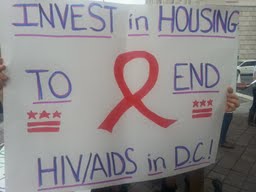
  • Amber Harding delivered a version of the following speech at yesterday’s World AIDS Day Rally in front of the Wilson Building.aidsrally2

    My focus since I started at the Legal Clinic in 2003 has been on ensuring that people with disabilities have equal access to emergency shelters and affordable housing programs. Over the years I have worked with a lot of clients who were HIV positive or who had AIDS. What many people may not realize is how housing can mean the difference between life and death to someone with HIV/AIDS.

    My first year as attorney at the Legal Clinic, I met a woman with HIV/AIDS who I’ll call Ms. Johnson.* Ms. Johnson was staying at the family shelter called DC Village with her children. DC Village was a large homeless shelter for families, where all families ate in the same cafeteria, showered in shared bathrooms, and sometimes even slept in rooms separated from other families only by a curtain. When I met Ms. Johnson, she told me that she was having a really hard time there—she was catching every bug that went around because of all the shared space. She had been hospitalized three times in one month, was just getting over pneumonia, and had just been told that that her T cell count was dropping rapidly. I helped her request a move to an apartment-style shelter. There was no immediate opening and she was told she had to wait several months before she could transfer. She passed away before she could move.

    And then there is Mr. Harrison*, who was diagnosed with HIV three years ago. After contracting pneumonia from staying in a cramped, communal shelter and almost dying as a result, he decided that he would try his chances on the street instead. (All emergency shelters for men in DC have hundreds of men sharing sleeping space with no way to limit exposure to viruses or infections.)  Mr. Harrison tries to take care of himself by eating healthy and exercising daily, but that’s hard to do when you can’t cook for yourself and have to find a different bench or step to fall asleep on each night. He has a doctor and has access to medication, but his medication upsets his stomach and makes him lose control of his bowels. Since Mr. Harrison does not always have access to a bathroom on the street, he’s decided to stop taking his HIV medication. Now he is no longer HIV positive. Instead, he has AIDS and his T cells are dangerously low.

    Mr. Harrison talks about how he watches his weight to make sure he’s not “wasting,” which he knows is a sign that his body is failing him. A few months ago, he lost 30 pounds in a little over a month and had to be hospitalized. Luckily he recovered. He knows he may not be so lucky next time.

    Mr. Harrison has been trying to get affordable housing for the last three years. He’s met with social workers, housing counselors, and lawyers – he’s applied to several different programs, but most were full and have long waiting lists. He actually did get into housing for people with HIV once, but that program was shut down only a few months after he entered. While he waits, he faces harassment on a daily basis. Men approach him and proposition him, offering sex in exchange for a place to sleep. He’s lost any hope that he will find housing assistance in the District, and instead he focuses on surviving for as long as he can on the street. He’s not alone.

    Ms. Johnson didn’t have to die. Neither does Mr. Harrison. DC can, and should, make sure that Mr. Harrison and others like him don’t die on the street. No responsible plan to end HIV/AIDS can ignore the impact that a living environment has on a patient’s prognosis. DC must implement a right to housing for all DC residents with HIV/AIDS, and get to zero the number of residents who die on the street or in unsafe shelters.

    * Names have been changed to protect privacy.

  • December 1st is World AIDS Day, an opportunity for community members to unite in the fight against HIV/AIDS by increasing awareness, remembering those lost, demonstrating support for those living with HIV, and sharing solutions for moving forward and ending this epidemic.

    We want to let you know about a couple of events happening in the District this weekend and Monday to commemorate this important day:

    On Saturday, December 1st at 5pm, join community members at a candlelight vigil in Dupont Circle organized by Whitman-Walker Health in honor of all those who have lost their lives to HIV/AIDS.

    This Monday, December 3rd, join advocates, stakeholders, and community members in a rally to call on Mayor Vincent C. Gray and his Commission on HIV/AIDS to attack this epidemic with a comprehensive strategy that tackles issues such as lack of housing, incarceration, access to care, substance abuse, and more. The rally will take place from 3:30-5:30 pm in front of the Wilson Building (1350 Pennsylvania Ave., NW).

    As the Fair Budget Coalition (FBC) states on its blog, “A comprehensive, district-wide, multi-sector HIV/AIDS strategy is necessary because the needs of people at risk of, or living with HIV/AIDS are dynamic, overlapping, and interrelated.  An effective and sustainable approach to HIV/AIDS must address the tendency of individuals to only prioritize their health when the myriad factors of work, home, family, and finances permit them to do so. A comprehensive plan that stretches across the District government, including and expanding beyond the DOH, and incorporates the expertise of the vast coalition of non-governmental organizations and individuals is what we need to combat this epidemic.”

    Tens of thousands of DC residents live with HIV/AIDS and many of them do not have access to vital resources that would allow them to maintain their health. At the Legal Clinic, we are far too familiar with the struggles of our clients who live with HIV/AIDS and who cannot keep up with their medications or maintain their health because they’re forced to sleep on the streets or in crowded shelters where a compromised immune system makes them vulnerable to life threatening illnesses. For these clients, access to safe, affordable housing is a matter of life or death.

    We hope to see you on Monday at 3:30 pm in front of Wilson Building. Together, we can raise our voices and demand that our leaders make the investments necessary to end HIV/AIDS in the District.

    For additional background and information on the rally, click here.

I am a Search Dialog!