• Our Gratitude and Congratulations for the Alabama Ave/13th Street Coalition Members on their Vision for Housing Justice

    “We refused to be marginalized and displaced. In the beginning winning simply meant standing up and fighting back. No one was going to push us out of our community without a fight.” – Ruth Barnwell President of the Alabama Ave/13th Street Tenant Coalition.

    After almost a decade and multiple lawsuits, the members of the Alabama Ave/13th Street Coalition have exercised their rights under the District’s Tenant Opportunity to Purchase Act, winning a protracted battle for housing justice against Sanford Capital and City Partners LLC. The Washington Legal Clinic for the Homeless congratulates and is deeply thankful to the Coalition members for their vision and commitment to housing justice in their community.

    The Washington Legal Clinic for the Homeless, through our Affordable Housing Initiative, first began working with these community members in 2013. At that time there were horrendous conditions on the property which landlord Sanford Capital refused to fix. The Legal Clinic and the residents alleged that the failure to make these repairs was intentional and that Sanford Capital was attempting to constructively evict the tenants to empty the buildings, making way for their demolition and redevelopment into luxury housing. But these residents refused to be pushed out of their homes.

    “Rampant land speculation in the District of Columbia means that developers are incentivized to displace working class residents because unoccupied land is more profitable than land that’s in use as affordable housing. Tens of thousands of Black DC residents have been pushed out under this development approach. The Alabama Ave/13th Street Tenant Coalition flipped the script in Congress Heights through the members’ tenacity and refusal to be displaced – these DC residents stayed on the land. The tenants knew that if they remained, eventually they would be able to exercise their rights under the Tenant Opportunity to Purchase Act (TOPA).”  –

    Will Merrifield, Affordable Housing Initiative Attorney, Washington Legal Clinic for the Homeless

    TOPA gives tenants the first opportunity to buy their building if it goes up for sale, or to assign that right to an entity of their choosing. It is a vital tool that allows tenants to push back against these short-sighted and harmful development practices, fight to remain in their own communities, and move forward inclusive development goals that meet the needs of existing residents while promoting growth. In many ways, this case came down to whether the development team was going to be able to displace the residents before they were able to exercise their TOPA rights.

    The Coalition’s resolve and vision for broader housing justice in DC culminated in its members exercising their rights under TOPA. The result of this struggle will be the development of 179 new units of affordable housing. This in and of itself is a huge win. However, it is not the only victory that the residents achieved. Their fight exposed how development practices are playing out across DC. It exposed how developers try to deprive tenants of the ability to exercise their TOPA rights, and exposed Sanford Capital as one of the District’s most notorious landlords, which received District subsidies while operating housing in slum conditions. In 2018, Sanford Capital was ordered to pay over one million dollars in restitution to the tenants at their properties, and prohibited from operating subsidized housing in DC for the next seven years.

    These outcomes were made possible by a group of residents who refused to be marginalized and pushed out. Not only did they stay and fight, but they won. The Legal Clinic is honored to represent the Coalition and proud of our staff’s passionate and committed lawyering. This hard-fought battle had many fronts: we appeared before the Zoning Commission; the Office of Administrative Hearings to challenge the horrifying conditions on the property; and the DC Superior Court, in partnership with Arnold & Porter, to secure tenants’ TOPA rights.

    We are grateful to our donors and supporters for the many contributions that enable the Legal Clinic to do this work. We’re honored to have contributed to this victory along with the Office of the Attorney General of the District of Columbia, pro bono attorneys from Arnold & Porter, and organizers with Housing Counseling Services – their dedication and excellent work makes this outcome possible. We would also like to acknowledge the community members and groups – particularly ONE DC – and fellow tenant associations who marched in the streets, packed courtrooms and supported the tenants throughout their battle. This solidarity helped to sustain the struggle and reach this victory. It is because of all of you that there will be 179 new units of affordable housing in Congress Heights.

    We at the Legal Clinic have been inspired by the members of the Alabama Ave/13th Street Coalition for many years now and are grateful to be entering 2022 energized and galvanized by their example as the work for housing justice continues across the District of Columbia.

  • ​Yesterday, the Bowser Administration evicted dozens of unhoused residents from an encampment at New Jersey and O. Dozens of police officers and city workers evicted– with bulldozers, again— encampment residents after the Bowser Administration failed to house all of the people there. The park is now a “no tent” zone. No one will be allowed to return.

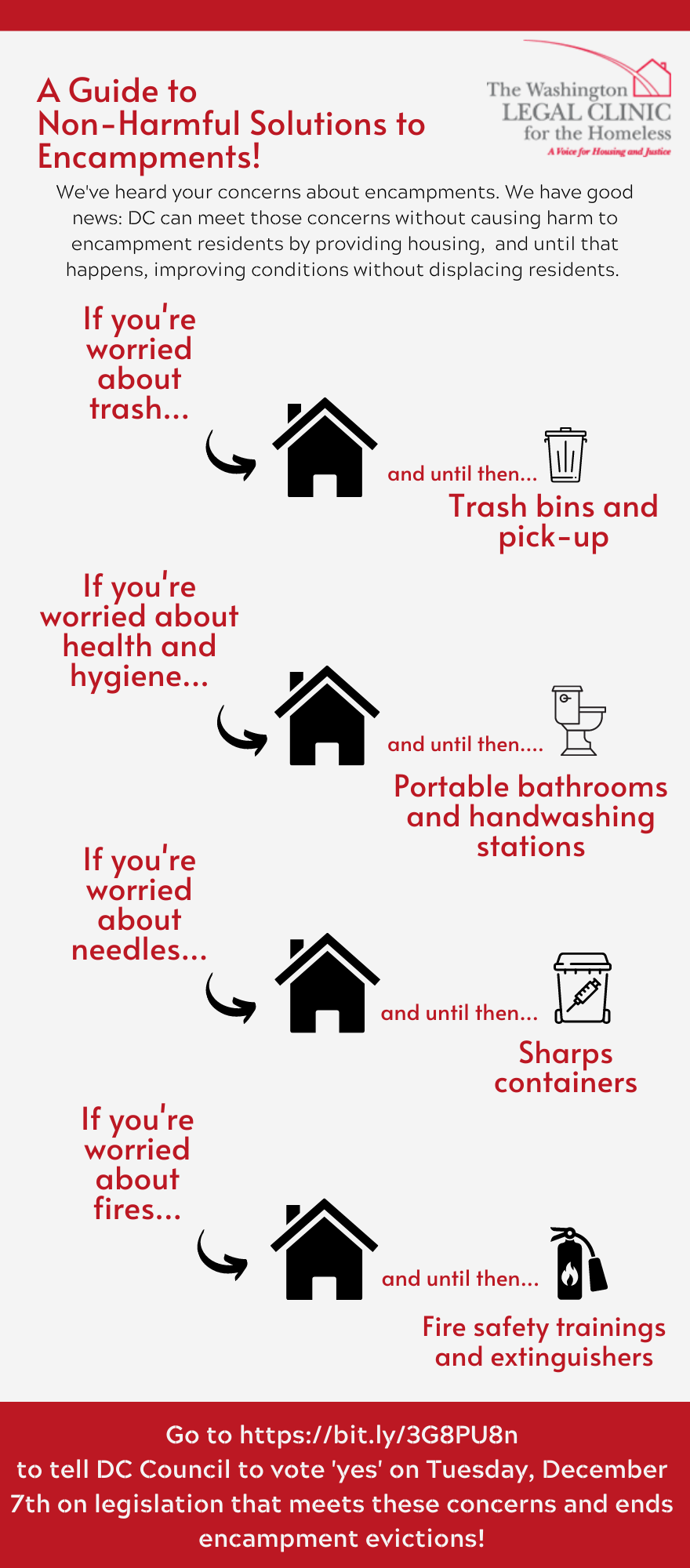
    But despite what happened yesterday, there is hope on the horizon. Councilmember Brianne Nadeau announced emergency legislation that would prohibit encampment evictions and the creation of “no tent” zones while also addressing some of the health and safety concerns raised by housed and unhoused residents. The bill will be voted on next Tuesday, December 7, and needs 9 votes to pass.

    We urge you to reach out to your Councilmembers today and ask them to “vote yes” on Councilmember Nadeau’s emergency legislation next Tuesday. Stopping these evictions will save lives this winter, and will put a stop to the increasingly aggressive and traumatizing tactics being used by the Bowser Administration to evict people living on the street.

    Click here​ to send an email to your Councilmembers!


  • Our statement opposing the creation of “no camping zones” and continued violence against unhoused persons

    Mayor Bowser recently announced the creation of a new “CARE pilot program” which is designed to permanently evict unsheltered residents from a few large and visible encampments. While the program aims to offer housing resources to some of those residents, the overall goal is to permanently close these encampments regardless of whether all residents have accepted or obtained housing by the time of the clearing. These areas will then be designated as “no camping” zones, meaning anyone’s belongings placed in that area will be subject to immediate disposal without notice. We strongly oppose the creation of “no camping” zones on public space.

    We support providing housing to all people experiencing homelessness. However, we reject the Bowser administration’s attempt to frame forced displacement from large visible encampments as new or necessary to the provision of housing. The first clearing under this pilot program was a dangerous effort with disastrous implications for some encampment residents, including one who was hospitalized after a bulldozer picked up his tent while he was still inside.

    Displacement of low-income, primarily Black D.C. residents has, unfortunately, been the status quo for decades. The Bowser administration has consistently escalated forced displacement tactics against people who are unhoused, and this pilot program is a continuation of that approach. It is disingenuous to frame eviction and the harm it causes as a benevolent pilot program. The mere offer of housing to some encampment residents must not distract from the clear intention to evict, especially since not all residents of the encampment that the District cleared on October 4 have received housing.

    The Bowser administration should focus its efforts on the efficient and timely provision of the historic and unprecedented housing resources that were funded by the federal government and DC Council in the FY22 budget. When people receive truly safe and permanent housing, there will be no need for our unhoused neighbors to seek safety and stability through encampments. Access to safe permanent housing should be the priority, not forced displacement.

    The Legal Clinic adds our voice to that of the Way Home Campaign and others in demanding that the DC Government:

    • Stop the creation of any and all future “no camping zones” and repeal laws that criminalize homelessness and poverty;
    • Work with urgency to end homelessness for all who need housing, not just residents of specific encampments;
    • Employ a person-centered and trauma-informed approach to ending homelessness instead of punishing people for living in tents;
    • Stop all encampment clearings during COVID-19 in compliance with CDC guidance;
    • Work to reform the emergency shelter system to remove real barriers that people living outside have identified as standing in the way of entering shelter; and
    • Ensure that all encampments are provided with portable toilets and sanitation stations.

    *Update: Take action here!*

  • Historic Housing Investments Present Opportunity to Make Real Progress in Ending Homelessness

    The FY22 DC Budget Invests in Housing Justice

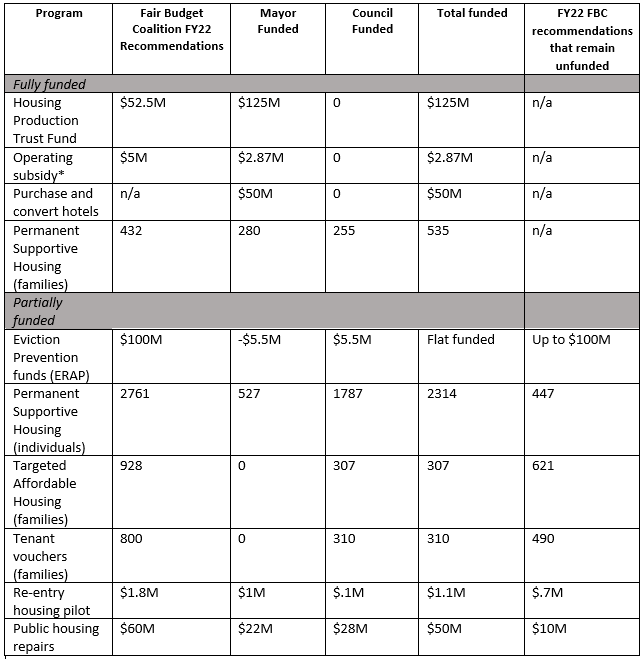
    On August 3, the DC Council took its final vote on the Fiscal Year 2022 (FY22) budget, followed by the final vote on the Budget Support Act on August 10. We are pleased to report that all of the increased investments in housing that we reported here and in the below table made it into the final budget.

    *With an investment of $42M through 2025, there should be sufficient funds to support later projects that come online. Therefore, we consider this “ask” fully funded at this time.

    These housing investments are large and potentially transformative, and we want to take a moment to talk about their potential impact on affordable housing and homelessness in DC as well as preview some next steps for advocacy. The housing investments in DC’s FY22 budget do not exist in a vacuum — their impact on homelessness in DC will be affected by the eventual end of the eviction moratorium, whether there will be any further federal or local extensions of such moratoria, or whether DC will improve its distribution of eviction prevention resources through STAY DC.

    Investments in the creation and preservation of deeply affordable housing

    The Housing Production Trust Fund has record high investments, and there is enough money in the matching operating budget to ensure that the fund creates deeply affordable housing over the next few years. DC could make real progress in building affordable housing with these investments. But DC has struggled to meet its legally-required minimums for building housing for the lowest income households for years. With such large amounts of money in the fund this year and next, it is even more critical that the DC Council engages in active, regular oversight of the Department of Housing and Community Development to make sure that 50% of the fund is used to build housing for households earning between 0 and 30% of Area Median Income, as the law requires. This budget also includes $50 million for the purchase and renovation of hotels in order to create deeply affordable housing. We will be monitoring this process and will work to ensure that this investment meets the stated goal.

    For the second year in a row, $50 million has been appropriated for the DC Housing Authority’s repair and renovation of public housing. Although DCHA has struggled to spend money swiftly, it has assured policymakers that it has a plan to quickly and effectively use this funding for the properties most in need of repair. During this process, the DC Council must engage in regular oversight to make sure that this funding is used efficiently. As advocates, we will continue to focus our efforts on preventing the displacement of DC residents, and ensuring the preservation of DC’s public housing units.

    Investments in housing vouchers that will end homelessness for families and individuals

    The most substantial increase comes in the form of housing vouchers for people experiencing homelessness. Roughly 2300 individuals experiencing “chronic homelessness” will be placed in Permanent Supportive Housing (PSH) during the FY22 fiscal year. About 1152 homeless families will get vouchers: 535 PSH, 307 Targeted Affordable Housing, and 310 tenant vouchers (from the DCHA waitlist).

    For individuals, these investments are almost enough to end homelessness for every individual living in the hotels (PEP-V), the street, and low-barrier shelters. With the recent announcement that the federal government would extend funding for hotels until the end of November, DC now has a cushion of funding to transition people out of hotels and into housing, rather than forcing them back to the street or shelters when federal funding lapses. As for people living in encampments, DC can take a non-punitive, effective approach to clearing encampments—by providing housing to people living on the street. In the shelter system, DC could see much lower numbers, providing a real opportunity to improve the safety and dignity of the shelters. This increase in PSH will not only make unprecedented strides towards ending chronic homelessness but could substantially impact what homeless services look like for individuals.

    For families, there is no longer any legitimate budget-based reason to threaten families with termination from Rapid Re-housing. The Department of Human Services (DHS) has not confirmed yet that families are safe from termination, but if DHS chooses to terminate them it won’t be because of funding constraints. Prior to the budget passing, DHS had stated that 1000 families in Rapid Re-housing had been in the program for over 18 months and were at risk of termination for reaching the time limit. DHS stated that they could no longer afford to give extensions to those families, as they had during the public health emergency, and that 580 of the 1000 families would get termination notices in the next few months, effective in the spring. But with enough permanent housing for 1152 families, now there is no budgetary pressure to terminate families from Rapid Re-housing. Instead, DHS can exit families from the program who have reached the time limit in the way that everyone agrees is best—into permanent, affordable housing. Our core concern with Rapid Re-housing—that arbitrary time limits cause harm to the vast majority of families who cannot afford market rate housing—has been resolved by funding enough permanent vouchers to create a secure safety net for families this year. This is the fundamental shift in resources that must happen every year in order for Rapid Re-housing to be a humane, successful program in DC.

    DC’s FY22 budget season has concluded with historic investments, but the work continues!

    Minimize barriers to create greater access to housing

    Of course, all this potential for transformative change hinges on DHS and DCHA moving quickly and landlords renting to participants. For years, the Department of Human Services (DHS) and the coordinated entry system have viewed Permanent Supportive Housing (PSH) and Targeted Affordable Housing (TAH) through a lens of scarcity, comparing individuals to each other to determine who is most in need of a housing intervention, i.e. who scores highest on the “vulnerability index.” However, with this many available vouchers in one year, DHS and coordinated entry should develop a more streamlined prioritization process and just provide vouchers to every person who is eligible. (The Budget Support Act requires DHS to issue regulations on who is eligible for TAH (such regulations already exist for PSH) and provides some guidance for how to prioritize families who are eligible for TAH.)

    DCHA  is now required, through the Budget Support Act, to lower the barriers to its tenant voucher program, including PSH and TAH. (Unlike its federal voucher program, which must comply with federal regulations, the local voucher program can be modified substantially to improve accessibility and efficiency.) First, DCHA must remove any eligibility requirements that screen out applicants on the basis of criminal convictions  or pending criminal legal matters. Second, DCHA must remove any requirements that screen out or tend to screen out undocumented immigrants. Finally, DCHA must review its verification requirements and allow self-attestation of eligibility factors where the applicant cannot quickly or easily acquire documents. These changes will increase access and efficiency within the voucher programs.

    Once someone receives a voucher, the process of finding an apartment can be challenging. There are plenty of vacant units, but there are also plenty of landlords who discriminate against voucher holders or who have unreasonable eligibility criteria. In the last year, DC has made tremendous progress  in removing housing barriers by starting to seal eviction records. However, legislation that prohibits landlords from using sealed eviction records, bolsters tenant protections, and strengthens DC’s voucher discrimination laws remains in the Housing Committee. (You can read about our support for those bills here.) It is unfortunate that a slow legislative process and lack of funding in this budget will prevent thousands of new housing applicants from enjoying those crucial protections. Still, our current Human Rights Act and Fair Criminal Records Screening Act do provide some housing protections. We, along with our legal services colleagues, stand ready to assist any applicant facing discrimination while in search of a home.

    The DC budget is a moral document

    We are grateful for the advocacy and support of  blog readers and community members – our collective efforts to increase funding for deeply affordable housing and end homelessness were incredibly successful this year. It’s vital to keep this success in context because, as always, our work with the Fair Budget Coalition is rooted in the belief that low-income DC residents have a multitude of interrelated needs. Our clients who need housing also need things like accessible healthcare (i.e. removing Healthcare Alliance barriers) and sufficient income support (i.e. excluded worker payments), among other things. Unfortunately, this budget did not make substantial investments towards meeting those holistic needs, and DC has a lot of work to do to achieve a truly equitable budget. We continue to believe that the DC budget is a moral document.  Dire circumstances, dogged advocacy, and political will combined this year to make our housing goals a reality.  Thousands of DC residents will no longer experience the trauma of homelessness because of this budget. Lives will be saved because of this budget. However, the progress cannot end with this FY22 budget. We must urge our lawmakers to continue to make decisions that prioritize the lives of vulnerable and marginalized DC residents. Through a sustained commitment to reducing harm and supporting resident needs, DC can, one day, become the inclusive city that we envision and know it can be.

  • After the first vote, what’s in the budget for housing and homelessness?

    On July 20, the DC Council took its first vote on DC’s Fiscal Year (FY) 2022 budget, and the final vote will be on August 3. With the end of the FY22 budget season on the horizon, we want to check in with our community of readers and update you on how our housing and homelessness priorities have fared in the budget process thus far. But of course, it’s not over until it’s over – it is possible that the numbers we are reporting may change a bit here and there, and it is possible that the Council could make more changes at the August 3 vote.

    As we reported here, the Mayor’s budget invested substantially in some areas, like the Housing Production Trust Fund, but fell far short of the need in many others. The Council had a lot of work to do to move DC closer to housing justice in this budget. As Legal Clinic attorney Amber Harding wrote in a commentary for the DC Line two days before the budget vote:

    “DC is on the precipice of a homelessness emergency beyond anything we have ever seen, but that doesn’t mean it’s too late to turn around. The budget decisions that the DC Council makes in the next few weeks about how much money to invest in homelessness prevention, public housing repairs, and ending homelessness will determine whether we experience a humanitarian nightmare or a just and equitable recovery.”

    Over the past few weeks, over 500 people participated in our email action asking the Council to make substantial investments to end homelessness and repair public housing, not to mention the many separate individual emails and phone calls. The DC Council made some small but important increases in housing investments prior to the first vote.

    • Councilmember Brianne Nadeau found $1 million for eviction prevention (which the Mayor had cut by $5.5 million).
    • Councilmember Robert White dedicated $100,000 for a re-entry housing pilot and $650,000 for public housing repairs.
    • Chairman Mendelson found an additional $4.5 million for eviction prevention (bringing the program back up to FY21 levels), $20 million for permanent supportive housing for 775 individuals, and an additional $27.35 million for public housing repairs, bringing the total to $50 million.

    But even with those investments, the budget the Council had before it at the first vote on July 20 included no vouchers to take people off the waiting list, no vouchers for homeless families about to fall off the rapid re-housing cliff, and nowhere near enough housing vouchers to house residents currently staying in encampments humanely or ensure that people in hotels are not forced to return to the street or overcrowded shelters when federal funding lapses. In the 12 hours leading up to the Council’s first budget vote, 300 people participated in an email action asking DC councilmembers to vote for a tax increase on high-income earners to dramatically increase funding to end homelessness. The tax increase was the only option left to get the funding to increase housing resources and protect thousands of DC residents experiencing homelessness.

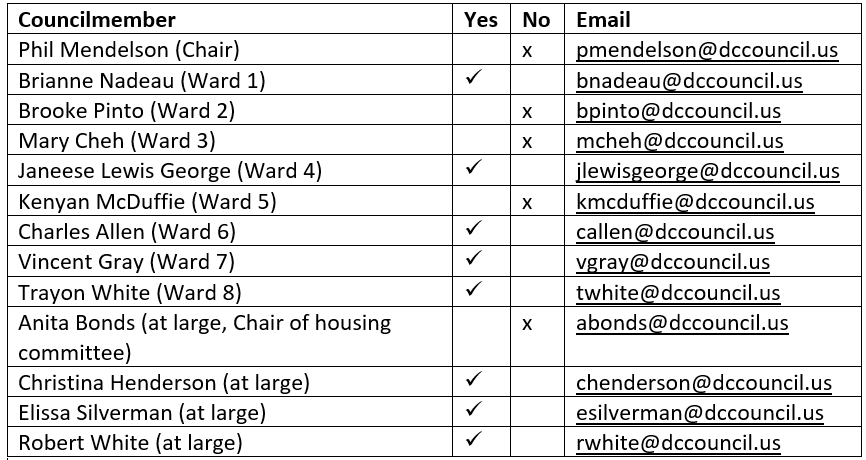
    We are inspired by and grateful for the outpouring of community support for this measure – thanks to many of you, DC’s elected leaders heard that support loud and clear. The measure to increase taxes on high-income earners (led by Councilmembers Nadeau, Allen and Lewis George) passed by an 8-5 vote, funding enough vouchers to end homelessness for 2400 individuals and families, as well as ensuring higher wages for childcare workers and expanding DC’s Earned Income Tax Credit, a program that helps out low-wage workers. You can thank the eight Councilmembers who voted “yes” here, or you can use the chart below to reach out to specific members.

    It was reported this week that Mayor Bowser wants the Council to “reconsider” the tax increase. But that would mean cutting $100 million in investments—critical investments that further racial and economic justice. We encourage the Council to instead maintain these investments and take heed of Mayor Bowser’s words from just a few weeks before the vote:

    “We know that stable housing is a necessary foundation for all things in life – health, education, steady employment, and connection to one’s family and community…We are proud of the progress we’ve made since launching Homeward DC, but there is more work to do. As we recover from the pandemic, we must keep pushing to not only protect our progress, but realize the goal we know is possible: ending long-term homelessness for all people in Washington, DC.”

    Below are the investments in affordable housing and homelessness so far in the budget. In these final days of the FY22 budget season we are hoping to see increased investments to meet our full asks in the chart below. We are also asking the Council to find a little money to fund the Cashless Retailers Prohibition Act and Office of Human Rights enforcement of protections like those found in the Eviction Record Sealing Authority Act and the Fair Tenant Screening Act to ensure that housing applicants can enforce tenant screening and anti-discrimination laws.

    *With an investment of $42M through 2025, there should be sufficient funds to support later projects that come online. Therefore, we consider this “ask” fully funded at this time.

    Editor’s note: The original publication of this post included a version of the above table that contained a typo. It has been updated to reflect the correct amount of funding put forward for public housing repairs by DC Council.

  • Tomorrow, the DC Council will vote on an emergency bill that will begin phasing in evictions again in DC. Since March of 2020, an eviction moratorium has been in place that is tied to the COVID-19 Public Health Emergency. Mayor Bowser has told the DC Council that she does not intend to extend the Public Health Emergency past July 25. The bill before the Council has some good parts, and some parts that could stand to be improved. We are asking the DC Council to amend the bill to delay evictions a little more and to ensure that DC residents are protected from eviction when they could be eligible for rental payments from STAY DC but the program is too difficult to access. We are also asking for some clarifying amendments to protect the rights of tenants. The Legal Clinic has joined the below sign-on letter to DC Council. If additional organizations wish to sign on to this letter, they should contact Beth Mellen at Legal Aid Society of the District of Columbia – bmellen@legalaiddc.org. For individual members of our advocacy community, we invite you to contact your Councilmember today and urge them to improve the bill to protect tenant rights and minimize evictions!

    Dear Councilmembers:

    We work with tenants across the District who are facing eviction, searching for safe and affordable housing, navigating the homeless services system, and seeking health care, employment, and education for their families.  We are writing to share our request to amend the Eviction and Utility Moratorium Phasing Emergency Amendment Act of 2021.

    Eviction should always be a last resort, because of the devastating consequences that it has for families and communities, as well as the costs it imposes on landlords and safety net systems.  We believe the current proposal inevitably will result in preventable evictions.  We are asking the Council to provide more time before the eviction process restarts.  The Council also should adopt several specific amendments, described below, to ensure tenants’ rights are protected and unnecessary evictions are avoided as evictions restart.

    The Council should take a clear public stand that the public health emergency, or at the very least eviction protections tied to it, should be extended.  Throughout the pandemic, we have advocated for the Council to maintain a moratorium on all stages of the eviction process until the public health emergency is over.  We understand the Mayor no longer plans to extend the public health emergency, but the public emergency declaration is likely to be extended.  With unemployment still at high levels and vaccination still underway, especially for Black and Brown residents, now is not the time to end public health protections that have saved lives.  The proposed, extended public emergency period through October 8, 2021 plus 60 days should be a minimum for all eviction protections.  The earliest start dates for various steps in the eviction process should be extended at least 30 to 60 additional days later than those proposed in the bill.

    Allowing nonpayment of rent evictions to proceed without fixing STAY DC or funding ERAP will result in preventable evictions.  Despite landlords and tenants sharing numerous problems with STAY DC at hearings and working group meetings, many issues have not been fixed.  Remaining problems not addressed by this bill include restrictions on self-certification, lack of a clear appeal process, language access, and limited plans for outreach and partnering with community-based organizations.  As the Washington Post highlighted this weekend, many tenants are continuing to struggle to complete STAY DC applications because of these barriers, and the bill does not protect tenants who have attempted but been unable to submit applications.  Meanwhile, ERAP is out of money, and providers will not have new Fiscal Year 2022 funds in place until the end of October or later, funds that will be critical for families with rent balances that are not eligible for STAY DC.  More time is needed to address these issues.

    We support provisions in the bill to expand tenant protections.  Several of our organizations participated in the working group convened by Chairman Mendelson to discuss STAY DC and the eviction moratorium.  While the bill is not a consensus document, it includes many of our recommendations – important changes that ultimately should be made permanent.  These include requiring landlords to apply for rental assistance first, allowing time for tenants to complete applications and have them approved, and strengthening pre-court notice requirements.

    Other targeted changes are needed to ensure tenants’ rights are protected and unnecessary evictions are avoided.  In addition to our significant concerns about timing, we recommend several targeted changes to reduce the risk of unnecessary evictions:

    1. Make clear that the Court must dismiss cases that do not meet the law’s requirements. Even if a tenant defaults or fails to raise defenses, the Court should dismiss a case immediately if the landlord has not followed all of the law’s new requirements.
    2. Make clear that the Court must continue a case if a tenant has attempted to apply for STAY DC and needs more time. A tenant who has attempted but been unable to complete a STAY DC application should get more time to submit their application, by adding a requirement for the Court to continue the case for at least 30 days.
    3. Remove or further tighten the exception for property damage claims. We oppose this exception.  If it is included, tenants should receive the same protections as under the public safety exception, with referrals to services and an offer of alternative housing.
    4. Ensure all pre-court notices have clear, non-threatening language. To prevent tenants from moving out early due to fear or harassment, all notices should include standard, non-threatening language emphasizing that tenants do not have to vacate and can take steps to avoid eviction.


    Bread for the City

    DC Bar Pro Bono Center

    DC For Democracy

    Jews United For Justice

    Latino Economic Development Center

    Legal Aid Society of the District of Columbia

    Legal Counsel for the Elderly

    Rising for Justice

    TENAC

    Washington Legal Clinic for the Homeless

    Renee L. Bowser, Chair, ANC 4D; ANC 4D02 Commissioner

    Zach Israel, ANC 4D04 Commissioner


  • Editor’s Note – July 29, 2021: For Updated Information on the FY22 Budget – Visit This Blog Post!

    We are in crunch time for DC’s budget! We need your help to tell the DC Council that they have a lot of work to do to end homelessness and repair public housing.

    Take action here: 

    https://actionnetwork.org/letters/tell-dc-council-end-homelessness-and-repair-public-housing

    The following is adapted from Amber Harding’s oral testimony provided to the DC Council Committee of the Whole last Friday at the final budget hearing. Our full written testimony can be found here.

    When the COVID-19 pandemic hit DC, it hit homeless people hard. When businesses and day programs closed and most of us stayed home, people living on the street had no place to go to the bathroom, no way to make money to buy food, no free dining programs, and no access to water. In shelters, people had access to toilets, food and water—but they also had access to COVID. Some left shelters for the street to avoid getting sick.

    Families fared better in some ways. In shelters, the relative privacy meant that their chance of getting COVID was lower, but not as low as it would have been if they had their own bathrooms or housing. In rapid re-housing, families felt tremendous anxiety over whether they would be lose their housing in the middle of a pandemic. Many parents could no longer ask friends or family to help with child care. Like many of us, parents had to be parent, teacher, friend, and even therapist for their kids while struggling with what their future would hold.

    DC did attempt to mitigate or even alleviate the harm. It provided handwashing stations and portable toilets at some encampments and figured out a food and water distribution system. It developed cleaning and social distancing protocols in shelters. It stopped forcibly displacing people from encampments. It operated a hotel program to prevent high risk people from dying of COVID-19—not enough rooms but transformative for the ones who got in. It put a stop to most shelter terminations and to all rapid re-housing time limit exits. It stopped evictions.

    Now the city is starting to reopen, starting to push to get “back to normal.” What does that mean for people who do not have stable, affordable housing? The Council is contemplating lifting the eviction moratorium, despite the eviction prevention program being deeply, deeply flawed. The Department of Human Services (DHS) will begin terminating families from rapid re-housing August 1, even if it is mathematically impossible for them to pay their rents, resulting in thousands of families at risk of homelessness just as the eviction moratorium lifts. Federal money will run out for the hotel program in September, and hundreds of high-risk individuals will be forced back to the street or crowded congregate shelters. Back to normal means eviction, displacement, terminations, and inhumane conditions. Back to normal means ignoring the racial impact of COVID, of policing, of homelessness, of displacement. Back to normal means pathologizing homelessness and pretending it is a consequence of individual decisions, rather than systemic failures or lack of political will.

    DC can do better than “normal.” While individuals can rarely end homelessness by making different choices, elected leaders sure can. We ask the DC Council to invest over $100 million to fund Permanent Supportive Housing (PSH), Targeted Affordable Housing (TAH), Local Rent Supplement Program (LRSP) tenant vouchers, and the Reentry Housing Pilot to end homelessness quickly for thousands of individuals and families. We also ask the Council to restore the cut and increase eviction prevention fund and invest an additional $38 million in public housing repairs.

    As for how or where to find the money, we support the Fair Budget Coalition’s tax platform, including raising income taxes on the highest-income earners, defunding the police, and moving money from failing programs. We trust that, if ending homelessness is truly our elected leaders’ priority, they will find a way to make it happen. It is unacceptable to allow homelessness to continue to exist because the Council cannot agree on how to grow or redistribute the pie.

    Don’t forget to take action here!

  • 2020 was a year of trauma and suffering for many who have lost loved ones, struggled with health, lost jobs or incomes, and/or struggled to pay for basic needs. That pain has not been felt equally by everyone though—it is neither race nor class blind. Ever since the early weeks of the global pandemic, Black residents of the District have been disproportionately harmed.

    In 2021, there are reasons for hope. There are now multiple vaccines and an increased focus on production and accessibility. There are fresh sets of eyes on policies and solutions and new approaches from elected leaders, nationally and locally. DC is poised to receive a significant infusion of federal dollars. DC government, as a result of the passage of the Racial Equity Achieves Results (REACH) Amendment Act of 2020, is newly focused on racial equity and how to achieve it.

    It is time to envision and pursue a path forward. We reject setting our goal posts at “back to normal” because too many people were suffering prior to the pandemic. We know that the death toll and harm of the pandemic could have been lessened if a well-threaded safety net had been in place. There is no better time than the present to reset those goal posts. Below are the Legal Clinic priorities we have been working on in 2021, which we will continue to advocate for along with the spending priorities of the Way Home Campaign and the Fair Budget Coalition. (The Legal Clinic is an active member of both coalitions.)


    Because DC Residents Are Homeless Now…

    Encampments where unhoused people live must not be cleared away.

    The Bowser Administration continues to conduct full encampment clearings during the COVID-19 pandemic despite CDC guidance to suspend all encampment clearings. (“Clearing encampments can cause people to disperse throughout the community and break connections with service providers. This increases the potential for infectious disease spread.”) They claim that full clearings are necessary when there is an imminent risk to the health and safety of the residents and the community. However, we have witnessed numerous full clearings where there is no evidence of an imminent risk to health and safety. Instead, full clearings seem to occur as a result of complaints from housed neighbors.

    Our Ask:

    Immediately suspend all full encampment clearings now and after the pandemic. Instead, conduct trash-only clearings, provide additional trash cans at encampments, and maintain portable bathrooms and hand washing stations after the end of the pandemic.

    Budget impact: DC could save money by ending clearings.


    Unhoused people, especially those with health vulnerabilities, must have private space to protect their health.

    Approximately 656 individuals experiencing homelessness have been medically determined to be at high risk of dying of COVID-19 and are on a waiting list for a safe placement in a hotel – in DC this program is called the Pandemic Emergency Program for Medically Vulnerable Individuals (PEP-V). (They are at greater risk of contracting and dying of COVID-19 because they live on the street or in a congregate shelter and are older or have serious medical conditions.) The federal government has announced it will pay 100% of costs through September.  DC has announced plans to expand hotel placements to an additional 200 residents, which is a step in the correct direction, but does not meet the full and pressing need. (In addition, right now, DC is claiming that no law governs client rights in these programs, which means DC intends to terminate clients without due process.)

    Our Ask:

    Expand the PEP-V program to meet the needs of every high-risk individual. (You can take action here!) This can be done by purchasing or leasing hotels, including requiring hotels that get DC relief funds to lease their units for this purpose. Require PEP-V programs to comply with the HSRA, including critical due process protections. Use federal and local dollars to make progress on transforming DC shelters into non-congregate spaces.

    Budget Impact: If additional people are served by hotels with federal dollars, there could be cost savings in the locally funded homeless services system.


    DC’s shelter system for single adults must be high quality and transparent.

    Most singles shelters are large, congregate spaces with poor conditions. Several of them are slated for redevelopment or replacement. Even newer shelters that have recently been renovated have major conditions problems, like the Patricia Handy Place for Women. We get frequent complaints about quality of services, disrespectful staff, and poor conditions.

    Our Ask:

    We need more transparency and oversight of proposed and planned development. Providers, District agencies and contractors need to be held accountable for quality services, maintaining shelters, and respecting client rights. In particular, we must look closely into shelter closures and redevelopments, including CCNV, 801 East and New York Ave.

    Budget Impact: TBD


    DC’s emergency shelter system for families must be low barrier.

    The Department of Human Service (DHS) is intentionally operating a family shelter intake system that is high barrier, leaving many vulnerable families in unsafe settings, risking their health and lives. Intake workers regularly unlawfully deny eligibility to families, requiring extensive documentation of homelessness in violation of the Homeless Services Reform Act (HSRA) and refusing to provide lawful notices of ineligibility when denied services. Recent oversight responses from DHS indicate that over 90% of family shelter applications are denied.

    Our Ask:

    Amend the Homeless Services Reform Act to require a low barrier, humane family shelter eligibility process.

    Budget Impact: N/A


    Funding must be increased, and bureaucracy reduced for housing subsidies/vouchers.

    There are 40,000 households on the DC Housing Authority waiting list and it has been closed since 2013. The vast majority of people experiencing homelessness need permanent assistance to maintain housing stability. There are also streamlining issues between agencies that need to be addressed so that participants do not continue to face the current prolonged wait times and inefficiencies of the lease-up process. Due to the pandemic and recent laws providing for more opportunities for release, there is an urgent need to fund housing for DC residents returning home from incarceration.

    Our Ask:

    Better oversight of both DHS and DC Housing Authority to reduce bureaucracy that can cause delays in renting units with vouchers. Drastically increase funding to permanent voucher programs and extend the Reentry Housing Pilot.

    Budget Impact:

    • $16.31 million for Permanent Supportive Housing for 432 families,
    • $79.82 million for Permanent Supportive Housing for 2761 individuals,
    • $23.34 million for Targeted Affordable Housing for 928 families,
    • $17.33 million for 800 LRSP Tenant Vouchers
    • $1.8 million for the second year of the Reentry Housing Pilot, providing housing and services for 50 returning citizens.

    Fair standards for tenant applications must be established, and existing protections strengthened.

    Even when affordability of housing is no longer a barrier, people often struggle to get housing because of exorbitant fees or irrational denials based on credit history, rental history (including eviction records), or criminal history.

    Our Ask:

    Establish fair standards for reviewing applicants for housing and strengthen existing protections. In particular, pass the Fair Tenant Screening Act, the Eviction Record Sealing Authority Act, and the Eviction Protections and Tenant Screening Amendment Act.

    Budget Impact: Estimated $1 million to Office of Human Rights for enforcement.

    Because DC residents are in Danger of Losing Their Housing…

    Families must be spared the rapid re-housing cliff, and permanent subsidies must be funded.

    Rapid Re-housing is a time-limited rental subsidy program. Families are regularly terminated at the end of an arbitrary time period even though they cannot afford the rent on their own, destabilizing families and causing eviction, homelessness, and other trauma. 2900 families are in this program right now. They have been allowed to remain during the public health emergency, but will face termination when the public health emergency ends.

    Our Ask:

    Extend all 2900 families in RRH through this fiscal year until there are enough permanent housing subsidies to support those who need it. Amend the HSRA to prohibit time limit terminations when families are unable to afford the rent on their own. Shift resources away from RRH into more permanent subsidies over time.

    Budget Impact: Extend families in program through FY21 (amount TBD) and exit to permanent housing subsidies (see above).


    People must not be forced to choose between vital utilities and housing.

    The pandemic and associated economic recession have put tens of thousands of DC residents into economic crisis, unable to pay critical utilities or rent. The moratorium on evictions and utility shut offs has been key to preventing a serious humanitarian crisis. Now we need to plan for what happens when the public health emergency ends, and those moratoria are lifted.

    Our Ask:

    Keep both the eviction moratorium and the utility shut-off prohibition in effect until 1) after the public health emergency has ended and 2) residents can access sufficient funds to pay back rent and utility arrears to prevent massive displacement, trauma, and homelessness. Ensure programs are low barrier and that strong enforcement mechanisms are in place to ensure that landlords keep their promises.

    Budget Impact: At least $100 million in rent and utility relief, depending on the need and how far the federal funding goes.


    Because DC Must Preserve and Expand Truly Affordable Housing…

    Any changes made to the Comprehensive Plan must further racial and housing equity.

    The mayor’s proposed amendments to the Comprehensive Plan (Comp Plan) will not further racial equity, economic equity, or ensure the creation and preservation of low-income housing. Weakening the language to the Plan will make the more than 1500 page document irrelevant and meaningless. Increasing the allowed building density by right by “upFLUMing” (FLUM=Future Land Use Maps) will be detrimental to the communities we serve, will further displacement, and will prevent opportunities for community engagement that are currently afforded through the PUD process. The Comprehensive Plan has been a valuable asset for communities we represent, such as the Brookland Manor tenants who are currently fighting displacement from their community.

    Our Ask:

    Reject the Office of Planning’s amendments as they are currently written. Review and align with the DC Grassroots Planning Coalition’s Housing Justice Priorities to ensure any changes to the Plan will accomplish goals of racial and housing equity in practice, not just in rhetoric. Commit to viewing the Comprehensive Plan as the foundation of planning processes for other pieces of legislation, including those related to development, affordable housing production and preservation, environmental and transportation issues, etc.

    Budget Impact: N/A


    DC’s public housing must be protected and rehabilitated.

    For decades, DC residents have complained about the deplorable conditions and dilapidated buildings in which they have been forced to reside. Due to years of disinvestment and neglect, these properties are in extreme disrepair. Currently, the DC Housing Authority is in the process of executing a large-scale public housing ‘transformation’ process that will demolish and/or renovate approximately eighteen properties. While the transformation plan is certainly about building restoration, it must fundamentally center the residents whose homes are within those buildings, now and in the future.

    Our Ask:

    Commit to a recurring $60 million for a minimum of ten years that will address the substantial preservation, rehabilitation, and redevelopment needs of DC’s public housing properties. Support the Public Housing Preservation and Tenant Protection Amendment Act of 2020 and include its language in the Budget Support Act (BSA) to memorialize DCHA’s stated commitment to its residents, ensuring that public housing residents can rightfully access the housing that is intended for them upon any property redevelopment or transformation.

    Budget Impact: $45 million in FY22 to bring the total to $60 million for public housing repairs, and then commit $60 million annually.

    The Housing Production Trust Fund and District Opportunity to Purchase Act must be made to work for deeply affordable housing.

    DC continues to have an affordable housing crisis that threatens thousands of its residents. In particular, there is a dearth of deeply affordable housing in DC. The Housing Production Trust Fund (HPTF) is the fundamental source for creating and preserving affordable housing in DC.  Despite this fact, deeply affordable housing for those at 0-30% AMI continues to be the most underproduced in DC. The Office of the D.C. Auditor extensively documented the failures of the Department of Housing and Community Development (DHCD) to meet the HPTF’s statutory requirements over the life of the HPTF. Most recently, in FY2020, despite an overall increase in the HPTF and a change requiring that fifty percent (50%) of the fund be used for 0-30% housing creation, only eighteen percent (18%) of the fund was used to create housing for that income level. In FY21, DHCD projects that a mere 27% of funds will be used for 0-30%.

    In addition, there is a unique opportunity to meet purchase struggling hotels and use them immediately for non-congregate shelter and/or convert them to deeply affordable housing.

    Our Ask:

    Assert greater and more regular oversight over HPTF project selection, ensuring that the HPTF money is being allocated as intended and preventing the continued mismatch of requisite funding to 0-30% AMI housing creation. Consider building legislative guardrails around the funds dedicated to the lowest income levels so that those funds are not continually misdirected. Regularly fund the corresponding operating subsidies in order to fully utilize the 0-30% AMI allocation. Amend the District Opportunity to Purchase Act (DOPA) to provide DC with the first right of refusal for the purchase of hotels and commit to converting hotels to non-congregate shelter and/or deeply affordable housing.

    Budget Impact:

    • Maintain minimum of $52 million for 0-30% AMI housing in HPTF, and match $5 million in operating subsidy (through LRSP)
    • Invest additional money (TBD, but likely federal and local) in purchasing hotels and converting to non-congregate shelter and/or deeply affordable housing.

  • It’s Budget Season in DC! Here Are a Few Ways to Make Your Voice Heard.

    With oversight hearings over and the Mayor set to release her proposed budget to the Council by May 27, it is time to sign up for budget hearings! Unlike oversight hearings, which cover the performance of the agencies over the last year, budget hearings are a time to advocate for how your local government should spend its money in the upcoming fiscal year (FY22, which starts October 1, 2021). To learn more about what the Legal Clinic think the local government should focus its resources on, check out the budget asks of the Way Home Campaign and the Fair Budget Coalition.

    What does it mean to testify before DC Council?

    Testifying is a way to share stories with DC Councilmembers and staff about the ways in which DC programs have affected your life. This is an opportunity for anyone tell their elected leaders what programs need more or less money or what needs in the community are most urgent.

    Things to keep in mind

    • These are public events. All DC Council hearings and roundtables are recorded and shown on public access television. The public can watch hearings live, as well as view the recordings afterward on the DC Council website.
    • Testimony can be verbal and written. Written testimonies are added to the public record.
    • During the COVID-19 public health emergency, Council hearings are happening virtually. “Live” testimony means participating in the hearing online, “voicemail” testimony means leaving a voicemail with your thoughts.
    • Generally, people who testify are referred to as witnesses, and individuals are usually given three minutes to speak (although there is some variation among committees).
    • If you or someone you are helping needs language interpretation or reasonable accommodations for live testimony, let the Council committee know when you sign up.

    Here are some tips on testifying from Legal Clinic Grassroots Advocacy Coordinator, Kristi Matthews:

    • Identify who you are (name, why you are testifying, and program you are testifying about)
    • Tell your story (pick an event or issue that you have worked directly on or been affected directly by that you are comfortable sharing with the public)
    • Explain why you felt the need to testify (how you have been impacted by this program)
    • Describe solutions (how can they improve the program if needed)

    Please feel free to contact us with questions or to request help preparing your testimony: (202) 328-5500.


    Some Key Agency Performance Oversight Hearings

    Department of Behavioral Health

    Under the oversight of the Committee on Health (Committee Chairperson: Ward 7 Councilmember Vincent Gray)
    Programs covered: mental health services, housing programs for people with mental illness

    Live testimony

    • Date: June 4, 2021, 9AM
    • How to sign up: email mcameron@dccouncil.us or call 202-341-4425
    • Deadline to sign up: COB on June 3, 2021

    Voicemail testimony: 202-350-1828

    Written testimony:

    Department of Housing and Community Development

    Under the oversight of the Committee on Housing and Executive Administration (Committee Chairperson: At-Large Councilmember Anita Bonds)
    Programs covered: Housing Production Trust Fund, use of federal funds for rent relief

    Live testimony:

    • Date: June 4, 2021, 9:30AM
    • How to sign up: call 202-724-8198 or email housing@dccouncil.us
    • Deadline to sign up: June 2, 2021

    Voicemail testimony: 202-350-0894

    Written testimony:

    Deputy Mayor for Health and Human Services

    Under the oversight of the Committee on Health (Committee Chairperson: Ward 7 Councilmember Vincent Gray)
    Programs covered: encampments, including trash removal and clearings/displacement

    Live testimony:

    • Date: June 7, 2021, 9AM
    • How to sign up: email mcameron@dccouncil.us or call 202-341-4425
    • Deadline to sign up: COB June 4, 2021

    Voicemail testimony: 202-350-1828

    Written testimony:

    Office on Returning Citizens Affairs, Commission on Reentry and Returning Citizen Affairs

    Under the oversight of the Committee on Government Operations and Facilities (Committee Chairperson: At-Large Councilmember Robert White)
    Programs covered: services and housing for returning citizens

    Live testimony:

    • Date: June 8, 2021, 12PM
    • How to sign up: email facilities@dccouncil.us or call (202) 741-8593
    • Deadline to sign up: COB June 4, 2021

    Voicemail testimony: none

    Written testimony:

    Metropolitan Police Department

    Under the oversight of the Committee on the Judiciary and Public Safety (Committee Chairperson Ward 6 Councilmember Charles Allen)
    Programs covered: policing, violence prevention, diversion of funding to community needs

    Live testimony:

    Voicemail testimony: none

    Written testimony:

    Department of Health

    Under the oversight of the Committee on Health (Committee Chairperson: Ward 7 Councilmember Vincent Gray)
    Programs covered: DC Healthcare Alliance, vaccine distribution, pandemic testing and response, housing programs for people with HIV/AIDS

    Live testimony:

    • Date: June 11, 2021, 9AM
    • How to sign up: email mcameron@dccouncil.us or call 202-341-4425
    • Deadline to sign up: COB June 10, 2021

    Voicemail testimony: 202-350-1828

    Written testimony:

    Department of Human Services

    Under the oversight of the Committee on Human Services (Committee Chairperson: Ward 1 Councilmember Brianne Nadeau)
    Programs covered: homeless services, emergency shelters, Permanent Supportive Housing, Targeted Affordable Housing, Rapid Re-housing, TANF, EBT (food stamps), IDA, eviction prevention funds (including ERAP), child care

    Live testimony:

    Voicemail testimony: 202-350-1927

    Written testimony:

    Office of Human Rights

    Under the oversight of the Committee on Government Operations and Facilities (Committee Chairperson At-Large Councilmember Robert White)
    Programs covered: enforcement of the DC Human Rights Act, Fair Criminal Records Screening for Housing Act, proposed new protections including Fair Tenant Screening Act and Eviction Records Sealing Authority Act

    Live testimony:

    • Date: June 14, 2021, 12PM
    • How to sign up: email facilities@dccouncil.us or call (202) 741-8593
    • Deadline to sign up: COB June 10, 2021

    Voicemail testimony: none

    Written testimony:

    DC Housing Authority

    Under the oversight of the Committee on Housing and Executive Administration (Committee Chairperson: At-Large Councilmember Anita Bonds)
    Programs covered: public housing, vouchers, Local Rent Supplement Program

    Live testimony:

    • Date: June 16, 2021, 9AM
    • How to sign up: call 202-724-8198 or email housing@dccouncil.us
    • Deadline to sign up: June 14, 2021

    Voicemail testimony: 202-350-0894

    Written testimony:

    Entire Budget

    Under the oversight of the Committee of the Whole (Chairperson Phil Mendelson)
    Programs covered: taxes, anything in the budget, Budget Support Act

    Live testimony:

    Voicemail testimony: (202) 430-6948

    Written testimony:

    For more key budget dates, you can see the schedule here.

  • DC’s Approach to Homelessness: Lessons from 2020

    The following is an adaptation of testimony provided by Amber Harding on March 1, 2021 before the DC Council Committee on Human Services,
    at the performance oversight hearing on the DC Department of Human Services (DHS). The full testimony can be found
    here.

    2020 was a rough year, without question. But when the world turns upside down, it provides an opportunity to reassess what we may have accepted as true, or right, or just how things are. We at the Legal Clinic want to take this opportunity to lay out some of the lessons we hope DC comes away with regarding homelessness.

    Homelessness is preventable—its existence is a political choice.

    There has been a fair amount of celebration from the Bowser Administration for how drastically family homelessness (as defined by the number of families in shelters) has decreased this year. The Director of DHS attributed the decrease to the agency’s effort at “system reform,” but the most obvious, substantial driver for the decrease is the eviction moratorium that has been in effect for almost a year, and, relatedly, the moratorium on time limit exits from rapid re-housing. (As the authors of the recent Georgetown eviction study recently concluded: “While the Rapid Rehousing Program aids households to exit shelters more quickly, it may be contributing to eviction rates in the District. More long-term solutions like permanently affordable housing can be more effective at achieving housing stability.”)

    When elected leaders choose to stop evictions and rapid re-housing terminations, the results are clear—homelessness decreases. This effect lays bare how decisions in more “typical” years—to allow thousands of evictions to move forward with little relief for renters—create and sustain homelessness.

    The lesson: DC must dedicate enough resources to prevent every possible eviction, extend time-limited subsidies, and drastically increase its investment in deeply affordable housing.


    Safe, private shelter and housing saves lives.

    Our clients have said for years that they get sick in large congregate shelters. We have clients who sleep on the street because they feel safer there or have fewer illnesses. Yet shelters continue to be large communal spaces, and even when Mayor Bowser replaced DC General, she (and the Council) refused to concede that private space is fundamental to safety, dignity, and good health. Instead, families must share bathrooms and living space.

    Then the pandemic hit. We were inundated with messaging to social distance, to stay home, to avoid mixing households. But homeless people weren’t given the opportunity to follow health guidelines. They were forced to share bathrooms and dining areas with strangers. Hundreds of homeless people without kids were forced to sleep in rooms with dozens of strangers, sometimes just a few feet away.

    The first COVID-19 case in DC was March 7. The first case among people experiencing homelessness was March 31. In just one month, over 200 homeless persons were infected. As of March 15, 523 people experiencing homelessness have contracted COVID-19 and 25 have died. Some people have contracted it more than once. A recent study concluded that the mortality rate for people experiencing homelessness in DC is twice the mortality rate of the general population, and higher than any other city surveyed.

    Eventually, DC moved over 600 people who doctors determined to be at high risk of dying of COVID-19 into a hotel program, called the Pandemic Emergency Program for Medically Vulnerable Individuals (PEP-V). Over 600 high risk individuals, though, remain on the waiting list for PEP-V. With the announcement by the Biden Administration that 100% of costs for these hotels would be reimbursed, including retroactive payments, we expected DHS to expand the program. That has not happened. Instead, two more people have died of COVID-19 since that announcement. DC must expand PEP-V immediately to prevent further loss of life, and to accommodate every high-risk person experiencing homelessness.

    As much as we support the expansion of PEP-V, though, we do not endorse the position DHS has taken—that PEP-V is not covered by the Homeless Service Reform Act (HSRA), the law that governs homelessness service programs in DC and the legal rights of residents interacting with those programs. Without legislative change confirming that PEP-V is covered by the HSRA, DHS will continue to deny due process rights to PEP-V residents. High risk individuals should not have to jettison their legal rights just to survive the pandemic.

    With new federal money coming into DC that allows DC to invest in longer term non congregate shelter spaces, we hope that DC will revisit its plans for new shelters with an eye to creating much smaller and more private spaces for people to be when they become homeless. If DC had had humane shelters, the numbers of homeless people impacted, dozens fatally, by COVID would be far smaller. There is no excuse for continuing to force people to live in such settings.

    The lesson: DHS needs to expand PEP-V to meet the full need and bring all sites into compliance with due process. If DHS does not voluntarily come into compliance, the Council needs to amend the emergency authorization for PEP-V to clarify that it is an HSRA-covered program. The Interagency Council on Homelessness needs to explore federal funding opportunities and revisit shelter redesign to maximize the privacy and safety of future shelters.

    Update: 11 members of the DC Council sent Mayor Bowser this letter on Friday, March 26, 2021, asking her to expand PEP-V immediately!

    4/2 Update: DHS announced it will be opening another hotel for 200 people! That is great, but at least 456 more people will need hotel rooms after that happens. Send the Mayor a quick email to thank her and ask her to keep it up here.

    To be humane and anti-racist, programs must be low barrier.

    Collecting and submitting documents for verification of eligibility is difficult and can get in the way of receiving lifesaving services.  When the pandemic hit, DC streamlined many of its programs to try to make them lower barrier.  The sky has not fallen. There are no reports of widescale fraud. These changes should be celebrated and maintained post-public health emergency.

    Yet emergency shelter for families remains extremely high barrier, perhaps the highest barrier public benefit program in the District. We regularly get calls from families who are turned away from shelter because they can’t provide documentation that they have nowhere to go—a burden imposed on families not by the law, but by DHS. (The burden is actually on DHS to prove that someone has a safe place to go, not on the applicant to prove that they do not have a safe place to go.)

    This high-barrier, unlawfully-run, intake system is dangerous to families every day. During a pandemic it is particularly cruel. Just in the last two months, here are some examples—in each case, the family was not placed until a lawyer intervened:

    • During a snowstorm, a mom was told she could not go into shelter because she is on her mother’s voucher. She explained that her mother had kicked her out of the apartment and had physically assaulted her, leading to a stay away order.
    • A mother was told she could not be placed in shelter until she provided her mother’s lease to show she wasn’t on it, a letter from her uncle’s landlord saying she can’t stay there, and additional names of friends and family members she could potentially stay with. Since she couldn’t get the documents, she was denied shelter.
    • A family was denied shelter even after the family they were doubled up with tested positive for COVID-19.
    • A mother and her one-year-old child slept in a hallway after being unable to provide an aunt’s lease to prove they were not on it.
    • A pregnant woman in her third trimester was denied family shelter because Virginia Williams determined that she could stay in a hypothermia shelter for women.

    A little math shows that these stories are not, as DHS often claims, exceptions or one-offs. In its performance oversight responses (question 44, page 66), DHS states that, in FY20, 7463 families applied for shelter through Virginia Williams and 1180 families applied through the hotline, for a total of 8643 applications. Out of those applications, only 807 were deemed eligible and placed in shelter. Although DHS splits the denials up into 1705 referred to the Homeless Prevention Program and 867 found ineligible, a referral to Homelessness Prevention Program is also a denial of shelter and finding of ineligibility. Using these numbers, only 9.3% of applications for family emergency shelter were granted in FY20—a 90.7% denial rate. For FY21, the denial rate has risen to 94.6%– during a period of time that included many hypothermic nights.

    High barrier programs are not just harmful—they are also racist. Pernicious, poisonous myths that poor Black people game the system to get public benefits, cannot be trusted to tell the truth, or do not know what is best for themselves or their families form the foundation of DC’s high barrier family shelter intake. If families apply for emergency shelter, it is because they have decided that shelter is safest option for their family. That decision is not an easy one for most families, and DHS should respect that families know what is best for them.

    The lesson: DC needs to recommit to a low barrier family shelter intake system during the pandemic and beyond. The HSRA should be amended to allow self-certification for all elements of eligibility. 


    External forces impact poverty and housing affordability.

    This pandemic has laid bare the core flaw of rapid re-housing: its arbitrary time limit leaves no room for crisis. DHS was, rightfully, quick to decide that it would be unfair and unwise to terminate families when a global pandemic interfered with a family’s ability to increase their income and afford market rent. But the speed and clarity of that decision stands starkly in contrast with their historic refusal to consider a more individualized exit policy for families in the program. The COVID-19 pandemic is not the only factor outside of families’ control. What about the lack of available jobs that pay enough for families to be able to afford rent? Lack of affordable childcare, education, or housing? Centuries of systemic racism?

    Individual decisions or motivation are not primary causes of housing instability. Building a program around the myth that families, almost exclusively Black families, need an arbitrary time limit to motivate them to increase their income is racist. Cutting families off from support before they can afford the rent is unjust, pandemic or no, and disproportionately harms Black families. DHS admits in its performance oversight responses that in FY20 that only 17% of families were exited from rapid re-housing because they no longer required assistance. (Question 64, Page 90.)

    People who are suffering from housing instability because of the pandemic or co-occurring recession are worthy of support. But so those suffering from housing instability because of a myriad of other external forces, some centuries in the making.

    The lesson: DC must do away with arbitrary time limits in programs, including rapid re-housing, and focus on resolving systemic inequities that have led to widescale housing instability and lack of deeply affordable housing.

    With a significant infusion of federal dollars, a new understanding of the importance of housing as healthcare, and a commitment by DHS to undergo an analysis of the racial equity impact of its programs, now is the time to take these lessons to heart and make substantial changes to the status quo.


    Five ways to advocate now for safer shelter and more permanent housing placements.

    1. Send this one-click email action. Thank the Mayor for expanding the hotel program, but ask her to keep expanding PEP-V until every high-risk person is placed, and to invest in deeply affordable housing and reimagining our shelter system.
    2. Sign this petition demanding that Mayor Bowser increase non congregate shelter and housing placements to save lives. If you’re part of an organization that wants to sign on, email amber@legalclinic.org. (Check out this post to see all of the organizations already signed on!
    3. Contact DC Council. Email your ward Councilmember and all the at-large members to remind them of the lessons 2020 taught us and ask them for their support. (You can find their contact information here.)
    4. Take to Twitter. Use the hashtag #WhatHomeDC and tag @MayorBowser, @ZLauraJeanne (DHS Director Zeilinger) and @BrianneKNadeau in your tweets.
    5. Spread the word! Share these asks, including the petition, with your friends, family, and social media circle!

I am a Search Dialog!